
联合呼吸链缺陷和新生儿脑病的突变:III 复合物缺陷中的缺陷超复合物组装。
Combined Respiratory Chain Deficiency and Mutations in Neonatal Encephalomyopathy: Defective Supercomplex Assembly in Complex III Deficiencies.
机构信息
Department of Pediatrics, Salzburger Landeskliniken (SALK) and Paracelsus Medical University (PMU), 5020 Salzburg, Austria.
Division of General Pediatrics, Department of Pediatrics and Adolescent Medicine, Medical University of Graz, 8010 Graz, Austria.
出版信息
Oxid Med Cell Longev. 2017;2017:7202589. doi: 10.1155/2017/7202589. Epub 2017 Jul 19.
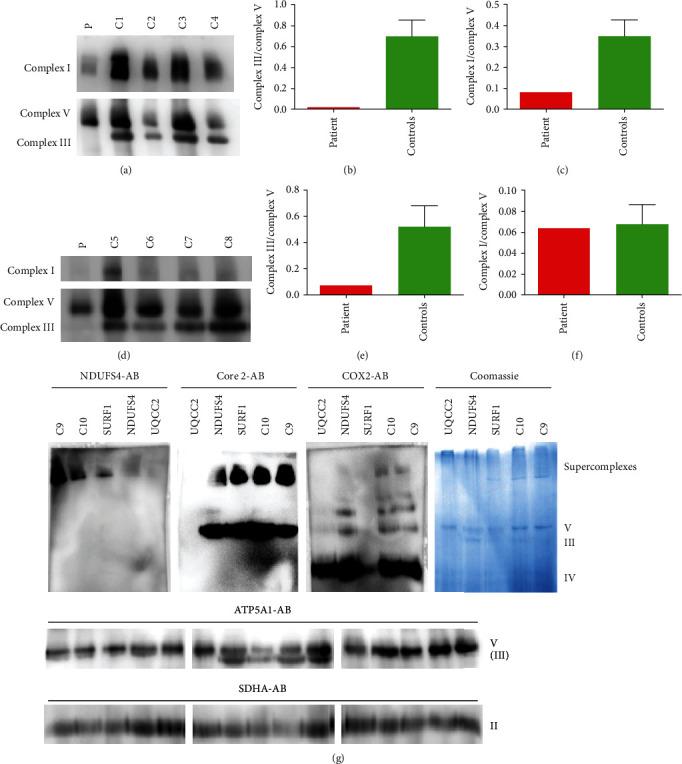
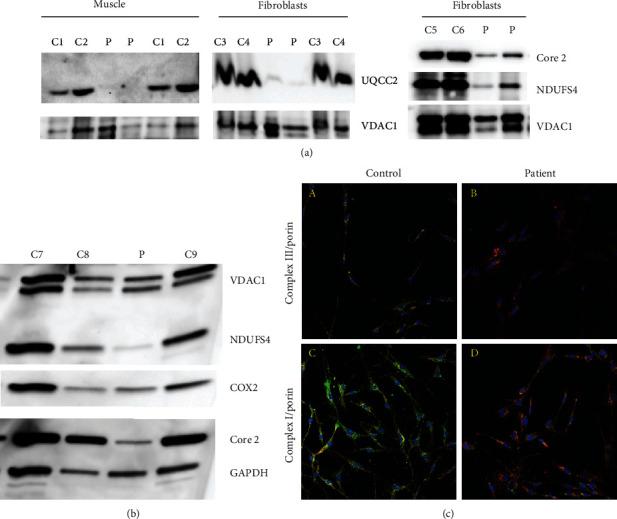
Vertebrate respiratory chain complex III consists of eleven subunits. Mutations in five subunits either mitochondrial (MT-CYB) or nuclear (CYC1, UQCRC2, UQCRB, and UQCRQ) encoded have been reported. Defects in five further factors for assembly (TTC19, UQCC2, and UQCC3) or iron-sulphur cluster loading (BCS1L and LYRM7) cause complex III deficiency. Here, we report a second patient with UQCC2 deficiency. This girl was born prematurely; pregnancy was complicated by intrauterine growth retardation and oligohydramnios. She presented with respiratory distress syndrome, developed epileptic seizures progressing to status epilepticus, and died at day 33. She had profound lactic acidosis and elevated urinary pyruvate. Exome sequencing revealed two homozygous missense variants in , leading to a severe reduction of UQCC2 protein. Deficiency of complexes I and III was found enzymatically and on the protein level. A review of the literature on genetically distinct complex III defects revealed that, except TTC19 deficiency, the biochemical pattern was very often a combined respiratory chain deficiency. Besides complex III, typically, complex I was decreased, in some cases complex IV. In accordance with previous observations, the presence of assembled complex III is required for the stability or assembly of complexes I and IV, which might be related to respirasome/supercomplex formation.
脊椎动物呼吸链复合物 III 由十一个亚基组成。已经报道了线粒体(MT-CYB)或核(CYC1、UQCRC2、UQCRB 和 UQCRQ)编码的五个亚基的突变。进一步的组装因子(TTC19、UQCC2 和 UQCC3)或铁硫簇加载(BCS1L 和 LYRM7)缺陷导致复合物 III 缺乏。在这里,我们报告了第二个 UQCC2 缺乏症患者。这个女孩早产;妊娠合并宫内生长迟缓及羊水过少。她表现为呼吸窘迫综合征,发展为癫痫发作,进展为癫痫持续状态,并在第 33 天死亡。她有严重的乳酸酸中毒和尿丙酮酸升高。外显子组测序显示 中有两个纯合错义变异,导致 UQCC2 蛋白严重减少。酶学和蛋白水平均发现复合物 I 和 III 缺乏。对遗传上不同的复合物 III 缺陷的文献回顾表明,除了 TTC19 缺乏症外,生化模式通常是复合呼吸链缺陷。除了复合物 III ,通常还会减少复合物 I ,在某些情况下还会减少复合物 IV 。与以前的观察结果一致,组装的复合物 III 的存在对于复合物 I 和 IV 的稳定性或组装是必需的,这可能与呼吸体/超级复合物的形成有关。

 Zotero 插件