
O-(2-[F]氟乙基)-L-酪氨酸PET在胶质瘤中的应用:不同中心数据处理的影响
O-(2-[F]fluoroethyl)-L-tyrosine PET in gliomas: influence of data processing in different centres.
作者信息
Filss Christian P, Albert Nathalie L, Böning Guido, Kops Elena Rota, Suchorska Bogdana, Stoffels Gabriele, Galldiks Norbert, Shah Nadim J, Mottaghy Felix M, Bartenstein Peter, Tonn Jörg C, Langen Karl-Josef
机构信息
Institute of Neuroscience and Medicine (INM-4, INM-3), Forschungszentrum Jülich, Jülich, Germany.
Department of Nuclear Medicine, RWTH University of Aachen, Aachen, Germany.
出版信息
EJNMMI Res. 2017 Aug 16;7(1):64. doi: 10.1186/s13550-017-0316-x.
BACKGROUND
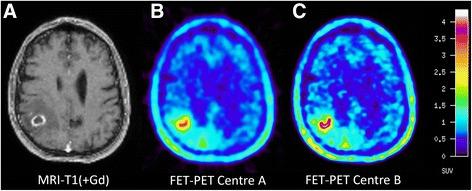
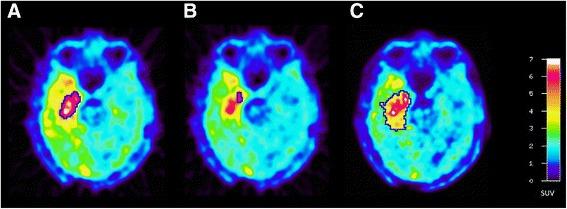
PET using O-(2-[F]fluoroethyl)-L-tyrosine (F-FET) is an established method for brain tumour diagnostics, but data processing varies in different centres. This study analyses the influence of methodological differences between two centres for tumour characterization with F-FET PET using the same PET scanner. Methodological differences between centres A and B in the evaluation of F-FET PET data were identified for (1) framing of PET dynamic data, (2) data reconstruction, (3) cut-off values for tumour delineation to determine tumour-to-brain ratios (TBR) and tumour volume (T) and (4) ROI definition to determine time activity curves (TACs) in the tumour. Based on the F-FET PET data of 40 patients with untreated cerebral gliomas (20 WHO grade II, 10 WHO grade III, 10 WHO grade IV), the effect of different data processing in the two centres on TBR, TBR, T, time-to-peak (TTP) and slope of the TAC was compared. Further, the effect on tumour grading was evaluated by ROC analysis.
RESULTS
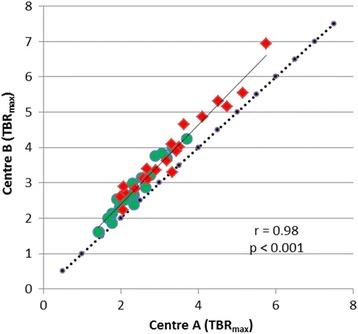
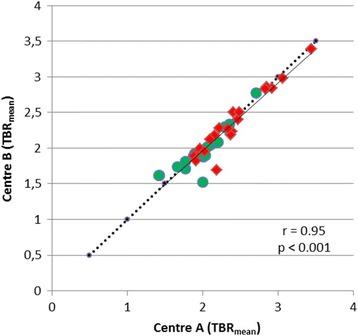
Significant differences between centres A and B were found especially for TBR (2.84 ± 0.99 versus 3.34 ± 1.13; p < 0.001), T (1.14 ± 1.28 versus 1.51 ± 1.44; p < 0.001) and TTP (22.4 ± 8.3 min versus 30.8 ± 6.3 min; p < 0.001) and minor differences for TBR and slope. Tumour grading was not influenced by different data processing.
CONCLUSIONS
Variable data processing of F-FET PET in different centres leads to significant differences especially for TBR and T. A standardization of data processing and evaluation is needed to make F-FET PET comparable between different centres.
背景
使用O-(2-[F]氟乙基)-L-酪氨酸(F-FET)的正电子发射断层扫描(PET)是一种成熟的脑肿瘤诊断方法,但不同中心的数据处理方式有所不同。本研究使用同一台PET扫描仪分析了两个中心之间方法学差异对F-FET PET肿瘤特征描述的影响。确定了中心A和中心B在F-FET PET数据评估方面的方法学差异,包括:(1)PET动态数据的帧化;(2)数据重建;(3)用于肿瘤勾画以确定肿瘤与脑比值(TBR)和肿瘤体积(T)的截断值;(4)用于确定肿瘤内时间-活性曲线(TAC)的感兴趣区(ROI)定义。基于40例未经治疗的脑胶质瘤患者(20例世界卫生组织(WHO)二级、10例WHO三级、10例WHO四级)的F-FET PET数据,比较了两个中心不同数据处理对TBR、T、到达峰值时间(TTP)和TAC斜率的影响。此外,通过ROC分析评估了对肿瘤分级的影响。
结果
中心A和中心B之间存在显著差异,尤其是TBR(2.84±0.99对3.34±1.13;p<0.001)、T(1.14±1.28对1.51±1.44;p<0.001)和TTP(22.4±8.3分钟对30.8±6.3分钟;p<0.001),TBR和斜率存在较小差异。肿瘤分级不受不同数据处理的影响。
结论
不同中心F-FET PET数据处理方式的差异导致显著差异,尤其是TBR和T。需要对数据处理和评估进行标准化,以使不同中心之间的F-FET PET具有可比性。



 Zotero 插件