
使用动态O-(2-[F]-氟乙基)-L-酪氨酸PET预测异柠檬酸脱氢酶野生型星形细胞瘤患者的生存率
Prediction of survival in patients with IDH-wildtype astrocytic gliomas using dynamic O-(2-[F]-fluoroethyl)-L-tyrosine PET.
作者信息
Bauer Elena K, Stoffels Gabriele, Blau Tobias, Reifenberger Guido, Felsberg Jörg, Werner Jan M, Lohmann Philipp, Rosen Jurij, Ceccon Garry, Tscherpel Caroline, Rapp Marion, Sabel Michael, Filss Christian P, Shah Nadim J, Neumaier Bernd, Fink Gereon R, Langen Karl-Josef, Galldiks Norbert
机构信息
Department of Neurology, Faculty of Medicine and University Hospital Cologne, University of Cologne, Kerpener St. 62, 50937, Cologne, Germany.
Institute of Neuroscience and Medicine (INM-3, -4, -5), Research Centre Juelich, Leo-Brandt-St. 5, 52425, Juelich, Germany.
出版信息
Eur J Nucl Med Mol Imaging. 2020 Jun;47(6):1486-1495. doi: 10.1007/s00259-020-04695-0. Epub 2020 Feb 7.
PURPOSE
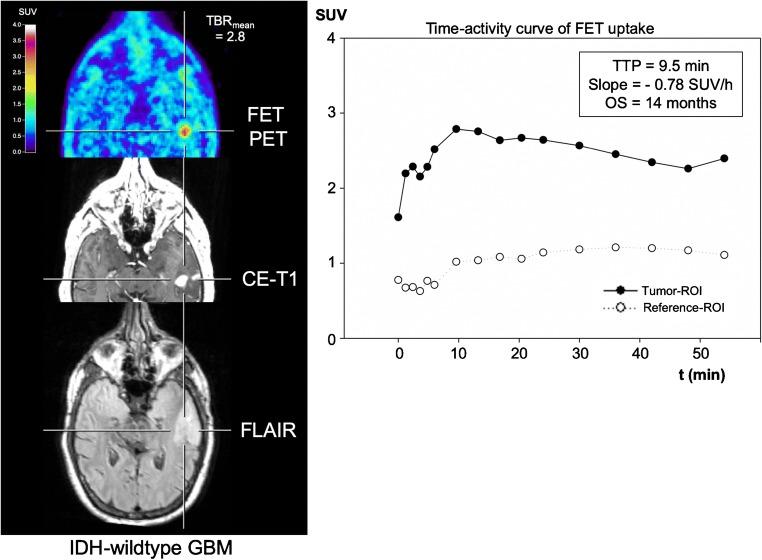
Integrated histomolecular diagnostics of gliomas according to the World Health Organization (WHO) classification of 2016 has refined diagnostic accuracy and prediction of prognosis. This study aimed at exploring the prognostic value of dynamic O-(2-[F]-fluoroethyl)-L-tyrosine (FET) PET in newly diagnosed, histomolecularly classified astrocytic gliomas of WHO grades III or IV.
METHODS
Before initiation of treatment, dynamic FET PET imaging was performed in patients with newly diagnosed glioblastoma (GBM) and anaplastic astrocytoma (AA). Static FET PET parameters such as maximum and mean tumour/brain ratios (TBR), the metabolic tumour volume (MTV) as well as the dynamic FET PET parameters time-to-peak (TTP) and slope, were obtained. The predictive ability of FET PET parameters was evaluated concerning the progression-free and overall survival (PFS, OS). Using ROC analyses, threshold values for FET PET parameters were obtained. Subsequently, univariate Kaplan-Meier and multivariate Cox regression survival analyses were performed to assess the predictive power of these parameters for survival.
RESULTS
Sixty patients (45 GBM and 15 AA patients) of two university centres were retrospectively identified. Patients with isocitrate dehydrogenase (IDH)-mutant or O-methylguanine-DNA-methyltransferase (MGMT) promoter-methylated tumours had a significantly longer PFS and OS (both P < 0.001). Furthermore, ROC analysis of IDH-wildtype glioma patients (n = 45) revealed that a TTP > 25 min (AUC, 0.90; sensitivity, 90%; specificity, 87%; P < 0.001) was highly prognostic for longer PFS (13 vs. 7 months; P = 0.005) and OS (29 vs. 12 months; P < 0.001). In contrast, at a lower level of significance, TBR, TBR, and MTV were only prognostic for longer OS (P = 0.004, P = 0.038, and P = 0.048, respectively). Besides complete resection and a methylated MGMT promoter, TTP remained significant in multivariate survival analysis (all P ≤ 0.02), indicating an independent predictor for OS.
CONCLUSIONS
Our data suggest that dynamic FET PET allows the identification of patients with longer OS among patients with newly diagnosed IDH-wildtype GBM and AA.
目的
根据2016年世界卫生组织(WHO)分类标准对胶质瘤进行综合组织分子诊断,提高了诊断准确性和预后预测能力。本研究旨在探讨动态O-(2-[F]-氟乙基)-L-酪氨酸(FET)PET在新诊断的WHO III或IV级组织分子分类星形细胞瘤中的预后价值。
方法
在开始治疗前,对新诊断的胶质母细胞瘤(GBM)和间变性星形细胞瘤(AA)患者进行动态FET PET成像。获取静态FET PET参数,如最大和平均肿瘤/脑比值(TBR)、代谢肿瘤体积(MTV)以及动态FET PET参数达峰时间(TTP)和斜率。评估FET PET参数对无进展生存期和总生存期(PFS、OS)的预测能力。通过ROC分析获得FET PET参数的阈值。随后,进行单变量Kaplan-Meier和多变量Cox回归生存分析,以评估这些参数对生存的预测能力。
结果
回顾性纳入两个大学中心的60例患者(45例GBM和15例AA患者)。异柠檬酸脱氢酶(IDH)突变或O-甲基鸟嘌呤-DNA甲基转移酶(MGMT)启动子甲基化肿瘤患者的PFS和OS显著更长(均P<0.001)。此外,对IDH野生型胶质瘤患者(n=45)的ROC分析显示,TTP>25分钟(AUC,0.90;敏感性,90%;特异性,87%;P<0.001)对更长的PFS(13个月对7个月;P=0.005)和OS(29个月对12个月;P<0.001)具有高度预后价值。相比之下,在较低的显著性水平下,TBR、TBR和MTV仅对更长的OS具有预后价值(分别为P=0.004, P=0.038和P=0.048)。除了完全切除和MGMT启动子甲基化外,TTP在多变量生存分析中仍然显著(所有P≤0.02),表明是OS的独立预测因素。
结论
我们的数据表明动态FET PET能够在新诊断的IDH野生型GBM和AA患者中识别出OS更长的患者。




 Zotero 插件