
英格兰 2001-2007 年按族裔划分的儿童癌症发病率:描述性流行病学研究。
Childhood cancer incidence by ethnic group in England, 2001-2007: a descriptive epidemiological study.
机构信息
Cancer Epidemiology Unit, University of Oxford, Richard Doll Building, Oxford, OX3 7LF, UK.
Public Health Research Center, New York University Abu Dhabi , Abu Dhabi, United Arab Emirates.
出版信息
BMC Cancer. 2017 Aug 25;17(1):570. doi: 10.1186/s12885-017-3551-7.
BACKGROUND
After the first year of life, cancers are the commonest cause of death in children. Incidence rates vary between ethnic groups, and recent advances in data linkage allow for a more accurate estimation of these variations. Identifying such differences may help identify potential risk or protective factors for certain childhood cancers. This study thus aims to ascertain whether such differences do indeed exist using nationwide data across seven years, as have previously been described in adult cancers.
METHODS
We obtained data for all cancer registrations for children (aged 0-14) in England from January 2001 to December 2007. Ethnicity (self-assigned) was established through record linkage to the Hospital Episodes Statistics database or cancer registry data. Cancers were classified morphologically according to the International Classification of Childhood Cancer into four groups - leukaemias; lymphomas; central nervous system; and other solid tumours. Age standardised incidence rates were estimated for each ethnic group, as well as incidence rate ratios comparing each individual ethnic group (Indian, Pakistani, Bangladeshi, Black African, Black Carribean, Chinese) to Whites, adjusting for sex, age and deprivation.
RESULTS
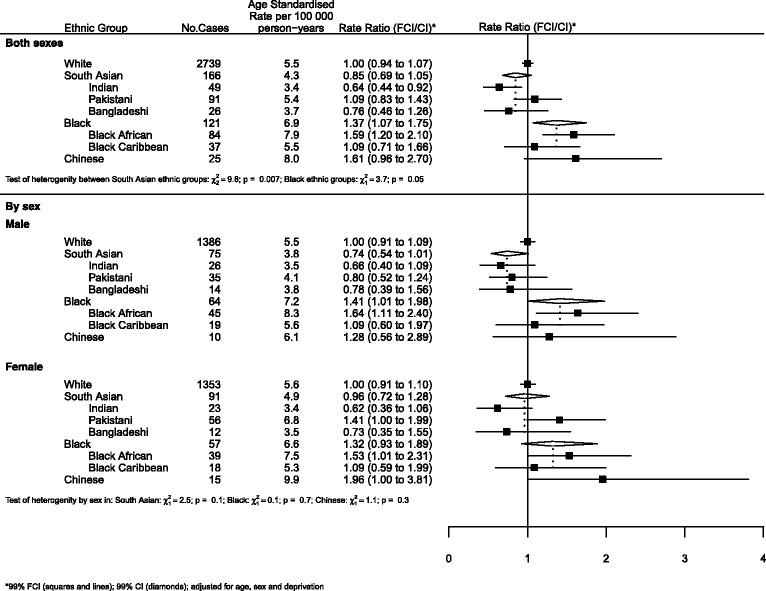
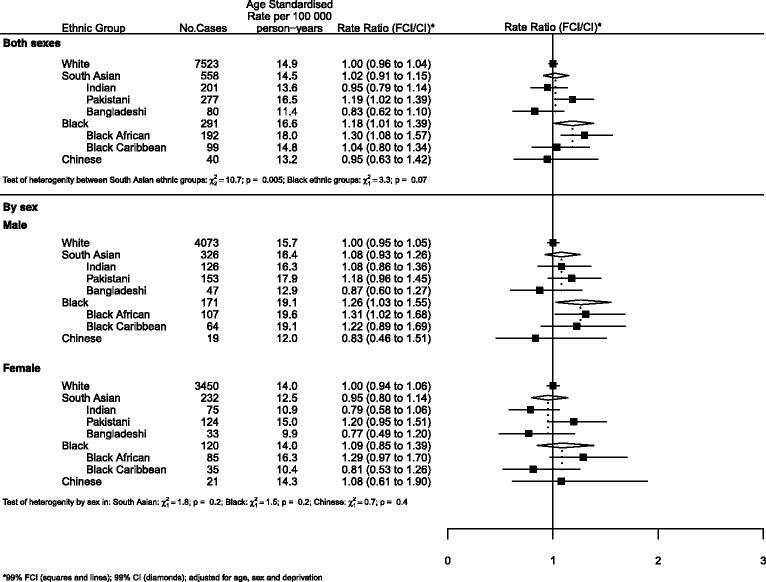
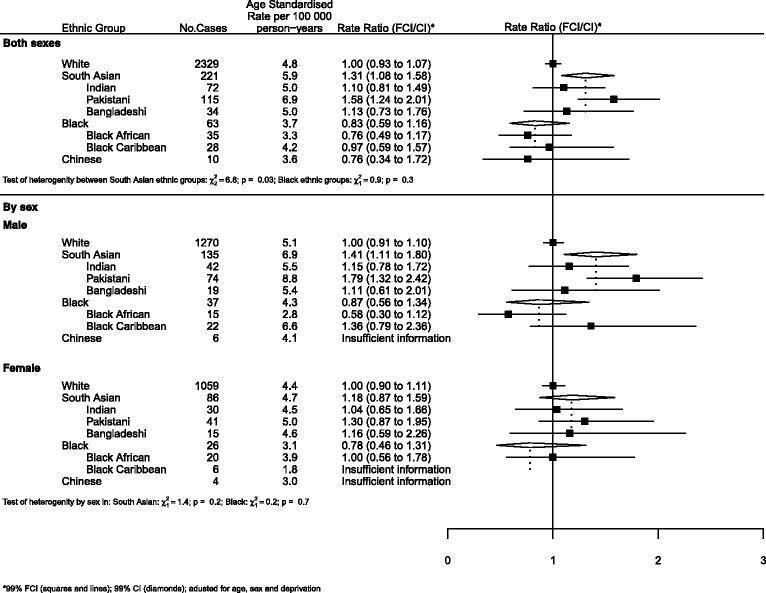
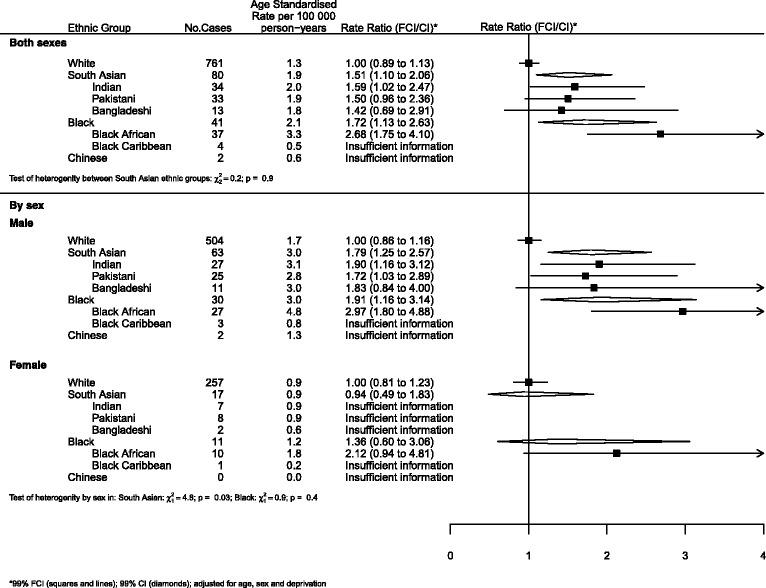
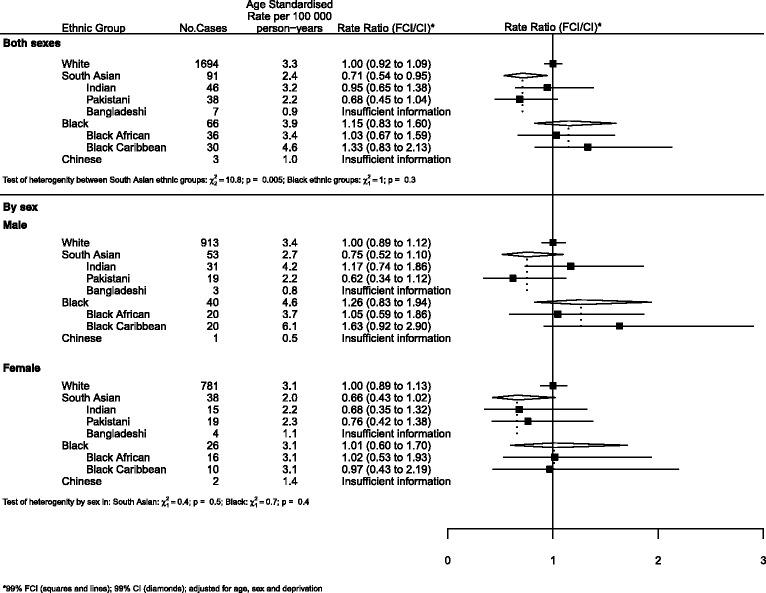
The majority of children in the study are UK born. Black children (RR = 1.18, 99% CI: 1.01-1.39), and amongst South Asians, Pakistani children (RR = 1.19, 99% CI: 1.02-1.39) appear to have an increased risk of all cancers. There is an increased risk of leukaemia in South Asians (RR = 1.31, 99% CI: 1.08-1.58), and of lymphoma in Black (RR = 1.72, 99% CI: 1.13-2.63) and South Asian children (RR = 1.51, 99% CI: 1.10-2.06). South Asians appear to have a decreased risk of CNS cancers (RR = 0.71, 99% CI: 0.54-0.95).
CONCLUSIONS
In the tradition of past migrant studies, such descriptive studies within ethnic minority groups permit a better understanding of disease incidence within the population, but also allow for the generation of hypotheses to begin to understand why such differences might exist. Though a major cause of mortality in this age group, childhood cancer remains a relatively rare disease; however, the methods used here have permitted the first nationwide estimation of childhood cancer by individual ethnic group.
背景
在一岁之后,癌症是儿童最常见的死因。不同种族的发病率不同,而最近在数据链接方面的进展可以更准确地估计这些差异。确定这些差异可能有助于确定某些儿童癌症的潜在风险或保护因素。因此,本研究旨在使用过去描述成人癌症时所采用的全国范围内七年的数据来确定是否确实存在这种差异。
方法
我们从 2001 年 1 月至 2007 年 12 月获得了英格兰所有儿童(0-14 岁)癌症登记的数据。通过与医院住院统计数据库或癌症登记数据的记录链接,确定了种族(自我报告)。根据国际儿童癌症分类,对癌症进行形态学分类,分为白血病、淋巴瘤、中枢神经系统和其他实体瘤四类。为每个种族群体估计了年龄标准化发病率,并比较了每个种族群体(印度人、巴基斯坦人、孟加拉国人、非裔黑人、加勒比黑人、中国人)与白人的发病率比值,调整了性别、年龄和贫困因素。
结果
研究中的大多数儿童都是英国出生的。黑人儿童(RR=1.18,99%CI:1.01-1.39)和南亚人中的巴基斯坦儿童(RR=1.19,99%CI:1.02-1.39)似乎所有癌症的风险都增加了。南亚人患白血病的风险增加(RR=1.31,99%CI:1.08-1.58),黑人(RR=1.72,99%CI:1.13-2.63)和南亚人(RR=1.51,99%CI:1.10-2.06)患淋巴瘤的风险增加。南亚人患中枢神经系统癌症的风险降低(RR=0.71,99%CI:0.54-0.95)。
结论
在过去的移民研究传统中,对少数民族群体进行这种描述性研究可以更好地了解人群中的疾病发病率,同时也可以提出假设,开始理解为什么会存在这种差异。尽管癌症是该年龄段的主要死亡原因之一,但儿童癌症仍然是一种相对罕见的疾病;然而,这里采用的方法允许首次按个别族裔群体对儿童癌症进行全国性估计。
 Zotero 插件