
抗氧化治疗策略在与氧化应激相关的心血管疾病中的应用。
Antioxidant Therapeutic Strategies for Cardiovascular Conditions Associated with Oxidative Stress.
机构信息
Departamento de Ingeniería Química, Facultad de Ingeniería y Ciencias, Universidad de La Frontera, Temuco 4780000, Chile.
Unidad de Cuidados Intensivos, Hospital de Niños Roberto del Río, Santiago 7500922, Chile.
出版信息
Nutrients. 2017 Sep 1;9(9):966. doi: 10.3390/nu9090966.
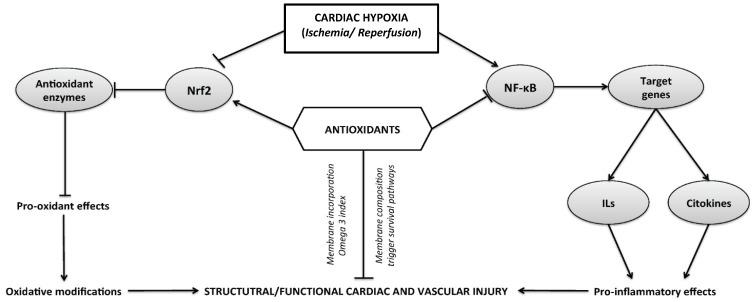
Oxidative stress (OS) refers to the imbalance between the generation of reactive oxygen species (ROS) and the ability to scavenge these ROS by endogenous antioxidant systems, where ROS overwhelms the antioxidant capacity. Excessive presence of ROS results in irreversible damage to cell membranes, DNA, and other cellular structures by oxidizing lipids, proteins, and nucleic acids. Oxidative stress plays a crucial role in the pathogenesis of cardiovascular diseases related to hypoxia, cardiotoxicity and ischemia-reperfusion. Here, we describe the participation of OS in the pathophysiology of cardiovascular conditions such as myocardial infarction, anthracycline cardiotoxicity and congenital heart disease. This review focuses on the different clinical events where redox factors and OS are related to cardiovascular pathophysiology, giving to support for novel pharmacological therapies such as omega 3 fatty acids, non-selective betablockers and microRNAs.
氧化应激(OS)是指活性氧(ROS)的产生与内源性抗氧化系统清除这些 ROS 的能力之间失去平衡,导致 ROS 超过抗氧化能力。ROS 的过度存在会通过氧化脂质、蛋白质和核酸来导致细胞膜、DNA 和其他细胞结构的不可逆转损伤。氧化应激在与缺氧、心脏毒性和缺血再灌注相关的心血管疾病的发病机制中起着至关重要的作用。在这里,我们描述了 OS 参与心肌梗死、蒽环类药物心脏毒性和先天性心脏病等心血管疾病的病理生理学过程。本综述重点介绍了氧化还原因子和 OS 与心血管病理生理学相关的不同临床事件,为新型药理学治疗提供了支持,如ω-3 脂肪酸、非选择性β受体阻滞剂和 microRNAs。
 Zotero 插件