
心脏氧化应激与抗氧化补充剂摄入和身体活动的治疗方法。
Cardiac Oxidative Stress and the Therapeutic Approaches to the Intake of Antioxidant Supplements and Physical Activity.
机构信息
Department of Exercise Physiology, Faculty of Sport Sciences, University of Guilan, Rasht 4199843653, Iran.
Faculty of Sport Sciences, Waseda University, 2-579-15 Mikajima, Tokorozawa 359-1192, Japan.
出版信息
Nutrients. 2021 Sep 30;13(10):3483. doi: 10.3390/nu13103483.
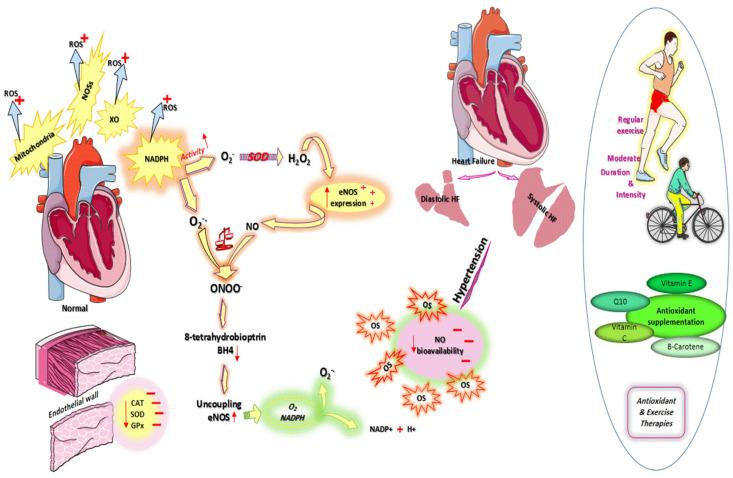
Reactive oxygen species (ROS) are strongly reactive chemical entities that include oxygen regulated by enzymatic and non-enzymatic antioxidant defense mechanisms. ROS contribute significantly to cell homeostasis in the heart by regulating cell proliferation, differentiation, and excitation-contraction coupling. When ROS generation surpasses the ability of the antioxidant defense mechanisms to buffer them, oxidative stress develops, resulting in cellular and molecular disorders and eventually in heart failure. Oxidative stress is a critical factor in developing hypoxia- and ischemia-reperfusion-related cardiovascular disorders. This article aimed to discuss the role of oxidative stress in the pathophysiology of cardiac diseases such as hypertension and endothelial dysfunction. This review focuses on the various clinical events and oxidative stress associated with cardiovascular pathophysiology, highlighting the benefits of new experimental treatments such as creatine supplementation, omega-3 fatty acids, microRNAs, and antioxidant supplements in addition to physical exercise.
活性氧(ROS)是一种具有强反应性的化学实体,包括受酶和非酶抗氧化防御机制调节的氧。ROS 通过调节细胞增殖、分化和兴奋-收缩偶联,对心脏的细胞内稳态有重要贡献。当 ROS 的产生超过抗氧化防御机制缓冲它们的能力时,就会发生氧化应激,导致细胞和分子紊乱,最终导致心力衰竭。氧化应激是导致缺氧和缺血再灌注相关心血管疾病的一个关键因素。本文旨在讨论氧化应激在高血压和内皮功能障碍等心脏疾病的病理生理学中的作用。本综述重点讨论了与心血管病理生理学相关的各种临床事件和氧化应激,强调了除了体育锻炼之外,新型实验治疗方法如肌酸补充、ω-3 脂肪酸、microRNAs 和抗氧化补充剂的益处。
 Zotero 插件