
人呼吸道上皮细胞中黄嘌呤脱氢酶基因表达及尿酸生成的调控
Regulation of xanthine dehydrogensase gene expression and uric acid production in human airway epithelial cells.
作者信息
Huff Ryan D, Hsu Alan C-Y, Nichol Kristy S, Jones Bernadette, Knight Darryl A, Wark Peter A B, Hansbro Philip M, Hirota Jeremy A
机构信息
Division of Respiratory Medicine, Department of Medicine, University of British Columbia, Vancouver, British Columbia, Canada.
Priority Research Centre for Healthy Lungs, Hunter Medical Research Institute, The University of Newcastle, Newcastle, New South Wales, Australia.
出版信息
PLoS One. 2017 Sep 1;12(9):e0184260. doi: 10.1371/journal.pone.0184260. eCollection 2017.
INTRODUCTION
The airway epithelium is a physical and immunological barrier that protects the pulmonary system from inhaled environmental insults. Uric acid has been detected in the respiratory tract and can function as an antioxidant or damage associated molecular pattern. We have demonstrated that human airway epithelial cells are a source of uric acid. Our hypothesis is that uric acid production by airway epithelial cells is induced by environmental stimuli associated with chronic respiratory diseases. We therefore examined how airway epithelial cells regulate uric acid production.
MATERIALS AND METHODS
Allergen and cigarette smoke mouse models were performed using house dust mite (HDM) and cigarette smoke exposure, respectively, with outcome measurements of lung uric acid levels. Primary human airway epithelial cells isolated from clinically diagnosed patients with asthma and chronic obstructive pulmonary disease (COPD) were grown in submerged cultures and compared to age-matched healthy controls for uric acid release. HBEC-6KT cells, a human airway epithelial cell line, were grown under submerged monolayer conditions for mechanistic and gene expression studies.
RESULTS
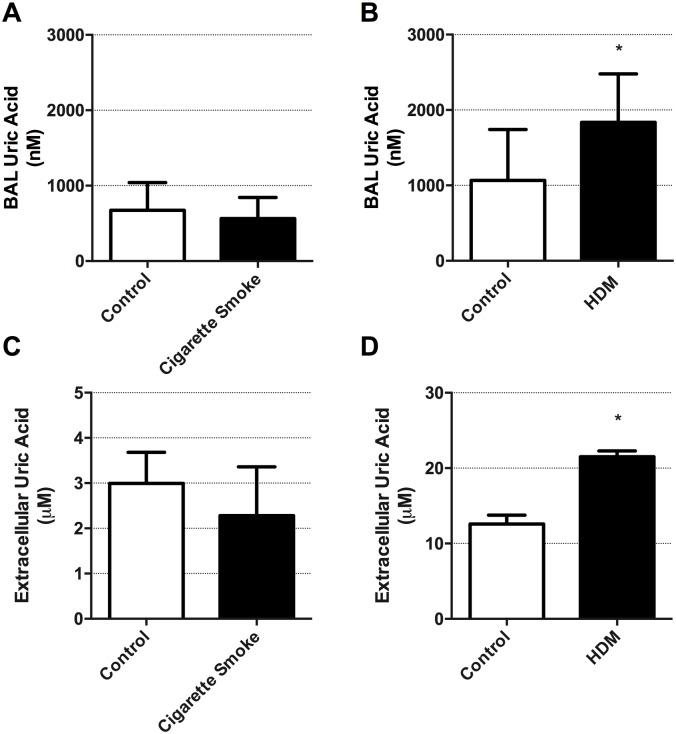
HDM, but not cigarette smoke exposure, stimulated uric acid production in vivo and in vitro. Primary human airway epithelial cells from asthma, but not COPD patients, displayed elevated levels of extracellular uric acid in culture. In HBEC-6KT, production of uric acid was sensitive to the xanthine dehydrogenase (XDH) inhibitor, allopurinol, and the ATP Binding Cassette C4 (ABCC4) inhibitor, MK-571. Lastly, the pro-inflammatory cytokine combination of TNF-α and IFN-γ elevated extracellular uric acid levels and XDH gene expression in HBEC-6KT cells.
CONCLUSIONS
Our results suggest that the active production of uric acid from human airway epithelial cells may be intrinsically altered in asthma and be further induced by pro-inflammatory cytokines.
引言
气道上皮是一种物理和免疫屏障,可保护肺部系统免受吸入性环境损伤。已在呼吸道中检测到尿酸,其可作为抗氧化剂或损伤相关分子模式发挥作用。我们已证明人类气道上皮细胞是尿酸的一个来源。我们的假设是,气道上皮细胞产生尿酸是由与慢性呼吸道疾病相关的环境刺激所诱导的。因此,我们研究了气道上皮细胞如何调节尿酸的产生。
材料与方法
分别使用屋尘螨(HDM)和香烟烟雾暴露建立变应原和香烟烟雾小鼠模型,并测量肺尿酸水平作为结果指标。从临床诊断的哮喘和慢性阻塞性肺疾病(COPD)患者中分离出的原代人气道上皮细胞在浸没培养中生长,并与年龄匹配的健康对照进行尿酸释放比较。人气道上皮细胞系HBEC-6KT细胞在浸没单层条件下生长,用于机制和基因表达研究。
结果
HDM而非香烟烟雾暴露在体内和体外均刺激了尿酸的产生。来自哮喘患者而非COPD患者的原代人气道上皮细胞在培养中显示出细胞外尿酸水平升高。在HBEC-6KT细胞中,尿酸的产生对黄嘌呤脱氢酶(XDH)抑制剂别嘌呤醇和ATP结合盒转运体C4(ABCC4)抑制剂MK-571敏感。最后,TNF-α和IFN-γ的促炎细胞因子组合提高了HBEC-6KT细胞的细胞外尿酸水平和XDH基因表达。
结论
我们的结果表明,人类气道上皮细胞中尿酸的活性产生在哮喘中可能内在改变,并由促炎细胞因子进一步诱导。



 Zotero 插件