
纳米抗体:化学功能化策略及细胞内应用。
Nanobodies: Chemical Functionalization Strategies and Intracellular Applications.
机构信息
Chemical Biology, Leibniz-Forschungsinstitut für Molekulare, Pharmakologie and Department of Chemistry, Humboldt-Universität zu Berlin, Berlin, Germany.
Department of Biology II, Ludwig Maximilians Universität München und Center for Integrated Protein Science Munich, Martinsried, Germany.
出版信息
Angew Chem Int Ed Engl. 2018 Feb 23;57(9):2314-2333. doi: 10.1002/anie.201708459. Epub 2018 Jan 26.
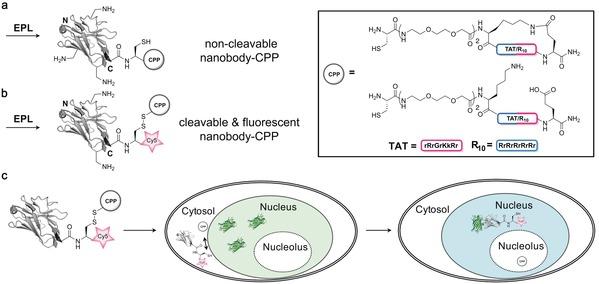
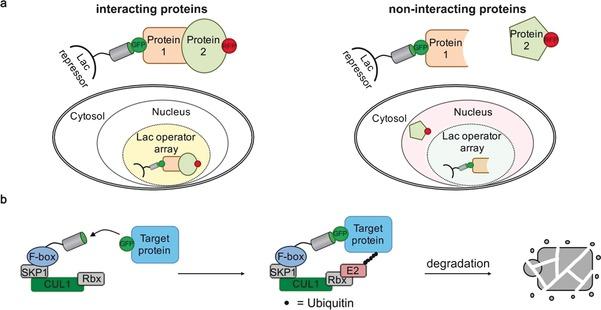
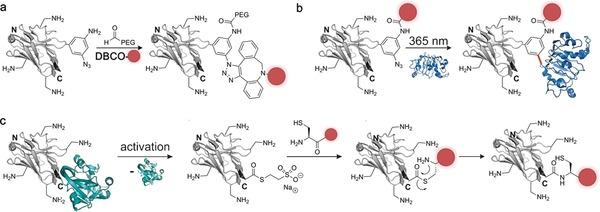
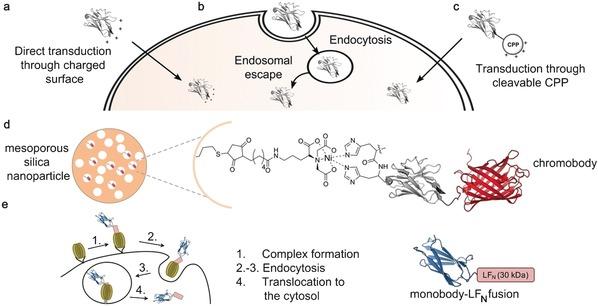
Nanobodies can be seen as next-generation tools for the recognition and modulation of antigens that are inaccessible to conventional antibodies. Due to their compact structure and high stability, nanobodies see frequent usage in basic research, and their chemical functionalization opens the way towards promising diagnostic and therapeutic applications. In this Review, central aspects of nanobody functionalization are presented, together with selected applications. While early conjugation strategies relied on the random modification of natural amino acids, more recent studies have focused on the site-specific attachment of functional moieties. Such techniques include chemoenzymatic approaches, expressed protein ligation, and amber suppression in combination with bioorthogonal modification strategies. Recent applications range from sophisticated imaging and mass spectrometry to the delivery of nanobodies into living cells for the visualization and manipulation of intracellular antigens.
纳米抗体可以被视为下一代工具,用于识别和调节传统抗体无法识别的抗原。由于其紧凑的结构和高稳定性,纳米抗体在基础研究中得到了频繁的应用,并且其化学功能化开辟了有前途的诊断和治疗应用的途径。在这篇综述中,介绍了纳米抗体功能化的核心方面及其选定的应用。虽然早期的缀合策略依赖于天然氨基酸的随机修饰,但最近的研究集中在功能部分的定点附着上。这些技术包括化学酶法方法、表达蛋白连接以及与生物正交修饰策略结合的琥珀终止。最近的应用范围从复杂的成像和质谱分析到将纳米抗体递送到活细胞中,以可视化和操纵细胞内抗原。





 Zotero 插件