
罗氟司特逆转香烟暴露小鼠 CFTR 介导的离子转运功能障碍。
Roflumilast reverses CFTR-mediated ion transport dysfunction in cigarette smoke-exposed mice.
机构信息
Department of Medicine, University of Alabama at Birmingham, Birmingham, AL, USA.
Department of Cell, Integrative, and Developmental Biology, University of Alabama at Birmingham, Birmingham, AL, USA.
出版信息
Respir Res. 2017 Sep 18;18(1):173. doi: 10.1186/s12931-017-0656-0.
BACKGROUND
Dysfunction in cystic fibrosis transmembrane conductance regulator (CFTR) can be elicited by cigarette smoke and is observed in patients with chronic bronchitis. We have previously demonstrated in human airway epithelial cell monolayers that roflumilast, a clinically approved phosphodiesterase 4 inhibitor that reduces the risk of exacerbations in chronic obstructive pulmonary disease patients with chronic bronchitis and a history of exacerbations, activates CFTR-dependent chloride secretion via a cAMP-mediated pathway, partially restores the detrimental effects of cigarette smoke on CFTR-mediated ion transport, and increases CFTR-dependent gastrointestinal fluid secretion in isolated murine intestine segments. Based on these findings, we hypothesized that roflumilast could improve CFTR-mediated chloride transport and induce secretory diarrhea in mice exhibiting cigarette smoke-induced CFTR dysfunction.
METHODS
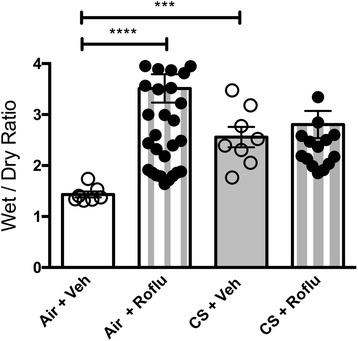
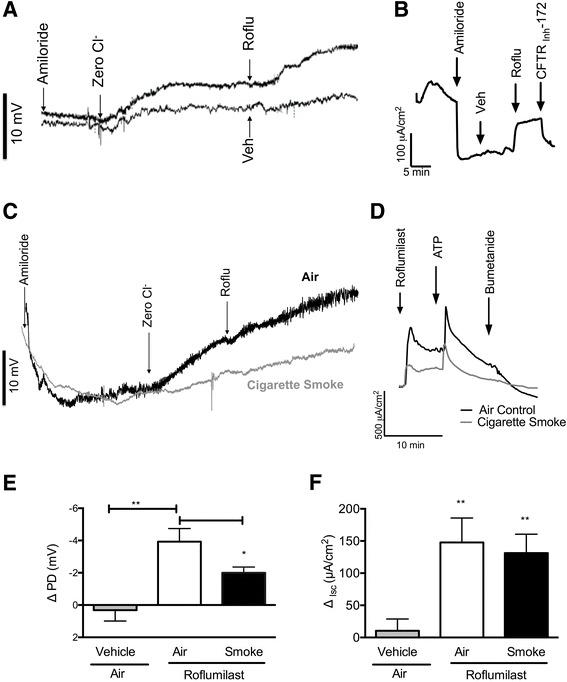
A/J mice expressing wild type CFTR (+/+) were exposed to cigarette smoke or air with or without roflumilast and the effect of treatment on CFTR-dependent chloride transport was quantified using nasal potential difference (NPD) measurements in vivo and short-circuit current (Isc) analysis of trachea ex vivo. Stool specimen were collected and the wet/dry ratio measured to assess the effect of roflumilast on secretory diarrhea.
RESULTS
Acute roflumilast treatment increased CFTR-dependent chloride transport in both smoke- and air-exposed mice (smoke, -2.0 ± 0.4 mV, 131.3 ± 29.3 μA/cm, P < 0.01 and air, 3.9 ± 0.8 mV, 147.7 ± 38.0 μA/cm, P < 0.01 vs. vehicle -0.3 ± 0.7 mV, 10.4 ± 7.0 μA/cm). Oral administration of roflumilast over five weeks completely reversed the deleterious effects of cigarette smoke on CFTR function in smoke-exposed animals, in which CFTR-dependent chloride transport was 64% that of air controls (roflumilast, -15.22 ± 2.7 mV vs. air, -14.45 ± 1.4 mV, P < 0.05). Smoke exposure increased the wet/dry ratio of stool specimen to a level beyond which roflumilast had little additional effect.
CONCLUSIONS
Roflumilast effectively rescues CFTR-mediated chloride transport in vivo, further implicating CFTR activation as a mechanism through which roflumilast benefits patients with bronchitis.
背景
囊性纤维化跨膜电导调节因子(CFTR)功能障碍可由香烟烟雾引发,并在慢性支气管炎患者中观察到。我们之前在人呼吸道上皮细胞单层中证明,罗氟司特,一种临床批准的磷酸二酯酶 4 抑制剂,可降低慢性阻塞性肺病伴有慢性支气管炎和加重史的患者的加重风险,通过 cAMP 介导的途径激活 CFTR 依赖性氯离子分泌,部分恢复香烟烟雾对 CFTR 介导的离子转运的有害影响,并增加分离的小鼠肠段中 CFTR 依赖性胃肠液分泌。基于这些发现,我们假设罗氟司特可以改善 CFTR 介导的氯离子转运,并在表现出 CFTR 功能障碍的小鼠中诱导分泌性腹泻。
方法
表达野生型 CFTR(+/+)的 A/J 小鼠暴露于香烟烟雾或空气,或在暴露于香烟烟雾或空气的同时给予罗氟司特,并通过体内鼻电位差(NPD)测量和气管离体短电路电流(Isc)分析来量化治疗对 CFTR 依赖性氯离子转运的影响。收集粪便标本并测量湿/干比,以评估罗氟司特对分泌性腹泻的影响。
结果
急性罗氟司特治疗增加了烟雾和空气暴露小鼠的 CFTR 依赖性氯离子转运(烟雾,-2.0±0.4 mV,131.3±29.3 μA/cm,P<0.01;空气,3.9±0.8 mV,147.7±38.0 μA/cm,P<0.01,与载体相比-0.3±0.7 mV,10.4±7.0 μA/cm)。五周的口服罗氟司特完全逆转了香烟烟雾对烟雾暴露动物 CFTR 功能的有害影响,其中 CFTR 依赖性氯离子转运是空气对照的 64%(罗氟司特,-15.22±2.7 mV 与空气,-14.45±1.4 mV,P<0.05)。烟雾暴露增加了粪便标本的湿/干比,超出了罗氟司特几乎没有额外效果的水平。
结论
罗氟司特有效地挽救了体内 CFTR 介导的氯离子转运,进一步表明 CFTR 激活是罗氟司特使支气管炎患者受益的机制之一。

 Zotero 插件