
肥胖轨迹与痴呆风险:Whitehall II 研究 28 年随访结果。
Obesity trajectories and risk of dementia: 28 years of follow-up in the Whitehall II Study.
机构信息
INSERM, U1018, Centre for Research in Epidemiology and Population Health, Villejuif, France; Department of Epidemiology and Public Health, University College London, UK.
INSERM, U1018, Centre for Research in Epidemiology and Population Health, Villejuif, France.
出版信息
Alzheimers Dement. 2018 Feb;14(2):178-186. doi: 10.1016/j.jalz.2017.06.2637. Epub 2017 Sep 21.
INTRODUCTION
We examined whether obesity at ages 50, 60, and 70 years is associated with subsequent dementia. Changes in body mass index (BMI) for more than 28 years before dementia diagnosis were compared with changes in BMI in those free of dementia.
METHODS
A total of 10,308 adults (33% women) aged 35 to 55 years in 1985 were followed up until 2015. BMI was assessed six times and 329 cases of dementia were recorded.
RESULTS
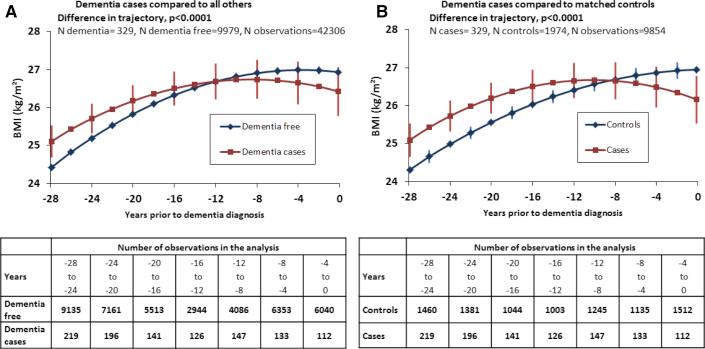
Obesity (BMI ≥30 kg/m) at age 50 years (hazard ratio = 1.93; 1.35-2.75) but not at 60 or 70 years was associated with risk of dementia. Trajectories of BMI differed in those with dementia compared with all others (P < .0001) or to matched control subjects (P < .0001) such that BMI in dementia cases was higher from 28 years (P = .001) to 16 years (P = .05) and lower starting 8 years before diagnosis.
DISCUSSION
Obesity in midlife and weight loss in the preclinical phase characterizes dementia; the current obesity epidemic may affect future dementia rates.
简介
我们研究了 50 岁、60 岁和 70 岁时的肥胖是否与随后的痴呆有关。在痴呆症诊断前超过 28 年的体重指数 (BMI) 变化与无痴呆症者的 BMI 变化进行了比较。
方法
共有 10308 名年龄在 35 至 55 岁的成年人(33%为女性)在 1985 年接受随访,直至 2015 年。BMI 评估了六次,记录了 329 例痴呆病例。
结果
50 岁时肥胖(BMI≥30kg/m)(危险比=1.93;1.35-2.75)而不是 60 岁或 70 岁时肥胖与痴呆风险相关。与所有其他人(P<.0001)或匹配的对照受试者(P<.0001)相比,痴呆患者的 BMI 轨迹不同,即痴呆病例的 BMI 从 28 年前(P=.001)到 16 年前(P=.05)较高,而在诊断前 8 年前较低。
讨论
中年肥胖和临床前阶段的体重减轻是痴呆的特征;当前的肥胖症流行可能会影响未来的痴呆症发病率。
 Zotero 插件