
一种CD200R-CD28融合蛋白获取抑制性信号以增强T细胞功能并用于小鼠白血病治疗。
A CD200R-CD28 fusion protein appropriates an inhibitory signal to enhance T-cell function and therapy of murine leukemia.
作者信息
Oda Shannon K, Daman Andrew W, Garcia Nicolas M, Wagener Felecia, Schmitt Thomas M, Tan Xiaoxia, Chapuis Aude G, Greenberg Philip D
机构信息
Program in Immunology, Fred Hutchinson Cancer Research Center, Seattle, WA; and.
Department of Immunology, University of Washington, Seattle, WA.
出版信息
Blood. 2017 Nov 30;130(22):2410-2419. doi: 10.1182/blood-2017-04-777052. Epub 2017 Oct 17.
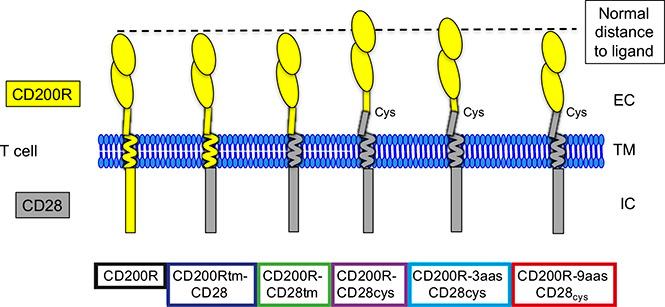
Acute myeloid leukemia (AML), the most common adult acute leukemia in the United States, has the poorest survival rate, with 26% of patients surviving 5 years. Adoptive immunotherapy with T cells genetically modified to recognize tumors is a promising and evolving treatment option. However, antitumor activity, particularly in the context of progressive leukemia, can be dampened both by limited costimulation and triggering of immunoregulatory checkpoints that attenuate T-cell responses. Expression of CD200 (OX2), a negative regulator of T-cell function that binds CD200 receptor (CD200R), is commonly increased in leukemia and other malignancies and is associated with poor prognosis in leukemia patients. To appropriate and redirect the inhibitory effects of CD200R signaling on transferred CD8 T cells, we engineered CD200R immunomodulatory fusion proteins (IFPs) with the cytoplasmic tail replaced by the signaling domain of the costimulatory receptor, CD28. An analysis of a panel of CD200R-CD28 IFP constructs revealed that the most effective costimulation was achieved in IFPs containing a dimerizing motif and a predicted tumor-T-cell distance that facilitates localization to the immunological synapse. T cells transduced with the optimized CD200R-CD28 IFPs exhibited enhanced proliferation and effector function in response to CD200 leukemic cells in vitro. In adoptive therapy of disseminated leukemia, CD200R-CD28-transduced leukemia-specific CD8 T cells eradicated otherwise lethal disease more efficiently than wild-type cells and bypassed the requirement for interleukin-2 administration to sustain in vivo activity. The transduction of human primary T cells with the equivalent human IFPs increased proliferation and cytokine production in response to CD200 leukemia cells, supporting clinical translation. This trial was registered at www.clinicaltrials.gov as #NCT01640301.
急性髓系白血病(AML)是美国最常见的成人急性白血病,生存率最低,仅有26%的患者能存活5年。采用经基因改造以识别肿瘤的T细胞进行过继性免疫治疗是一种有前景且不断发展的治疗选择。然而,抗肿瘤活性,尤其是在进行性白血病的情况下,可能会因共刺激有限以及免疫调节检查点的触发而受到抑制,这些检查点会减弱T细胞反应。CD200(OX2)是一种T细胞功能的负调节因子,可与CD200受体(CD200R)结合,其表达在白血病和其他恶性肿瘤中通常会增加,并且与白血病患者的不良预后相关。为了适当且重新引导CD200R信号对转移的CD8 T细胞的抑制作用,我们构建了CD200R免疫调节融合蛋白(IFP),将其胞质尾替换为共刺激受体CD28的信号域。对一组CD200R - CD28 IFP构建体的分析表明,在含有二聚化基序和预测的肿瘤 - T细胞距离(有助于定位于免疫突触)的IFP中实现了最有效的共刺激。用优化的CD200R - CD28 IFP转导的T细胞在体外对CD200白血病细胞的反应中表现出增强的增殖和效应功能。在播散性白血病的过继治疗中,用CD200R - CD28转导的白血病特异性CD8 T细胞比野生型细胞更有效地根除了原本致命的疾病,并且无需给予白细胞介素 - 2来维持体内活性。用等效的人IFP转导人原代T细胞可增加对CD200白血病细胞的反应中的增殖和细胞因子产生,支持临床转化。该试验已在www.clinicaltrials.gov上注册,编号为#NCT01640301。
 Zotero 插件