
自杀理论、评估与预防的社会生态框架
A Social-Ecological Framework of Theory, Assessment, and Prevention of Suicide.
作者信息
Cramer Robert J, Kapusta Nestor D
机构信息
School of Community and Environmental Health Sciences, Old Dominion University, Norfolk, VA, United States.
Suicide Research Group, Department for Psychoanalysis and Psychotherapy, Medical University of Vienna, Vienna, Austria.
出版信息
Front Psychol. 2017 Oct 9;8:1756. doi: 10.3389/fpsyg.2017.01756. eCollection 2017.
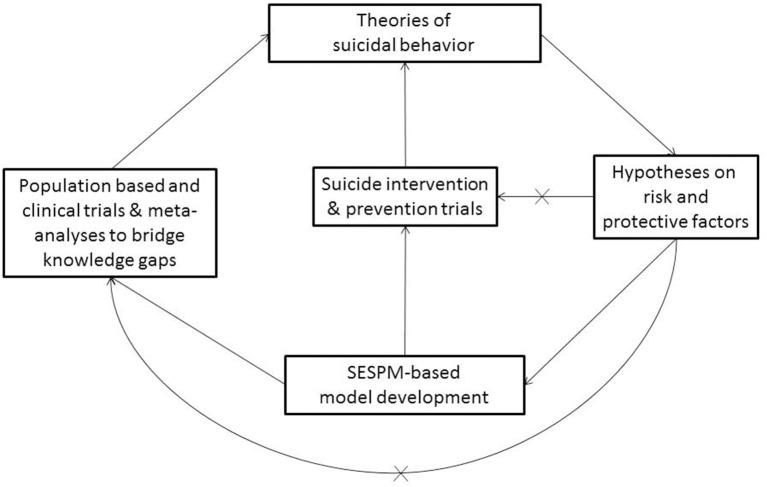
The juxtaposition of increasing suicide rates with continued calls for suicide prevention efforts begs for new approaches. Grounded in the Centers for Disease Control and Prevention (CDC) framework for tackling health issues, this personal views work integrates relevant suicide risk/protective factor, assessment, and intervention/prevention literatures. Based on these components of suicide risk, we articulate a Social-Ecological Suicide Prevention Model (SESPM) which provides an integration of general and population-specific risk and protective factors. We also use this multi-level perspective to provide a structured approach to understanding current theories and intervention/prevention efforts concerning suicide. Following similar multi-level prevention efforts in interpersonal violence and Human Immunodeficiency Virus (HIV) domains, we offer recommendations for social-ecologically informed suicide prevention theory, training, research, assessment, and intervention programming. Although the SESPM calls for further empirical testing, it provides a suitable backdrop for tailoring of current prevention and intervention programs to population-specific needs. Moreover, the multi-level model shows promise to move suicide risk assessment forward (e.g., development of multi-level suicide risk algorithms or structured professional judgments instruments) to overcome current limitations in the field. Finally, we articulate a set of characteristics of social-ecologically based suicide prevention programs. These include the need to address risk and protective factors with the strongest degree of empirical support at each multi-level layer, incorporate a comprehensive program evaluation strategy, and use a variety of prevention techniques across levels of prevention.
自杀率不断上升,同时人们持续呼吁开展自杀预防工作,这就需要新的方法。基于疾病控制与预防中心(CDC)应对健康问题的框架,这篇个人观点文章整合了相关的自杀风险/保护因素、评估以及干预/预防文献。基于这些自杀风险要素,我们阐述了一种社会生态自杀预防模型(SESPM),该模型整合了一般和特定人群的风险及保护因素。我们还运用这种多层次视角,提供一种结构化方法来理解当前有关自杀的理论以及干预/预防工作。借鉴人际暴力和人类免疫缺陷病毒(HIV)领域类似的多层次预防工作,我们针对基于社会生态的自杀预防理论、培训、研究、评估及干预规划提出建议。尽管社会生态自杀预防模型需要进一步的实证检验,但它为根据特定人群需求调整当前预防和干预项目提供了合适的背景。此外,这种多层次模型有望推动自杀风险评估向前发展(例如,开发多层次自杀风险算法或结构化专业判断工具),以克服该领域当前的局限性。最后,我们阐述了基于社会生态的自杀预防项目的一系列特征。这些特征包括需要在每个多层次层面处理具有最强实证支持度的风险和保护因素,纳入全面的项目评估策略,并在预防的各个层面运用多种预防技术。
 Zotero 插件