
老年人跌倒与跌倒预防:老年医学与太空飞行的交汇!
Falls and Fall-Prevention in Older Persons: Geriatrics Meets Spaceflight!
作者信息
Goswami Nandu
机构信息
Gravitational Physiology, Aging and Medicine Research Unit, Institute of Physiology, Medical University of Graz, Graz, Austria.
Department of Health Sciences, Alma Mater Europea University, Maribor, Slovenia.
出版信息
Front Physiol. 2017 Oct 11;8:603. doi: 10.3389/fphys.2017.00603. eCollection 2017.
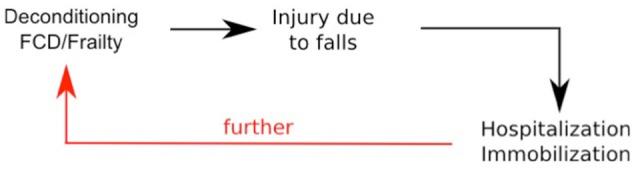
This paper provides a general overview of key physiological consequences of microgravity experienced during spaceflight and of important parallels and connections to the physiology of aging. Microgravity during spaceflight influences cardiovascular function, cerebral autoregulation, musculoskeletal, and sensorimotor system performance. A great deal of research has been carried out to understand these influences and to provide countermeasures to reduce the observed negative consequences of microgravity on physiological function. Such research can inform and be informed by research related to physiological changes and the deterioration of physiological function due to aging. For example, head-down bedrest is used as a model to study effects of spaceflight deconditioning due to reduced gravity. As hospitalized older persons spend up to 80% of their time in bed, the deconditioning effects of bedrest confinement on physiological functions and parallels with spaceflight deconditioning can be exploited to understand and combat both variations of deconditioning. Deconditioning due to bed confinement in older persons can contribute to a downward spiral of increasing frailty, orthostatic intolerance, falls, and fall-related injury. As astronauts in space spend substantial amounts of time carrying out exercise training to counteract the microgravity-induced deconditioning and to counteract orthostatic intolerance on return to Earth, it is logical to suggest some of these interventions for bed-confined older persons. Synthesizing knowledge regarding deconditioning due to reduced gravitational stress in space and deconditioning during bed confinement allows for a more comprehensive approach that can incorporate aspects such as (mal-) nutrition, muscle strength and function, cardiovascular (de-) conditioning, and cardio-postural interactions. The impact of such integration can provide new insights and lead to methods of value for both space medicine and geriatrics (Geriatrics meets spaceflight!). In particular, such integration can lead to procedures that address the morbidity and the mortality associated with bedrest immobilization and in the rising health care costs associated with an aging population demographic.
本文概述了太空飞行期间经历的微重力的关键生理影响,以及与衰老生理学的重要相似之处和联系。太空飞行期间的微重力会影响心血管功能、脑自动调节、肌肉骨骼和感觉运动系统性能。为了解这些影响并提供对策以减少微重力对生理功能的负面影响,已经开展了大量研究。此类研究可以为与衰老导致的生理变化和生理功能衰退相关的研究提供信息,同时也能从这些研究中获取信息。例如,头低位卧床休息被用作研究因重力降低导致的太空飞行去适应效应的模型。由于住院老年人在床上度过的时间高达80%,卧床限制对生理功能的去适应效应以及与太空飞行去适应效应的相似之处,可用于理解和应对这两种去适应变化。老年人因卧床限制导致的去适应可能会导致虚弱、直立性不耐受、跌倒以及跌倒相关伤害不断增加的恶性循环。由于太空中的宇航员花费大量时间进行运动训练,以抵消微重力引起的去适应并在返回地球时对抗直立性不耐受,因此对卧床的老年人建议采取其中一些干预措施是合理的。综合关于太空引力降低导致的去适应和卧床限制期间的去适应的知识,可以采用更全面的方法,纳入诸如(不良)营养、肌肉力量和功能、心血管(去)适应以及心脏与姿势相互作用等方面。这种整合的影响可以提供新的见解,并为太空医学和老年医学带来有价值的方法(老年医学与太空飞行相遇!)。特别是,这种整合可以导致一些程序,解决与卧床固定相关的发病率和死亡率,以及与人口老龄化相关的不断上升的医疗保健成本问题。

 Zotero 插件