
卧床休息后站立时,腿部肌肉血压依赖性激活的改变类似于衰老时观察到的情况。
Alterations in blood pressure dependent activation of leg muscles during standing following bed rest mimic those observed with ageing.
作者信息
Tremblay Malcom, Xu Da, Verma Ajay K, Goswami Nandu, Blaber Andrew P
机构信息
Department of Biomedical Physiology and Kinesiology, Simon Fraser University, Burnaby, BC, Canada.
Department of Neurology, University of Minnesota, Minneapolis, MN, United States.
出版信息
Front Physiol. 2025 Apr 29;16:1426648. doi: 10.3389/fphys.2025.1426648. eCollection 2025.
INTRODUCTION
Baroreflex-mediated activation of lower leg muscles (i.e., muscle-pump baroreflex) has been suggested to play a significant role in blood pressure regulation during standing. Compromised muscle-pump baroreflex because of ageing or prolonged inactivity could contribute to orthostatic hypotension. Understanding the contribution of individual lower leg muscles to blood pressure regulation could lead to the development of muscle-specific strategies to prevent orthostatic hypotension associated with muscle-pump baroreflex dysfunctions.
METHODS
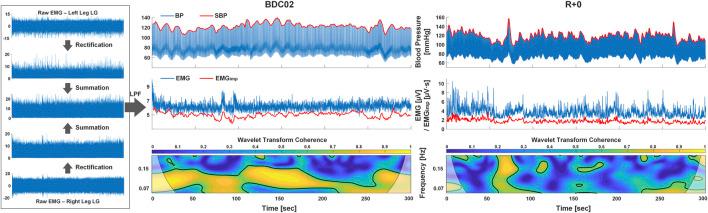
In this study, individual muscle (tibialis anterior (TA), lateral soleus (SOL), medial gastrocnemius (MG), and lateral gastrocnemius (LG)) responses to blood pressure changes upon a supine-to-stand orthostatic challenge were examined in young adult male participants (35 ± 2 years) before and after 60 days of 6° head-down tilt bed rest (HDBR). By analyzing the interactions between systolic blood pressure (SBP) and heartbeat-by-heartbeat electromyogram impulse (EMG) during standing, the interactions between SBP and EMGimp including muscle-pump baroreflex were characterized by fraction time active (FTA) and response gain from wavelet transform coherence analysis and the causality values using convergent cross mapping method for individual leg muscles. Since inactivity and ageing are common causes of orthostatic intolerance, the HDBR results were compared with those from young and older individuals in a previously published study to investigate the similarities in their effects on muscle-pump baroreflex.
RESULTS
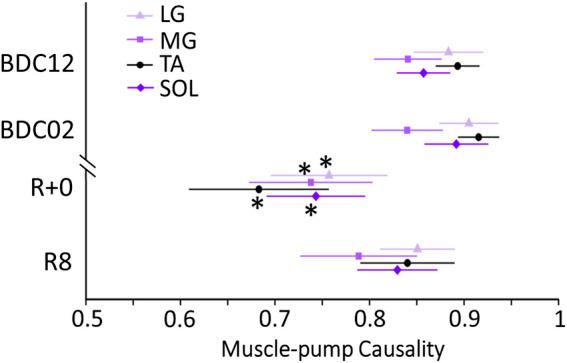
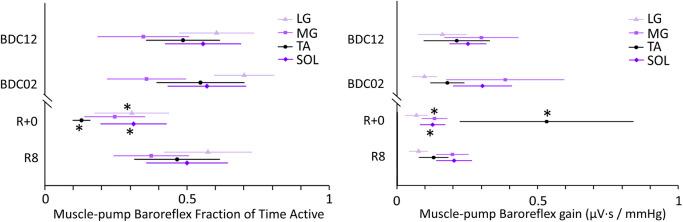
During standing, FTA reduced for all muscles except MG following HDBR and was lower in older compared to younger participants. Muscle-pump baroreflex causality (SBP→EMG) reduced for all muscles following HDBR and was lower for LG and SOL muscles in older compared to younger adults. The mechanical muscle-pump causality (SBP→EMG) was not affected by HDBR or by age. Increased TA muscle-pump baroreflex gain post-HDBR may point to a compensatory mechanism for decreased active control.
CONCLUSIONS
Our results showed striking similarities in the alteration of muscle-pump baroreflex induced via ageing and HDBR, suggesting strong commonalities between ageing and long-term inactivity in terms of the adverse effects on baroreflex mediated control of lower leg muscle activities in response to orthostatic challenge.
引言
压力反射介导的小腿肌肉激活(即肌肉泵压力反射)被认为在站立时的血压调节中起重要作用。由于衰老或长期不活动导致的肌肉泵压力反射受损可能会导致体位性低血压。了解小腿各肌肉对血压调节的贡献可能会促使制定针对特定肌肉的策略,以预防与肌肉泵压力反射功能障碍相关的体位性低血压。
方法
在本研究中,对年轻成年男性参与者(35±2岁)在60天6°头低位卧床休息(HDBR)前后,进行仰卧至站立体位挑战时各肌肉(胫骨前肌(TA)、比目鱼肌外侧头(SOL)、腓肠肌内侧头(MG)和腓肠肌外侧头(LG))对血压变化的反应进行了检查。通过分析站立期间收缩压(SBP)与逐搏肌电图冲动(EMG)之间的相互作用,利用小波变换相干分析的活跃时间分数(FTA)和反应增益以及使用收敛交叉映射方法计算个体腿部肌肉的因果值,来表征SBP与包括肌肉泵压力反射在内的EMGimp之间的相互作用。由于不活动和衰老体位不耐受的常见原因,将HDBR的结果与先前发表的一项研究中年轻人和老年人的结果进行比较,以研究它们对肌肉泵压力反射影响的相似性。
结果
站立期间,HDBR后除MG外所有肌肉的FTA均降低,且老年参与者低于年轻参与者。HDBR后所有肌肉的肌肉泵压力反射因果关系(SBP→EMG)均降低,老年成年人的LG和SOL肌肉低于年轻成年人。机械性肌肉泵因果关系(SBP→EMG)不受HDBR或年龄影响。HDBR后TA肌肉泵压力反射增益增加可能表明存在一种针对主动控制降低的代偿机制。
结论
我们的结果表明,衰老和HDBR引起的肌肉泵压力反射改变具有显著相似性,这表明在对体位挑战的压力反射介导的小腿肌肉活动控制产生不利影响方面,衰老和长期不活动之间存在很强的共性。
 Zotero 插件