
循环维生素D浓度与七种癌症风险:孟德尔随机化研究
Circulating vitamin D concentration and risk of seven cancers: Mendelian randomisation study.
作者信息
Dimitrakopoulou Vasiliki I, Tsilidis Konstantinos K, Haycock Philip C, Dimou Niki L, Al-Dabhani Kawthar, Martin Richard M, Lewis Sarah J, Gunter Marc J, Mondul Alison, Shui Irene M, Theodoratou Evropi, Nimptsch Katharina, Lindström Sara, Albanes Demetrius, Kühn Tilman, Key Timothy J, Travis Ruth C, Vimaleswaran Karani Santhanakrishnan, Kraft Peter, Pierce Brandon L, Schildkraut Joellen M
机构信息
Department of Hygiene and Epidemiology, School of Medicine, University of Ioannina, Ioannina, Greece.
School of Mathematics and Statistics, University College Dublin, Dublin, Ireland.
出版信息
BMJ. 2017 Oct 31;359:j4761. doi: 10.1136/bmj.j4761.
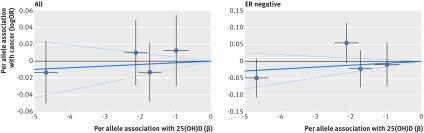
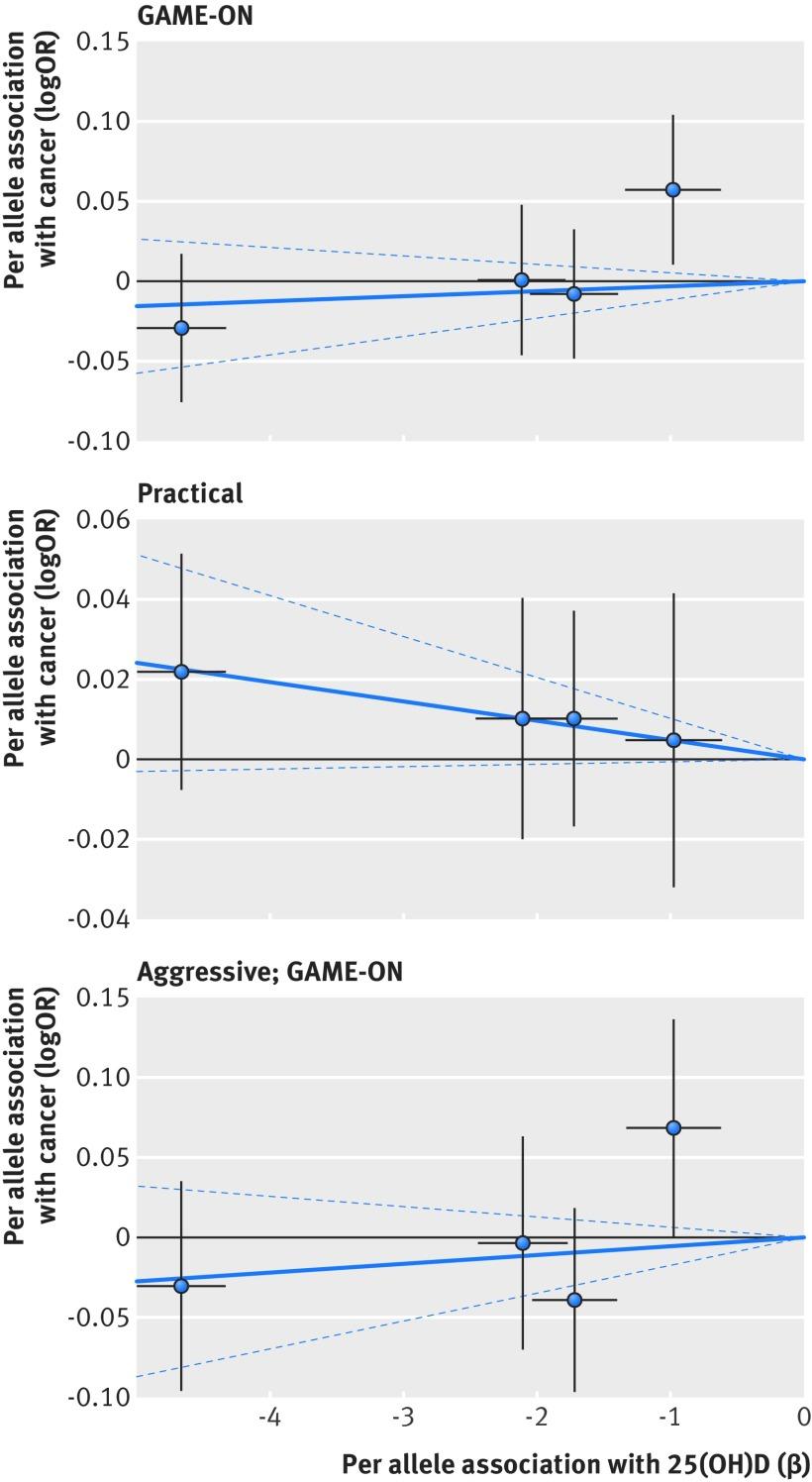
To determine if circulating concentrations of vitamin D are causally associated with risk of cancer. Mendelian randomisation study. Large genetic epidemiology networks (the Genetic Associations and Mechanisms in Oncology (GAME-ON), the Genetic and Epidemiology of Colorectal Cancer Consortium (GECCO), and the Prostate Cancer Association Group to Investigate Cancer Associated Alterations in the Genome (PRACTICAL) consortiums, and the MR-Base platform). 70 563 cases of cancer (22 898 prostate cancer, 15 748 breast cancer, 12 537 lung cancer, 11 488 colorectal cancer, 4369 ovarian cancer, 1896 pancreatic cancer, and 1627 neuroblastoma) and 84 418 controls. Four single nucleotide polymorphisms (rs2282679, rs10741657, rs12785878 and rs6013897) associated with vitamin D were used to define a multi-polymorphism score for circulating 25-hydroxyvitamin D (25(OH)D) concentrations. The primary outcomes were the risk of incident colorectal, breast, prostate, ovarian, lung, and pancreatic cancer and neuroblastoma, which was evaluated with an inverse variance weighted average of the associations with specific polymorphisms and a likelihood based approach. Secondary outcomes based on cancer subtypes by sex, anatomic location, stage, and histology were also examined. There was little evidence that the multi-polymorphism score of 25(OH)D was associated with risk of any of the seven cancers or their subtypes. Specifically, the odds ratios per 25 nmol/L increase in genetically determined 25(OH)D concentrations were 0.92 (95% confidence interval 0.76 to 1.10) for colorectal cancer, 1.05 (0.89 to 1.24) for breast cancer, 0.89 (0.77 to 1.02) for prostate cancer, and 1.03 (0.87 to 1.23) for lung cancer. The results were consistent with the two different analytical approaches, and the study was powered to detect relative effect sizes of moderate magnitude (for example, 1.20-1.50 per 25 nmol/L decrease in 25(OH)D for most primary cancer outcomes. The Mendelian randomisation assumptions did not seem to be violated. There is little evidence for a linear causal association between circulating vitamin D concentration and risk of various types of cancer, though the existence of causal clinically relevant effects of low magnitude cannot be ruled out. These results, in combination with previous literature, provide evidence that population-wide screening for vitamin D deficiency and subsequent widespread vitamin D supplementation should not currently be recommended as a strategy for primary cancer prevention.
确定循环中维生素D的浓度是否与癌症风险存在因果关系。孟德尔随机化研究。大型遗传流行病学网络(肿瘤学中的遗传关联和机制(GAME-ON)、结直肠癌联盟的遗传与流行病学(GECCO)、前列腺癌协会基因组癌症相关改变研究组(PRACTICAL)联盟以及MR-Base平台)。70563例癌症患者(22898例前列腺癌、15748例乳腺癌、12537例肺癌、11488例结直肠癌、4369例卵巢癌、1896例胰腺癌和1627例神经母细胞瘤)和84418名对照者。使用与维生素D相关的4个单核苷酸多态性(rs2282679、rs10741657、rs12785878和rs6013897)来定义循环25-羟基维生素D(25(OH)D)浓度的多态性评分。主要结局是结直肠癌、乳腺癌、前列腺癌、卵巢癌、肺癌、胰腺癌和神经母细胞瘤的发病风险,通过对特定多态性关联的逆方差加权平均值和基于似然性的方法进行评估。还检查了基于癌症亚型的性别、解剖位置、分期和组织学的次要结局。几乎没有证据表明25(OH)D的多态性评分与七种癌症及其亚型中的任何一种的风险相关。具体而言,遗传决定的25(OH)D浓度每增加25 nmol/L,结直肠癌的比值比为0.92(95%置信区间0.76至1.10),乳腺癌为1.05(0.89至1.24),前列腺癌为0.89(0.77至1.02),肺癌为1.03(0.87至1.23)。结果与两种不同的分析方法一致,该研究有能力检测中等程度的相对效应大小(例如,对于大多数原发性癌症结局,25(OH)D每降低25 nmol/L,效应大小为1.20 - 1.50)。孟德尔随机化假设似乎未被违反。几乎没有证据表明循环维生素D浓度与各种类型癌症的风险之间存在线性因果关系,尽管不能排除存在低程度因果临床相关效应的可能性。这些结果与先前的文献相结合,提供了证据表明目前不应推荐进行全人群维生素D缺乏筛查及随后广泛补充维生素D作为原发性癌症预防策略。




 Zotero 插件