
强制性运动疗法治疗急性和亚急性中风:16项随机对照试验的荟萃分析
Constraint-induced movement therapy in treatment of acute and sub-acute stroke: a meta-analysis of 16 randomized controlled trials.
作者信息
Liu Xi-Hua, Huai Juan, Gao Jie, Zhang Yang, Yue Shou-Wei
机构信息
Department of Physical Medicine & Rehabilitation, Qilu Hospital, Shandong University, Jinan, Shandong Province, China.
Department of Physical Medicine & Rehabilitation, The Affiliated Hospital of Shandong Traditional Chinese Medicine University, Jinan, Shandong Province, China.
出版信息
Neural Regen Res. 2017 Sep;12(9):1443-1450. doi: 10.4103/1673-5374.215255.
OBJECTIVE
The aim of this meta-analysis was to evaluate the clinical efficacy of constraint-induced movement therapy in acute and sub-acute stroke.
DATA SOURCES
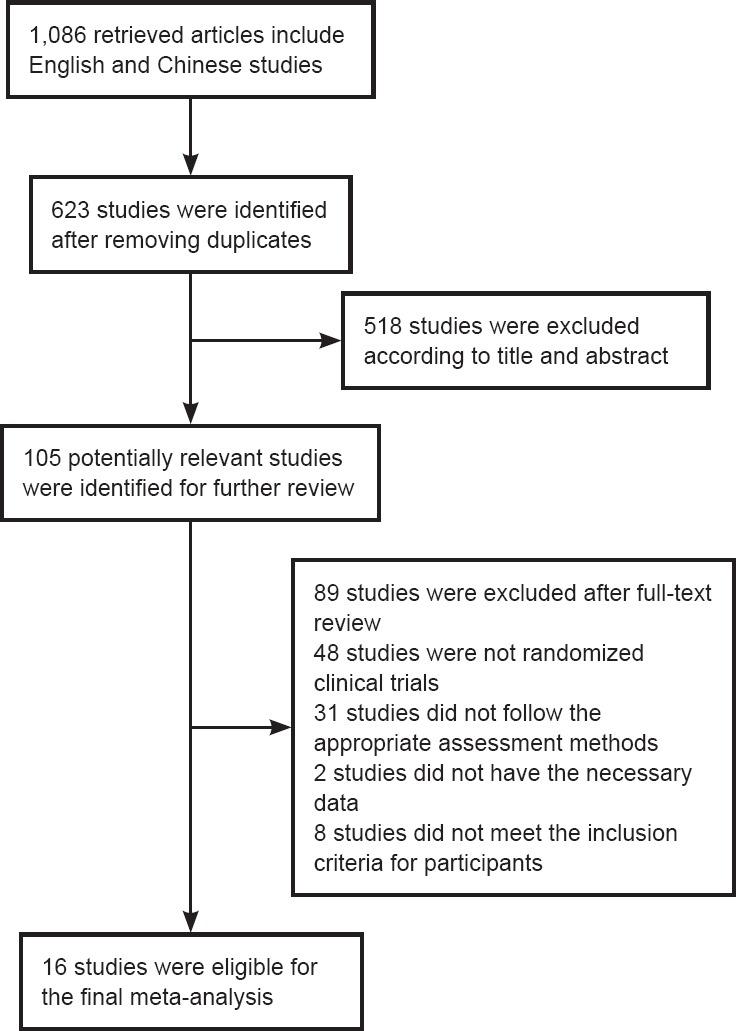
The key words were stroke, cerebrovascular accident, constraint-induced therapy, forced use, and randomized controlled trial. The databases, including China National Knowledge Infrastructure, WanFang, Weipu Information Resources System, Chinese Biomedical Literature Database, PubMed, Medline, Embase, the Cochrane Central Register of Controlled Trials, and the Cochrane Database of Systematic Reviews, were searched for studies on randomized controlled trials for treating acute or sub-acute stroke published before March 2016.
DATA SELECTION
We retrieved relevant randomized controlled trials that compared constraint-induced movement therapy in treatment of acute or sub-acute stroke with traditional rehabilitation therapy (traditional occupational therapy). Patients were older than 18 years, had disease courses less than 6 months, and were evaluated with at least one upper extremity function scale. Study quality was evaluated, and data that met the criteria were extracted. Stata 11.0 software was used for the meta-analysis.
OUTCOME MEASURES
Fugl-Meyer motor assessment of the arm, the action research-arm test, a motor activity log for amount of use and quality of movement, the Wolf motor function test, and a modified Barthel index.
RESULTS
A total of 16 prospective randomized controlled trials (379 patients in the constraint-induced movement-therapy group and 359 in the control group) met inclusion criteria. Analysis showed significant mean differences in favor of constraint-induced movement therapy for the Fugl-Meyer motor assessment of the arm (weighted mean difference () = 10.822; 95% confidence intervals (95% ): 7.419-14.226), the action research-arm test ( = 10.718; 95% : 5.704-15.733), the motor activity log for amount of use and quality of movement ( = 0.812; 95% : 0.331-1.293) and the modified Barthel index ( = 10.706; 95% : 4.417-16.966).
CONCLUSION
Constraint-induced movement therapy may be more beneficial than traditional rehabilitation therapy for improving upper limb function after acute or sub-acute stroke.
目的
本荟萃分析旨在评估强制性运动疗法对急性和亚急性脑卒中的临床疗效。
资料来源
检索词为脑卒中、脑血管意外、强制性运动疗法、强制使用和随机对照试验。检索中国知网、万方、维普资讯资源系统、中国生物医学文献数据库、PubMed、Medline、Embase、Cochrane对照试验中心注册库和Cochrane系统评价数据库,查找2016年3月以前发表的关于治疗急性或亚急性脑卒中的随机对照试验研究。
资料选择
检索相关随机对照试验,比较强制性运动疗法与传统康复疗法(传统作业疗法)治疗急性或亚急性脑卒中的效果。患者年龄大于18岁,病程小于6个月,且至少使用一种上肢功能量表进行评估。评估研究质量,提取符合标准的数据。采用Stata 11.0软件进行荟萃分析。
观察指标
上肢Fugl-Meyer运动评估、动作研究臂试验、使用量和运动质量的运动活动日志、Wolf运动功能测试以及改良Barthel指数。
结果
共有16项前瞻性随机对照试验(强制性运动疗法组379例患者和对照组359例患者)符合纳入标准。分析显示,在Fugl-Meyer上肢运动评估(加权均数差(WMD)=10.822;95%置信区间(CI):7.419-14.226)、动作研究臂试验(WMD=10.718;95%CI:5.704-15.733)、使用量和运动质量的运动活动日志(WMD=0.812;95%CI:0.331-1.293)以及改良Barthel指数(WMD=10.706;95%CI:4.417-16.966)方面,强制性运动疗法组均有显著的平均差异,结果支持强制性运动疗法。
结论
对于改善急性或亚急性脑卒中后的上肢功能,强制性运动疗法可能比传统康复疗法更有益。

 Zotero 插件