
城市化与2型糖尿病之间的关联:一项生态学研究。
Association between urbanisation and type 2 diabetes: an ecological study.
作者信息
Gassasse Zakariah, Smith Dianna, Finer Sarah, Gallo Valentina
机构信息
Centre for Primary Care and Public Health, Blizard Institute, Queen Mary University of London, London, UK.
Faculty of Geography, University of Southampton, Southampton, UK.
出版信息
BMJ Glob Health. 2017 Oct 23;2(4):e000473. doi: 10.1136/bmjgh-2017-000473. eCollection 2017.
INTRODUCTION
Previous studies have explored the effect of urbanisation on the prevalence of type 2 diabetes (T2D) at regional/national level. The aim of this study is to investigate the association between urbanisation and T2D at country level, worldwide, and to explore the role of intermediate variables (physical inactivity, sugar consumption and obesity). The potential effect modification of gross domestic product (GDP) was also assessed.
METHODS
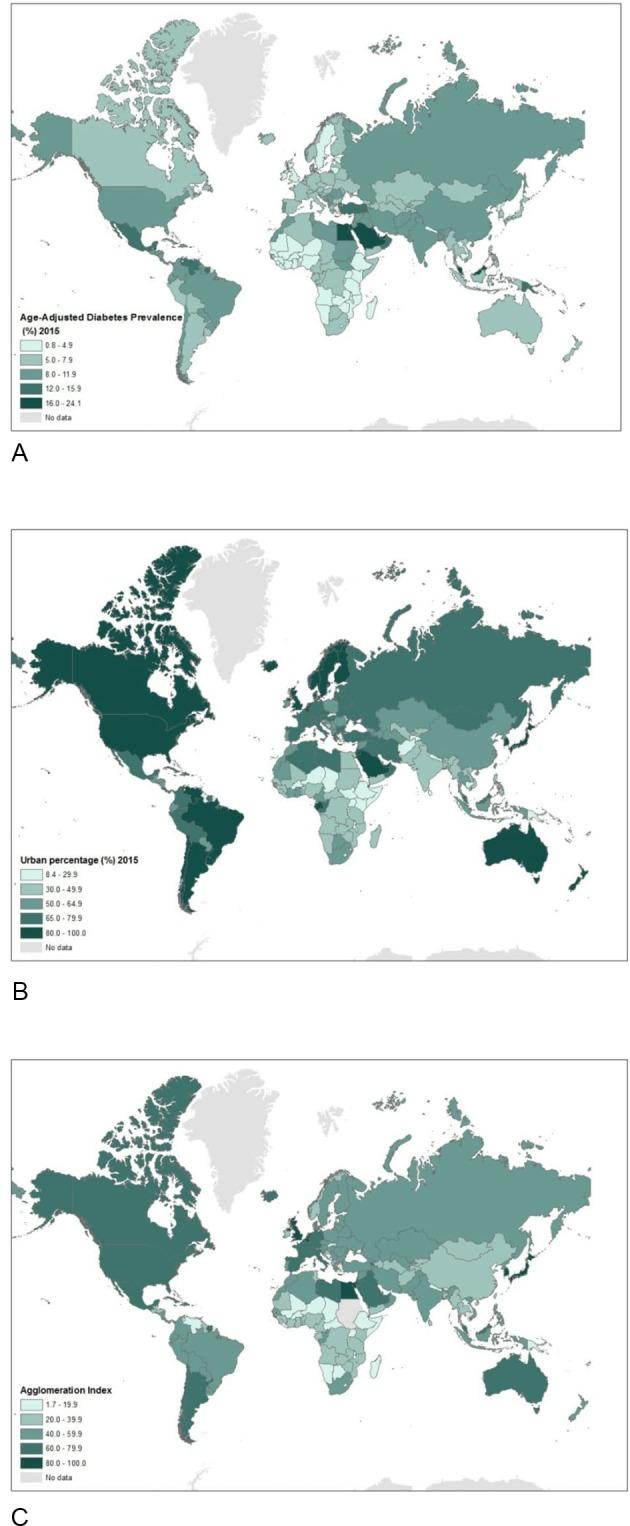
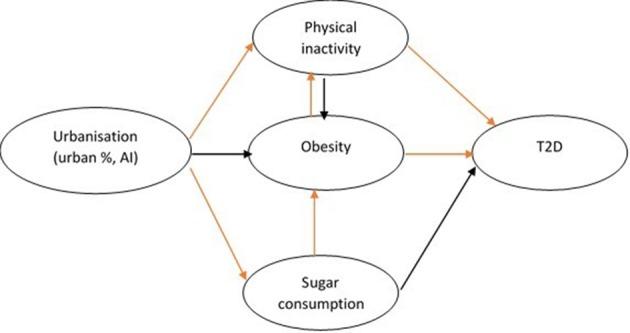
Data for 207 countries were collected from accessible datasets. Direct acyclic graphs were used to describe the association between urbanisation, T2D and their intermediate variables (physical inactivity, sugar consumption and obesity). Urbanisation was measured as urban percentage (UP) and as agglomeration index (AI). Crude and multivariate linear regression analyses were conducted to explore selected associations. The interaction between urbanisation and T2D across levels of GDP per capita was investigated.
RESULTS
The association between urbanisation and T2D diverged by exposure: AI was positively associated, while UP negatively associated with T2D prevalence. Physical inactivity and obesity were statistically significantly associated with increased prevalence of T2D. In middle-income countries (MIC) UP, AI and GDP were significantly associated with T2D prevalence, while in high-income countries (HIC), physical inactivity and obesity were the main determinant of T2D prevalence.
CONCLUSIONS
The type of urban growth, not urbanisation per se, predicted T2D prevalence at country level. In MIC, population density and GDP were the main determinant of diabetes, while in HIC. these were physical inactivity and obesity. Globalisation is playing an important role in the rise of T2D worldwide.
引言
以往研究在区域/国家层面探讨了城市化对2型糖尿病(T2D)患病率的影响。本研究旨在调查全球国家层面城市化与T2D之间的关联,并探讨中间变量(缺乏身体活动、糖摄入量和肥胖)的作用。还评估了国内生产总值(GDP)的潜在效应修正作用。
方法
从可获取的数据集中收集了207个国家的数据。使用直接无环图来描述城市化、T2D及其中间变量(缺乏身体活动、糖摄入量和肥胖)之间的关联。城市化用城市人口百分比(UP)和集聚指数(AI)来衡量。进行了粗线性回归和多变量线性回归分析以探索选定的关联。研究了城市化与T2D在人均GDP水平上的相互作用。
结果
城市化与T2D之间的关联因暴露因素而异:AI与T2D患病率呈正相关,而UP与T2D患病率呈负相关。缺乏身体活动和肥胖与T2D患病率增加在统计学上显著相关。在中等收入国家(MIC),UP、AI和GDP与T2D患病率显著相关,而在高收入国家(HIC),缺乏身体活动和肥胖是T2D患病率的主要决定因素。
结论
城市增长类型而非城市化本身,在国家层面预测了T2D患病率。在中等收入国家,人口密度和GDP是糖尿病的主要决定因素,而在高收入国家,这些因素是缺乏身体活动和肥胖。全球化在全球T2D的上升中发挥着重要作用。
 Zotero 插件