
采用液体反溶剂沉淀技术制备芹菜素纳米粒、对其进行表征及抗肿瘤活性评价
Preparation, characterization and antitumor activity evaluation of apigenin nanoparticles by the liquid antisolvent precipitation technique.
作者信息
Wu Weiwei, Zu Yuangang, Wang Li, Wang Lingling, Wang Huimei, Li Yuanyuan, Wu Mingfang, Zhao Xiuhua, Fu Yujie
机构信息
a Key Laboratory of Saline-alkali Vegetation Ecology Restoration in Oil Field (SAVER), Ministry of Education , Alkali Soil Natural Environmental Science Center (ASNESC), Northeast Forestry University , Harbin , China.
b Key Laboratory of Forest Plant Ecology , Northeast Forestry University, Ministry of Education , Harbin , China.
出版信息
Drug Deliv. 2017 Nov;24(1):1713-1720. doi: 10.1080/10717544.2017.1399302.
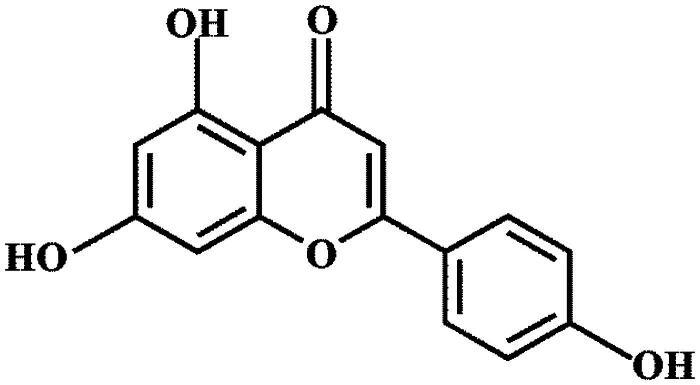
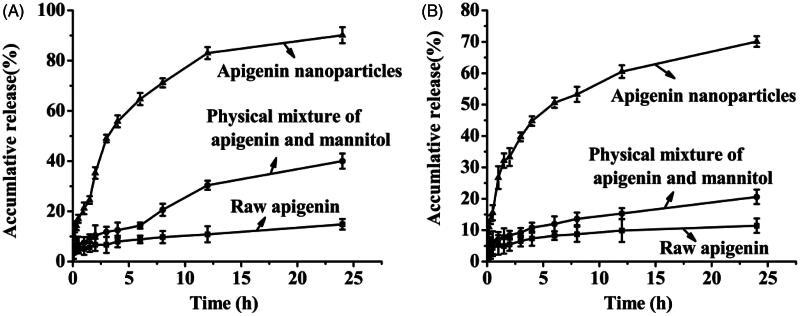
The present work aimed to apply the liquid antisolvent precipitation (LAP) method for preparing the apigenin nanoparticles and thereby improving the solubility and bioavailability of apigenin. The different experimental parameters on particle size were optimized through central composite design (CCD) using the Design-Expert software. Under the optimum conditions, the particle size of the apigenin nanosuspension was about 159.2 nm. In order to get apigenin nanoparticles, the freeze-drying method was selected and the mannitol was used as a cryoprotectant. Then the solid state properties of the apigenin nanoparticles were investigated using scanning electron microscopy (SEM), differential scanning calorimetry (DSC), thermo gravimetric (TG), and X-ray diffraction (XRD). The results obtained displayed that the apigenin nanoparticles exhibited near-spherical shape and could be transformed into an amorphous form. In addition, the dissolving test, the bioavailability in rats, and the antitumor activity were also studied. The experimental results showed that the solubility of the apigenin nanoparticles were about 29.61 times and 64.81 times of raw apigenin in artificial gastric juice and in artificial intestinal juice, respectively, and the apigenin nanoparticles showed higher dissolution rates compared to raw apigenin, and was about 6.08 times and 6.14 times than that of raw apigenin in artificial gastric juice and in artificial intestinal juice. The oral bioavailability of apigenin nanoparticles was about 4.96 times higher than that of the raw apigenin, but the apigenin nanoparticles had no toxic effect on the organs of rats. In addition, the apigenin nanoparticles had a higher inhibition to HepG2 cells by lower IC50 than that of raw apigenin.
本研究旨在应用液相抗溶剂沉淀法(LAP)制备芹菜素纳米颗粒,从而提高芹菜素的溶解度和生物利用度。通过使用Design-Expert软件的中心复合设计(CCD)对影响粒径的不同实验参数进行优化。在最佳条件下,芹菜素纳米混悬液的粒径约为159.2 nm。为了得到芹菜素纳米颗粒,选择冷冻干燥法并使用甘露醇作为冷冻保护剂。然后使用扫描电子显微镜(SEM)、差示扫描量热法(DSC)、热重分析法(TG)和X射线衍射法(XRD)对芹菜素纳米颗粒的固态性质进行研究。所得结果显示芹菜素纳米颗粒呈近球形,且可转变为无定形形式。此外,还研究了其溶出度试验、在大鼠体内的生物利用度以及抗肿瘤活性。实验结果表明,芹菜素纳米颗粒在人工胃液和人工肠液中的溶解度分别约为芹菜素原料药的29.61倍和64.81倍,且与芹菜素原料药相比,芹菜素纳米颗粒的溶出速率更高,在人工胃液和人工肠液中分别约为芹菜素原料药的6.08倍和6.14倍。芹菜素纳米颗粒的口服生物利用度比芹菜素原料药高约4.96倍,但对大鼠器官无毒性作用。此外,芹菜素纳米颗粒对HepG2细胞的抑制作用更强,其IC50低于芹菜素原料药。



 Zotero 插件