
队列资料简介:荷兰炎症性肠病生物库的设计和初步结果:一项前瞻性、全国性的炎症性肠病患者生物库。
Cohort profile: design and first results of the Dutch IBD Biobank: a prospective, nationwide biobank of patients with inflammatory bowel disease.
机构信息
Department of Gastroenterology and Hepatology, University of Groningen and Medical Center Groningen, Groningen, The Netherlands.
Department of Genetics, University of Groningen and University Medical Center Groningen, Groningen, The Netherlands.
出版信息
BMJ Open. 2017 Nov 8;7(11):e016695. doi: 10.1136/bmjopen-2017-016695.
PURPOSE
The Dutch IBD Biobank aims to facilitate the discovery of predictors for individual disease course and treatment response in patients with inflammatory bowel disease (IBD). In this paper, we aim to describe the establishment of the Dutch IBD Biobank, including the facilitators and barriers to establishment. Moreover, we aim to provide a complete overview of the content of the Dutch IBD Biobank.
PARTICIPANTS
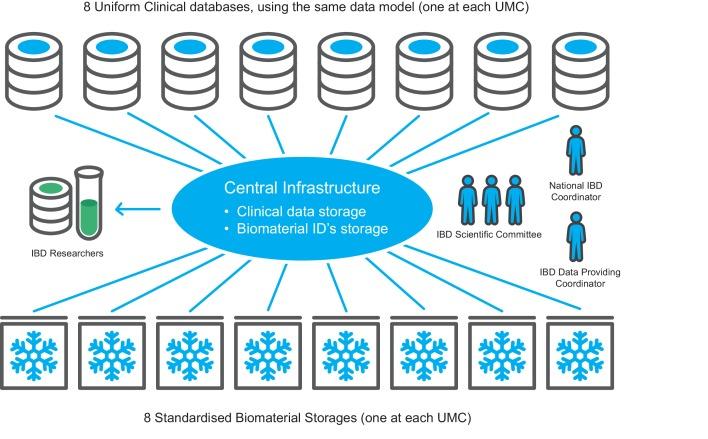
Since 2007, every patient with IBD treated in one of the eight Dutch university medical centres is asked to participate in the Dutch IBD Biobank in which 225 standardised IBD-related data items and biomaterials, such as serum, DNA, biopsies and a stool sample, are collected.
FINDINGS TO DATE
As of June 2014, the Dutch IBD Biobank had enrolled 3388 patients with IBD: 2118 Crohn's disease (62.5%), 1190 ulcerative colitis (35.1%), 74 IBD-unclassified (2.2%) and 6 IBD-indeterminate (0.2%). The inclusion of patients with IBD is ongoing. The quality of the biomaterials is good and serum, DNA and biopsies have been used in newly published studies.
FUTURE PLANS
The genotyping (750 000 genetic variants) of all participants of the Dutch IBD Biobank is currently ongoing, enabling more genetic research. In addition, all participants will start reporting disease activity and outcome measures using an online platform and mobile .
目的
荷兰炎症性肠病生物库旨在促进发现炎症性肠病(IBD)患者个体疾病进程和治疗反应的预测因子。本文旨在描述荷兰炎症性肠病生物库的建立,包括建立的促进因素和障碍。此外,我们旨在提供荷兰炎症性肠病生物库内容的完整概述。
参与者
自 2007 年以来,在荷兰八所大学医疗中心之一接受治疗的每位 IBD 患者都被要求参与荷兰炎症性肠病生物库,该生物库收集了 225 个标准化的 IBD 相关数据项和生物材料,如血清、DNA、活检和粪便样本。
截至 2014 年 6 月,荷兰炎症性肠病生物库已招募了 3388 名 IBD 患者:2118 名克罗恩病(62.5%)、1190 名溃疡性结肠炎(35.1%)、74 名 IBD 未分类(2.2%)和 6 名 IBD 不确定(0.2%)。IBD 患者的纳入仍在进行中。生物材料的质量良好,血清、DNA 和活检已用于新发表的研究中。
未来计划
目前正在对荷兰炎症性肠病生物库的所有参与者进行基因分型(750000 个遗传变异),从而能够进行更多的遗传研究。此外,所有参与者将开始使用在线平台和移动设备报告疾病活动和结果测量。


 Zotero 插件