
伴有淋巴结肿大的不明原因发热的罕见病因——复发性多软骨炎:一例报告
An unusual cause of fever of unknown origin with enlarged lymph nodes-relapsing polychondritis: A case report.
作者信息
Liu Wei, Jiang Hongli, Jing Han, Mao Bing
机构信息
Division of Respiratory Medicine, Department of Integrated Traditional Chinese and Western Medicine, West China Hospital, Sichuan University, Chengdu, Sichuan, People's Republic of China.
出版信息
Medicine (Baltimore). 2017 Nov;96(46):e8734. doi: 10.1097/MD.0000000000008734.
INTRODUCTION
Fever of unknown origin (FUO) is a common initial presentation leading to a diagnostic challenge.
PATIENT CONCERNS
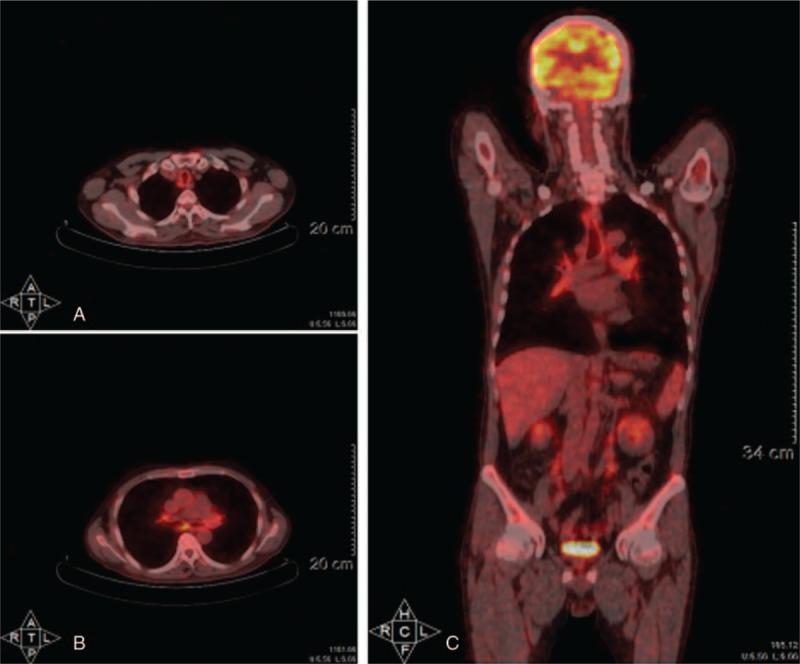
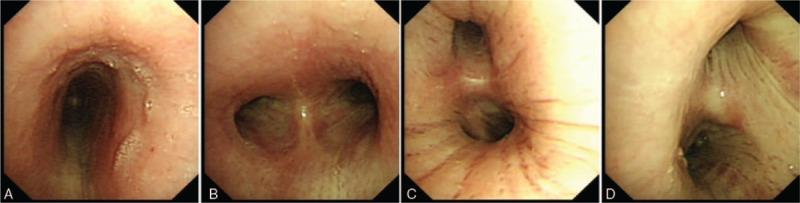
A 3-month history of moderate-to-high fever was reported in an otherwise healthy 54-year-old man. Enhanced computed tomography (CT) scans of his chest showed a remarkable progressive enlargement of bilateral cervical, supraclavicular, hilar, and mediastinal lymph nodes within 2 weeks. Bronchofibroscopy manifested obvious luminal stenosis with swelling, thick pale mucosa, and disappearing of structures of trachea cricoid cartilage, followed by a 18F-fluorodeoxyglucose positron-emission tomography-computed tomography (18F-FDG PET/CT) with intense symmetric FDG uptake in larynx, tracheobronchial tree, and hilar, mediastinal, and axillary lymph nodes being demonstrated.
DIAGNOSIS
A diagnosis of relapsing polychondritis (RP) was finally reached.
INTERVENTIONS
The patient received methylprednisolone 40 mg daily with a gradual tapering in a 4-month follow-up.
OUTCOMES
The patient experienced no relapse of fever and lymph nodes enlargement in the 4-month follow-up.
LESSONS
Even though long-term fever with multiple lymphadenectasis usually lead to a diagnosis of lymphoma, the bronchoscopic features and evidence from 18F-FDG PET/CT in this case were much more approximate to RP, indicating an importance of a sensible differential diagnosis of RP in patients who present with nonspecific features such as FUO and lymph nodes enlargement. Keeping a high index of clinical suspicion in these patients can help recognize uncommon of RP and promote diagnosis and treatment. Our case highlights the significance of 18F-FDG PET/CT in helping reaching the diagnosis of RP in this condition. This report provides new data regarding the diagnostic difficulties of this rare type of autoimmune disease, and further investigations are needed as cases accumulate.
引言
不明原因发热(FUO)是一种常见的初始表现,会带来诊断挑战。
患者情况
一名54岁健康男性报告有3个月的中度至高热病史。他胸部的增强计算机断层扫描(CT)显示,双侧颈部、锁骨上、肺门和纵隔淋巴结在2周内显著进行性肿大。支气管纤维镜检查显示管腔明显狭窄,伴有肿胀、苍白增厚的黏膜,气管环状软骨结构消失,随后进行的18F-氟脱氧葡萄糖正电子发射断层扫描-计算机断层扫描(18F-FDG PET/CT)显示喉部、气管支气管树以及肺门、纵隔和腋窝淋巴结有强烈对称的FDG摄取。
诊断
最终诊断为复发性多软骨炎(RP)。
干预措施
患者每天接受40毫克甲泼尼龙治疗,并在4个月的随访中逐渐减量。
结果
患者在4个月的随访中未出现发热复发和淋巴结肿大。
经验教训
尽管长期发热伴多处淋巴结肿大通常会导致淋巴瘤的诊断,但该病例的支气管镜特征和18F-FDG PET/CT的证据更符合RP,这表明对于出现FUO和淋巴结肿大等非特异性特征的患者,合理鉴别诊断RP很重要。对这些患者保持高度的临床怀疑有助于识别罕见的RP,并促进诊断和治疗。我们的病例突出了18F-FDG PET/CT在帮助诊断这种情况下的RP的重要性。本报告提供了关于这种罕见自身免疫性疾病诊断困难的新数据,随着病例积累,需要进一步研究。

 Zotero 插件