
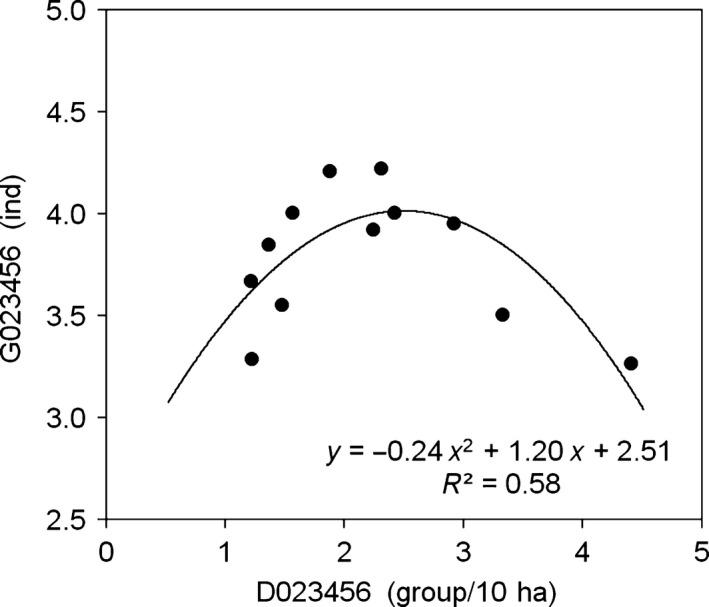
一种群居性繁殖雀形目鸟类中,长期平均群体大小与群体密度之间的二次相关性。
A quadratic correlation between long-term mean group size and group density in a cooperatively breeding passerine.
作者信息
Ke Dian-Hua, Deng Yan-Hui, Guo Wei-Bin, Huang Zu-Hao
机构信息
School of Life Sciences Jinggangshan University Ji'An China.
Library of Jinggangshan University Jinggangshan University Ji'An China.
出版信息
Ecol Evol. 2017 Sep 18;7(21):8719-8729. doi: 10.1002/ece3.3405. eCollection 2017 Nov.
Both mean group size (MGS) and mean group density (MGD) are critical indices to characterize a population of cooperatively breeding birds. When a population reaches its carrying capacity, both long-term MGS and long-term MGD will remain relatively stable. However, there has been little study of how these two variables relate. The Masked laughingthrush is a cooperatively breeding bird living in fragmented habitats. During 2010 and 2012-2016, we used song playback to observe and confirm the group sizes and territory ranges of the birds and the data of bird presence to determine habitat suitability. By grouping the nearest territories according to their geographical coordinates, we divided the whole study area into 12 subareas and the whole population into 12 subpopulations. Then, we calculated both MGS and MGD for different time durations for each subpopulation. Finally, using MGD as independent variable and MGS as the dependent variable, we explored the correlations between MGS and MGD by fitting quadratic functions and modeling quadratic regression. Both MGS and MGD were averaged for different time durations and were cross-related. Our results show that the MGS for more than 2 years significantly correlated with MGD for more than 3 years in a reverse parabolic shape, differing from that of short-term effects. Our findings suggest that long-term MGD is a better predictor of long-term habitat quality and that long-term MGS is determined by long-term habitat quality in Masked Laughingthrushes. Based on above findings, we can infer that: (1) Long-term habitat quality determines the long-term MGS, but it sets no prerequisite for the status and source of group members; (2) Long-term MGS in certain populations is adapted to the corresponding level of long-term habitat quality, it facilitates us to predict the helper effects on current or future survival or reproduction in different situations. These findings and inferences are both helpful for us to understand the evolution of cooperative breeding.
平均群体大小(MGS)和平均群体密度(MGD)都是表征合作繁殖鸟类种群的关键指标。当一个种群达到其承载能力时,长期的MGS和长期的MGD都将保持相对稳定。然而,关于这两个变量之间的关系却鲜有研究。黑脸噪鹛是一种生活在破碎化栖息地的合作繁殖鸟类。在2010年以及2012 - 2016年期间,我们使用鸣声回放来观察并确认鸟类的群体大小和领地范围,并利用鸟类出现的数据来确定栖息地适宜性。通过根据地理坐标对最近的领地进行分组,我们将整个研究区域划分为12个子区域,将整个种群划分为12个子种群。然后,我们计算了每个子种群在不同时间段的MGS和MGD。最后,以MGD为自变量,MGS为因变量,通过拟合二次函数和建立二次回归模型来探究MGS与MGD之间的相关性。对不同时间段的MGS和MGD进行平均并进行交叉关联分析。我们的结果表明,超过2年的MGS与超过3年的MGD呈显著的反向抛物线形相关,这与短期效应不同。我们的研究结果表明,长期的MGD是长期栖息地质量的更好预测指标,并且长期的MGS由黑脸噪鹛的长期栖息地质量决定。基于上述发现,我们可以推断:(1)长期栖息地质量决定长期MGS,但对群体成员的身份和来源没有设定前提条件;(2)特定种群中的长期MGS适应相应水平的长期栖息地质量,这有助于我们预测在不同情况下帮手对当前或未来生存或繁殖的影响。这些发现和推断都有助于我们理解合作繁殖的进化。


 Zotero 插件