
错配修复缺陷对结直肠癌免疫微环境的影响。
Impact of mismatch-repair deficiency on the colorectal cancer immune microenvironment.
作者信息
Zhang Yingyi, Sun Zhao, Mao Xinxin, Wu Huanwen, Luo Fei, Wu Xi, Zhou Liangrui, Qin Jing, Zhao Lin, Bai Chunmei
机构信息
Department of Oncology, Peking Union Medical College Hospital, Chinese Academy of Medical Sciences and Peking Union Medical College, Beijing, People's Republic of China.
Department of Pathology, Peking Union Medical College Hospital, Chinese Academy of Medical Sciences and Peking Union Medical College, Beijing, People's Republic of China.
出版信息
Oncotarget. 2017 Aug 14;8(49):85526-85536. doi: 10.18632/oncotarget.20241. eCollection 2017 Oct 17.
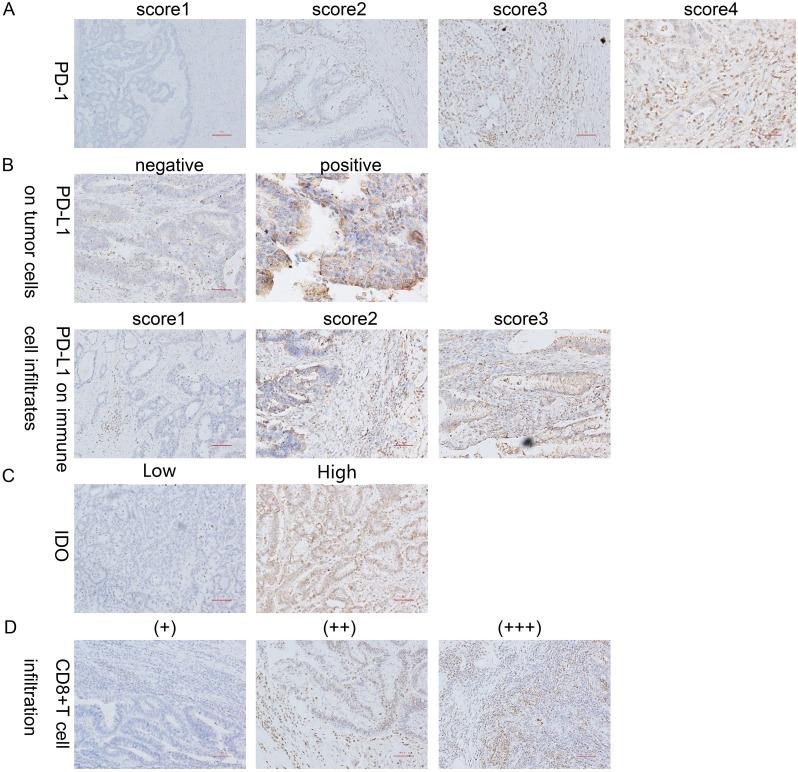
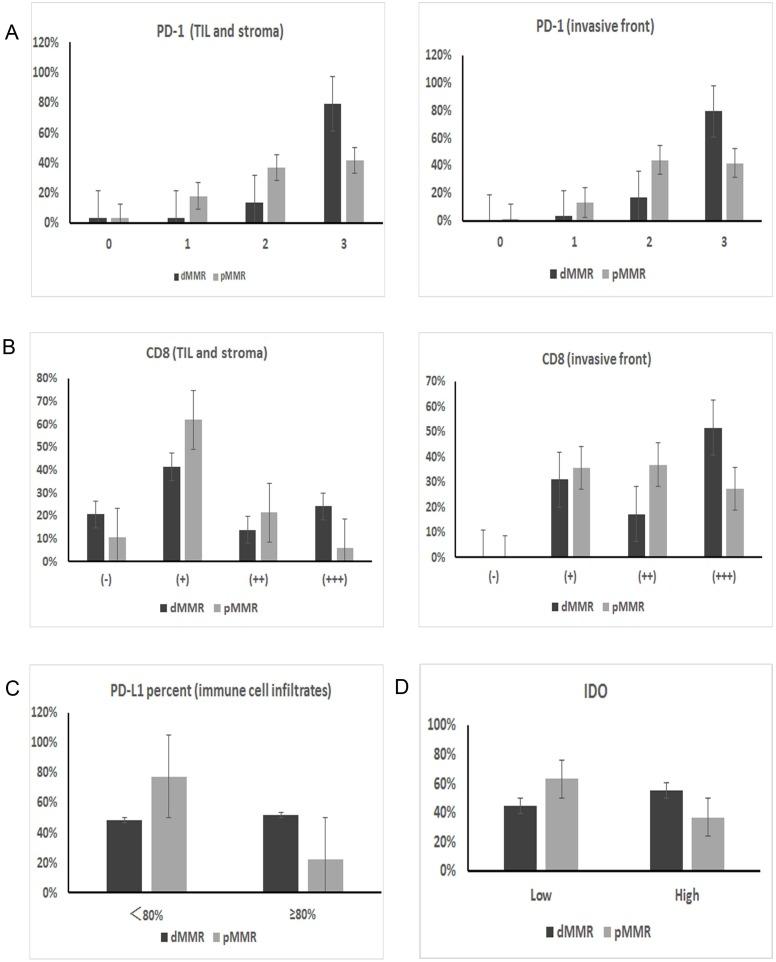
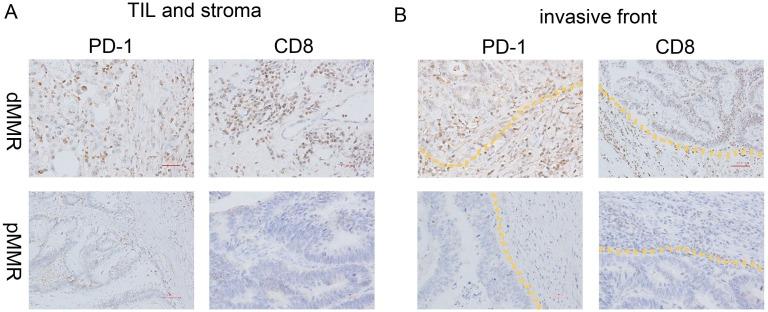
Colorectal cancer patients respond inconsistently to immunotherapies, likely due to the immune microenvironments around their tumors. We analyzed the relationship between deficient mismatch repair (dMMR) and the colorectal cancer immune microenvironment to identify predictors of effective immunotherapy. Colorectal cancer patients (n=113) who had undergone surgical resection were divided into dMMR and proficient mismatch repair (pMMR) groups. The levels of immune checkpoint proteins, including programmed cell death 1 (PD-1), programmed cell death 1 ligand 1 (PD-L1), indoleamine 2,3 dioxygenase and CD8 were assessed immunohistochemically. The percentage of tumor-infiltrating lymphocytes strongly positive for PD-1 (score=3) was higher in the dMMR than pMMR group (79.3% vs. 41.7%; p=0.003). The groups showed similar tumor cell PD-L1 positivity rates (34.5% vs. 35.7%, p=0.905) and PD-L1 intensity levels on immune cell infiltrates (86.2% vs. 84.5%, p=0.964). However, when a cut-off value of 80% was used for PD-L1 positivity, the rate of PD-L1 positivity on immune cell infiltrates differed between the groups (51.7% vs. 22.6%, p=0.003). The rate of high indoleamine 2,3 dioxygenase expression was greater in the dMMR than pMMR group (55.2% vs. 36.9%, p=0.026). CD8+ T cells were elevated in the dMMR group in both compartments (p=0.017 for tumor-infiltrating lymphocytes and stroma; p=0.038 for invasive front). Thus the immune microenvironment of dMMR colorectal cancer differs from that of pMMR colorectal cancer.
结直肠癌患者对免疫疗法的反应不一致,这可能归因于其肿瘤周围的免疫微环境。我们分析了错配修复缺陷(dMMR)与结直肠癌免疫微环境之间的关系,以确定有效免疫治疗的预测指标。将113例行手术切除的结直肠癌患者分为dMMR组和错配修复功能正常(pMMR)组。采用免疫组化法评估免疫检查点蛋白水平,包括程序性死亡蛋白1(PD-1)、程序性死亡蛋白1配体1(PD-L1)、吲哚胺2,3-双加氧酶和CD8。dMMR组中PD-1强阳性(评分=3)的肿瘤浸润淋巴细胞百分比高于pMMR组(79.3%对41.7%;p=0.003)。两组的肿瘤细胞PD-L1阳性率相似(34.5%对35.7%,p=0.905),免疫细胞浸润上的PD-L1强度水平也相似(86.2%对84.5%,p=0.964)。然而,当将PD-L1阳性的临界值设定为80%时,两组免疫细胞浸润上的PD-L1阳性率有所不同(51.7%对22.6%,p=0.003)。dMMR组中吲哚胺2,3-双加氧酶高表达率高于pMMR组(55.2%对36.9%,p=0.026)。dMMR组两个区域的CD8+T细胞均升高(肿瘤浸润淋巴细胞和基质中p=0.017;浸润前沿中p=0.038)。因此,dMMR结直肠癌的免疫微环境与pMMR结直肠癌不同。

 Zotero 插件