
糖尿病与活动性肺结核之间的关联:一项系统评价与荟萃分析。
Association between diabetes mellitus and active tuberculosis: A systematic review and meta-analysis.
作者信息
Al-Rifai Rami H, Pearson Fiona, Critchley Julia A, Abu-Raddad Laith J
机构信息
Infectious Disease Epidemiology Group, Weill Cornell Medical College-Qatar, Cornell University, Qatar Foundation-Education City, Doha, Qatar.
Department of Healthcare Policy and Research, Weill Cornell Medical College, Cornell University, New York, New York, United States of America.
出版信息
PLoS One. 2017 Nov 21;12(11):e0187967. doi: 10.1371/journal.pone.0187967. eCollection 2017.
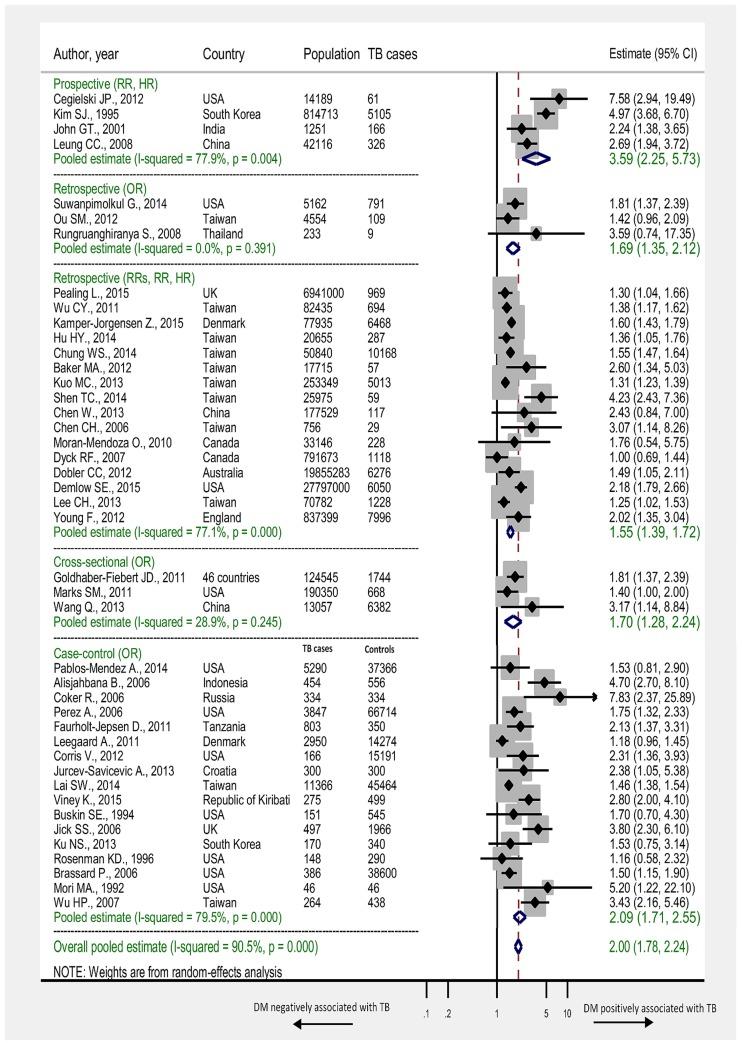
The burgeoning epidemic of diabetes mellitus (DM) is one of the major global health challenges. We systematically reviewed the published literature to provide a summary estimate of the association between DM and active tuberculosis (TB). We searched Medline and EMBASE databases for studies reporting adjusted estimates on the TB-DM association published before December 22, 2015, with no restrictions on region and language. In the meta-analysis, adjusted estimates were pooled using a DerSimonian-Laird random-effects model, according to study design. Risk of bias assessment and sensitivity analyses were conducted. 44 eligible studies were included, which consisted of 58,468,404 subjects from 16 countries. Compared with non-DM patients, DM patients had 3.59-fold (95% confidence interval (CI) 2.25-5.73), 1.55-fold (95% CI 1.39-1.72), and 2.09-fold (95% CI 1.71-2.55) increased risk of active TB in four prospective, 16 retrospective, and 17 case-control studies, respectively. Country income level (3.16-fold in low/middle-vs. 1.73-fold in high-income countries), background TB incidence (2.05-fold in countries with >50 vs. 1.89-fold in countries with ≤50 TB cases per 100,000 person-year), and geographical region (2.44-fold in Asia vs. 1.71-fold in Europe and 1.73-fold in USA/Canada) affected appreciably the estimated association, but potential risk of bias, type of population (general versus clinical), and potential for duplicate data, did not. Microbiological ascertainment for TB (3.03-fold) and/or blood testing for DM (3.10-fold), as well as uncontrolled DM (3.30-fold), resulted in stronger estimated association. DM is associated with a two- to four-fold increased risk of active TB. The association was stronger when ascertainment was based on biological testing rather than medical records or self-report. The burgeoning DM epidemic could impact upon the achievements of the WHO "End TB Strategy" for reducing TB incidence.
糖尿病(DM)的迅速流行是全球主要的健康挑战之一。我们系统地回顾了已发表的文献,以提供DM与活动性肺结核(TB)之间关联的汇总估计。我们检索了Medline和EMBASE数据库,以查找2015年12月22日之前发表的报告TB-DM关联调整估计值的研究,对地区和语言没有限制。在荟萃分析中,根据研究设计,使用DerSimonian-Laird随机效应模型汇总调整后的估计值。进行了偏倚风险评估和敏感性分析。纳入了44项符合条件的研究,这些研究包括来自16个国家的58,468,404名受试者。与非DM患者相比,在四项前瞻性研究、16项回顾性研究和17项病例对照研究中,DM患者发生活动性TB的风险分别增加了3.59倍(95%置信区间(CI)2.25-5.73)、1.55倍(95%CI 1.39-1.72)和2.09倍(95%CI 1.71-2.55)。国家收入水平(低收入/中等收入国家为3.16倍,高收入国家为1.73倍)、背景TB发病率(每10万人年TB病例>50例的国家为2.05倍,每10万人年TB病例≤50例的国家为1.89倍)和地理区域(亚洲为2.44倍,欧洲为1.71倍,美国/加拿大为1.73倍)对估计的关联有明显影响,但潜在的偏倚风险、人群类型(一般人群与临床人群)和重复数据的可能性则没有影响。TB的微生物学确诊(3.03倍)和/或DM的血液检测(3.10倍),以及未控制的DM(3.30倍),导致估计的关联更强。DM与活动性TB风险增加两到四倍相关。当基于生物学检测而非医疗记录或自我报告进行确诊时,这种关联更强。糖尿病的迅速流行可能会影响世界卫生组织“终止结核病战略”在降低结核病发病率方面所取得的成果。

 Zotero 插件