
表达和切割中东呼吸综合征冠状病毒 nsp3-4 多蛋白可诱导形成双层囊泡,这些囊泡模拟与冠状病毒 RNA 复制相关的囊泡。
Expression and Cleavage of Middle East Respiratory Syndrome Coronavirus nsp3-4 Polyprotein Induce the Formation of Double-Membrane Vesicles That Mimic Those Associated with Coronaviral RNA Replication.
机构信息
Molecular Virology Laboratory, Department of Medical Microbiology, Leiden University Medical Center, Leiden, The Netherlands.
Section Electron Microscopy, Department of Molecular Cell Biology, Leiden University Medical Center, Leiden, The Netherlands.
出版信息
mBio. 2017 Nov 21;8(6):e01658-17. doi: 10.1128/mBio.01658-17.
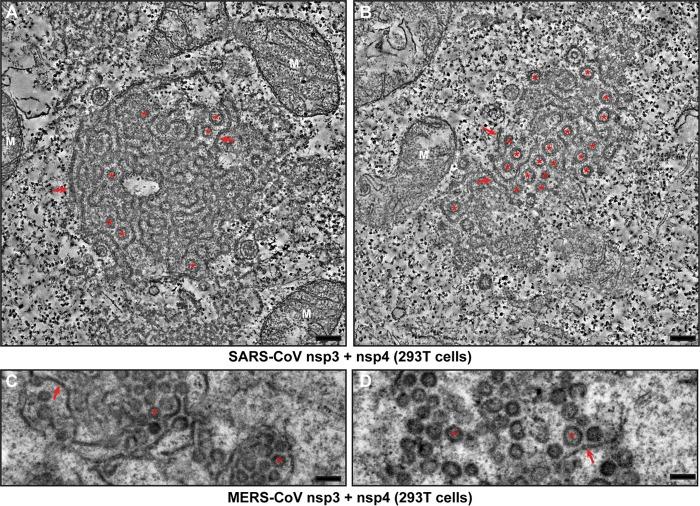
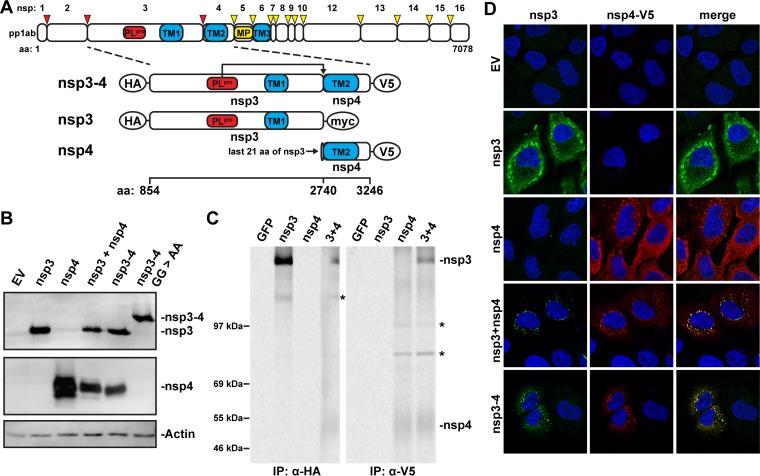
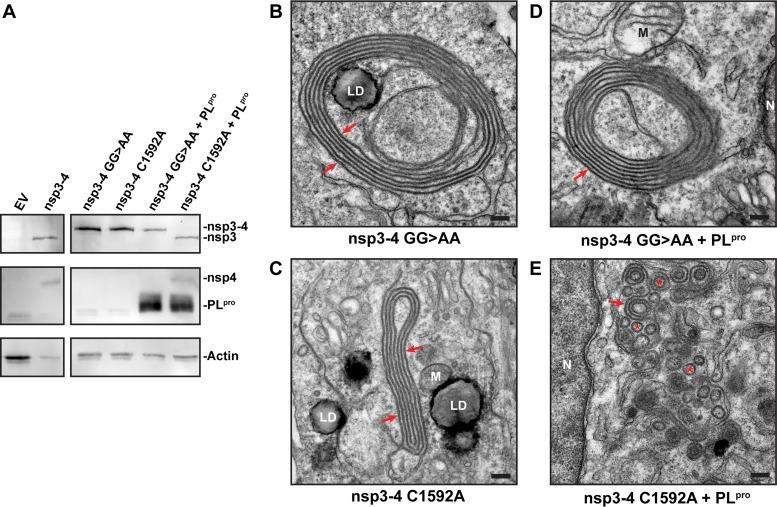
Betacoronaviruses, such as Middle East respiratory syndrome coronavirus (MERS-CoV), are important pathogens causing potentially lethal infections in humans and animals. Coronavirus RNA synthesis is thought to be associated with replication organelles (ROs) consisting of modified endoplasmic reticulum (ER) membranes. These are transformed into double-membrane vesicles (DMVs) containing viral double-stranded RNA and into other membranous elements such as convoluted membranes, together forming a reticulovesicular network. Previous evidence suggested that the nonstructural proteins (nsp's) 3, 4, and 6 of the severe acute respiratory syndrome coronavirus (SARS-CoV), which contain transmembrane domains, would all be required for DMV formation. We have now expressed MERS-CoV replicase self-cleaving polyprotein fragments encompassing nsp3-4 or nsp3-6, as well as coexpressed nsp3 and nsp4 of either MERS-CoV or SARS-CoV, to characterize the membrane structures induced. Using electron tomography, we demonstrate that for both MERS-CoV and SARS-CoV coexpression of nsp3 and nsp4 is required and sufficient to induce DMVs. Coexpression of MERS-CoV nsp3 and nsp4 either as individual proteins or as a self-cleaving nsp3-4 precursor resulted in very similar DMVs, and in both setups we observed proliferation of zippered ER that appeared to wrap into nascent DMVs. Moreover, when inactivating nsp3-4 polyprotein cleavage by mutagenesis, we established that cleavage of the nsp3/nsp4 junction is essential for MERS-CoV DMV formation. Addition of the third MERS-CoV transmembrane protein, nsp6, did not noticeably affect DMV formation. These findings provide important insight into the biogenesis of coronavirus DMVs, establish strong similarities with other nidoviruses (specifically, the arteriviruses), and highlight possible general principles in viral DMV formation. The RNA replication of positive stranded RNA viruses of eukaryotes is thought to take place at cytoplasmic membranous replication organelles (ROs). Double-membrane vesicles are a prominent type of viral ROs. They are induced by coronaviruses, such as SARS-CoV and MERS-CoV, as well as by a number of other important pathogens, yet little is known about their biogenesis. In this study, we explored the viral protein requirements for the formation of MERS-CoV- and SARS-CoV-induced DMVs and established that coexpression of two of the three transmembrane subunits of the coronavirus replicase polyprotein, nonstructural proteins (nsp's) 3 and 4, is required and sufficient to induce DMV formation. Moreover, release of nsp3 and nsp4 from the polyprotein by proteolytic maturation is essential for this process. These findings provide a strong basis for further research on the biogenesis and functionality of coronavirus ROs and may point to more general principles of viral DMV formation.
贝塔冠状病毒,如中东呼吸综合征冠状病毒(MERS-CoV),是导致人类和动物潜在致命感染的重要病原体。冠状病毒的 RNA 合成被认为与由修饰的内质网(ER)膜组成的复制细胞器(RO)有关。这些转化为含有病毒双链 RNA 的双膜囊泡(DMVs),以及其他膜元件,如盘旋膜,共同形成网状囊泡网络。先前的证据表明,严重急性呼吸综合征冠状病毒(SARS-CoV)的非结构蛋白(nsp's)3、4 和 6 都包含跨膜结构域,对于 DMV 的形成都是必需的。我们现在已经表达了包含跨膜结构域的 MERS-CoV 复制酶自我切割多蛋白片段,涵盖 nsp3-4 或 nsp3-6,以及共表达 MERS-CoV 或 SARS-CoV 的 nsp3 和 nsp4,以表征诱导的膜结构。通过电子断层摄影术,我们证明对于 MERS-CoV 和 SARS-CoV 的共表达,nsp3 和 nsp4 的共表达是必需的,足以诱导 DMV 的形成。MERS-CoV nsp3 和 nsp4 的共表达无论是作为单个蛋白还是作为自我切割的 nsp3-4 前体,都会导致非常相似的 DMV,并且在这两种设置中,我们观察到 zippered ER 的增殖,这些 ER 似乎包裹到新生的 DMV 中。此外,当通过突变使 nsp3-4 多蛋白切割失活时,我们确定 nsp3/nsp4 连接点的切割对于 MERS-CoV DMV 的形成是必需的。添加第三种 MERS-CoV 跨膜蛋白 nsp6 不会明显影响 DMV 的形成。这些发现为冠状病毒 DMV 的生物发生提供了重要的见解,与其他 nidoviruses(特别是动脉病毒)建立了很强的相似性,并突出了病毒 DMV 形成中的可能的一般原则。真核生物正链 RNA 病毒的 RNA 复制被认为发生在细胞质膜性复制细胞器(RO)中。双膜囊泡是一种突出的病毒 RO 类型。它们被 SARS-CoV 和 MERS-CoV 等冠状病毒以及许多其他重要病原体诱导,但它们的生物发生知之甚少。在这项研究中,我们探讨了 MERS-CoV 和 SARS-CoV 诱导的 DMV 形成所需的病毒蛋白,并确定了冠状病毒复制酶多蛋白的三个跨膜亚基的两个,非结构蛋白(nsp's)3 和 4 的共表达是必需的,足以诱导 DMV 的形成。此外,多蛋白中 nsp3 和 nsp4 的蛋白水解成熟释放对于该过程是必需的。这些发现为进一步研究冠状病毒 RO 的生物发生和功能提供了坚实的基础,并且可能指向病毒 DMV 形成的更普遍原则。


 Zotero 插件