
脑废物清除的血管旁途径:当前的认识、意义及争议
The Paravascular Pathway for Brain Waste Clearance: Current Understanding, Significance and Controversy.
作者信息
Bacyinski Andrew, Xu Maosheng, Wang Wei, Hu Jiani
机构信息
School of Medicine, Wayne State University, Detroit, MI, United States.
Department of Radiology, The First Affiliated Hospital of Zhejiang Chinese Medical University, Hangzhou, China.
出版信息
Front Neuroanat. 2017 Nov 7;11:101. doi: 10.3389/fnana.2017.00101. eCollection 2017.
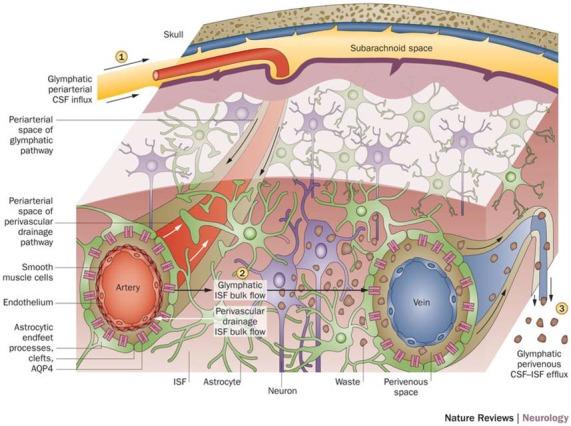
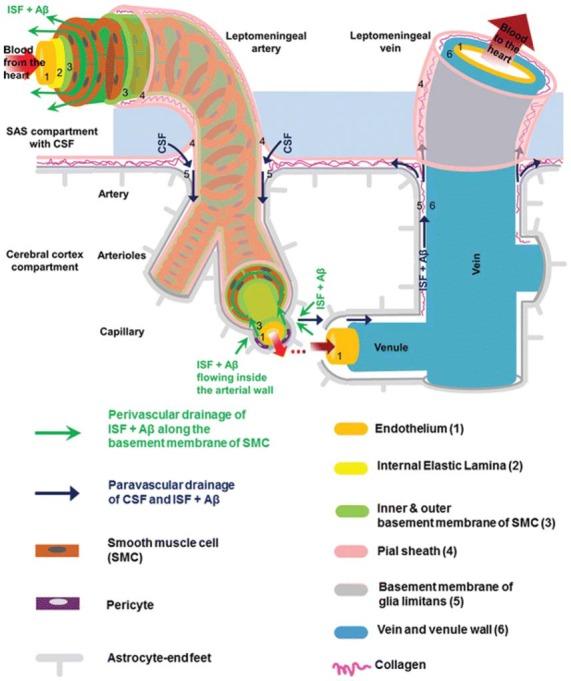
The paravascular pathway, also known as the "glymphatic" pathway, is a recently described system for waste clearance in the brain. According to this model, cerebrospinal fluid (CSF) enters the paravascular spaces surrounding penetrating arteries of the brain, mixes with interstitial fluid (ISF) and solutes in the parenchyma, and exits along paravascular spaces of draining veins. Studies have shown that metabolic waste products and solutes, including proteins involved in the pathogenesis of neurodegenerative diseases such as amyloid-beta, may be cleared by this pathway. Consequently, a growing body of research has begun to explore the association between glymphatic dysfunction and various disease states. However, significant controversy exists in the literature regarding both the direction of waste clearance as well as the anatomical space in which the waste-fluid mixture is contained. Some studies have found no evidence of interstitial solute clearance along the paravascular space of veins. Rather, they demonstrate a perivascular pathway in which waste is cleared from the brain along an anatomically distinct perivascular space in a direction opposite to that of paravascular flow. Although possible explanations have been offered, none have been able to fully reconcile the discrepancies in the literature, and many questions remain. Given the therapeutic potential that a comprehensive understanding of brain waste clearance pathways might offer, further research and clarification is highly warranted.
血管周围途径,也被称为“类淋巴”途径,是最近描述的一种大脑废物清除系统。根据这个模型,脑脊液(CSF)进入围绕大脑穿通动脉的血管周围间隙,与实质中的细胞间液(ISF)和溶质混合,然后沿着引流静脉的血管周围间隙流出。研究表明,包括参与神经退行性疾病发病机制的蛋白质(如β-淀粉样蛋白)在内的代谢废物和溶质可能通过该途径清除。因此,越来越多的研究开始探索类淋巴功能障碍与各种疾病状态之间的关联。然而,关于废物清除的方向以及容纳废-液混合物的解剖学空间,文献中存在重大争议。一些研究没有发现沿静脉血管周围间隙清除细胞间溶质的证据。相反,他们证明了一种血管周围途径,即废物沿着一个解剖学上不同的血管周围间隙从大脑中清除,其方向与血管周围流动方向相反。尽管已经提出了一些可能的解释,但没有一个能够完全调和文献中的差异,许多问题仍然存在。鉴于全面了解大脑废物清除途径可能带来的治疗潜力,进一步的研究和澄清非常有必要。
 Zotero 插件