
Robo1纤连蛋白III型重复序列的功能分析
Functional Analysis of Robo1 Fibronectin Type-III Repeats.
作者信息
Brown Haley E, Reichert Marie C, Evans Timothy A
机构信息
Department of Biological Sciences, University of Arkansas, Fayetteville, Arkansas 72701.
Department of Biological Sciences, University of Arkansas, Fayetteville, Arkansas 72701
出版信息
G3 (Bethesda). 2018 Feb 2;8(2):621-630. doi: 10.1534/g3.117.300418.
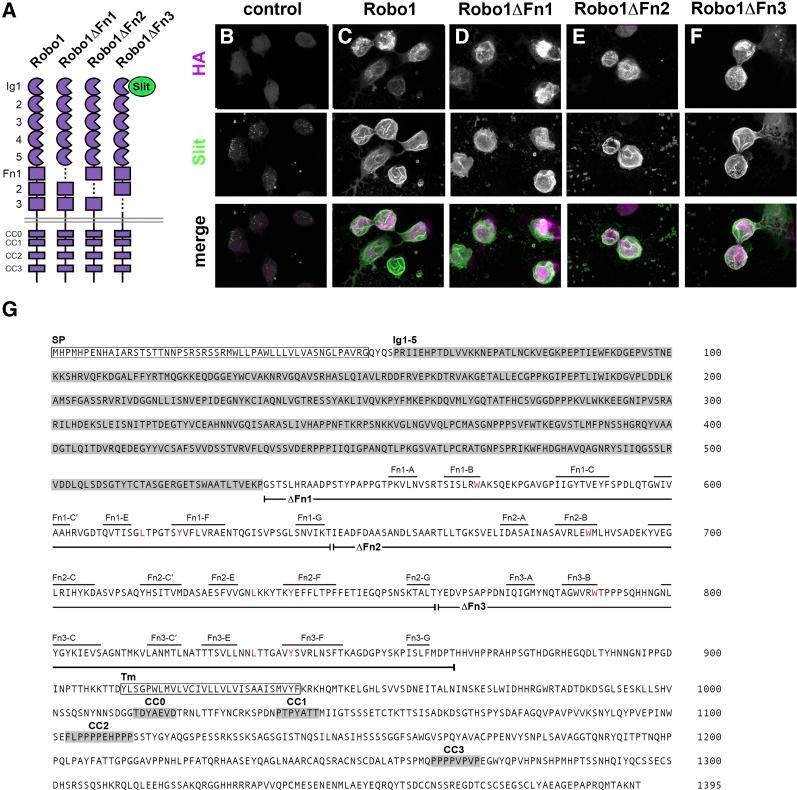
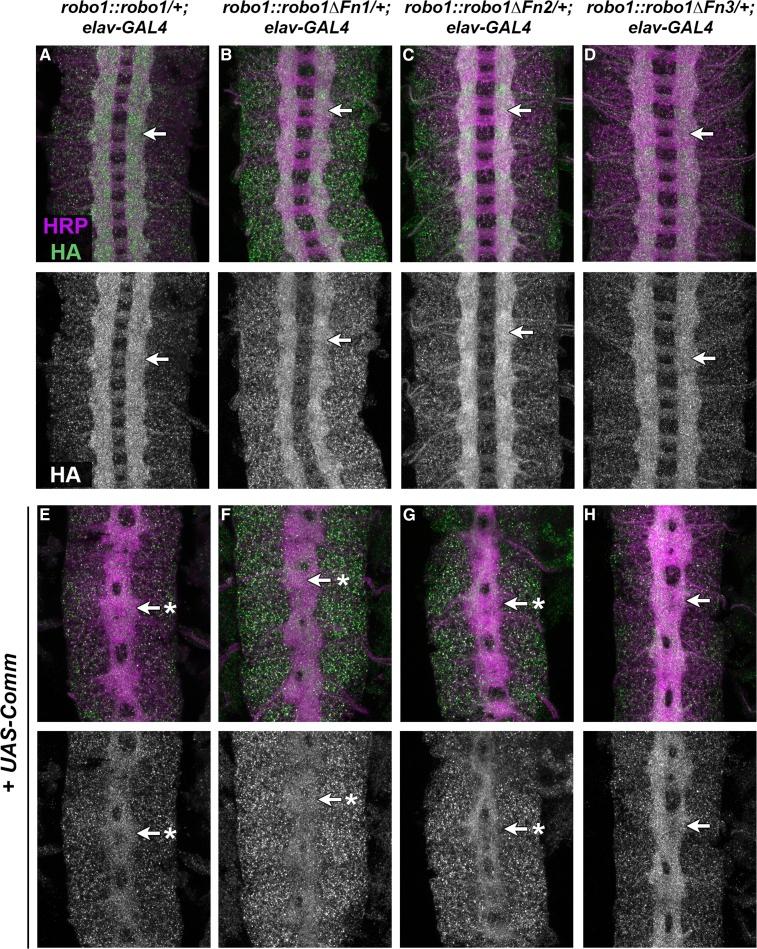
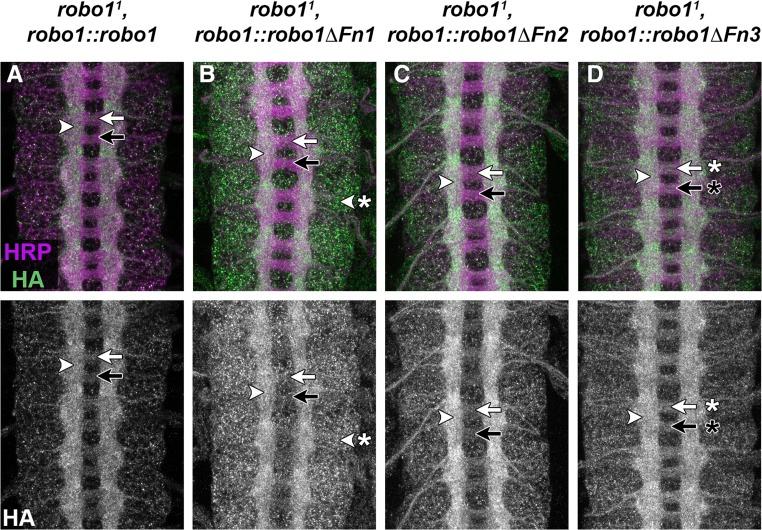
The repellant ligand Slit and its Roundabout (Robo) family receptors regulate midline crossing of axons during development of the embryonic central nervous system (CNS). Slit proteins are produced at the midline and signal through Robo receptors to repel axons from the midline. Disruption of Slit-Robo signaling causes ectopic midline-crossing phenotypes in the CNS of a broad range of animals, including insects and vertebrates. While previous studies have investigated the roles of Robo1's five Immunoglobulin-like (Ig) domains, little is known about the importance of the three evolutionarily conserved Fibronectin (Fn) type-III repeats. We have individually deleted each of Robo1's three Fn repeats, and then tested these Robo1 variants to determine their ability to bind Slit in cultured cells and to investigate the requirement for each domain in regulating Robo1's embryonic expression pattern, axonal localization, midline repulsive function, and sensitivity to Commissureless (Comm) downregulation. We demonstrate that the Fn repeats are not required for Robo1 to bind Slit or for proper expression of Robo1 in embryonic neurons. When expressed in a mutant background, these variants are able to restore midline repulsion to an extent equivalent to full-length Robo1. We identify a novel requirement for Fn3 in the exclusion of Robo1 from commissures and downregulation of Robo1 by Comm. Our results indicate that each of the Robo1 Fn repeats are individually dispensable for the protein's role in midline repulsion, despite the evolutionarily conserved "5 + 3" protein structure.
排斥性配体Slit及其Roundabout(Robo)家族受体在胚胎中枢神经系统(CNS)发育过程中调节轴突的中线交叉。Slit蛋白在中线产生,并通过Robo受体发出信号,以排斥来自中线的轴突。Slit-Robo信号传导的破坏会在包括昆虫和脊椎动物在内的多种动物的CNS中导致异位中线交叉表型。虽然先前的研究已经调查了Robo1的五个免疫球蛋白样(Ig)结构域的作用,但对于三个进化保守的纤连蛋白(Fn)III型重复序列的重要性却知之甚少。我们分别删除了Robo1的三个Fn重复序列中的每一个,然后测试这些Robo1变体,以确定它们在培养细胞中结合Slit的能力,并研究每个结构域在调节Robo1的胚胎表达模式、轴突定位、中线排斥功能以及对无连合蛋白(Comm)下调的敏感性方面的需求。我们证明,Fn重复序列对于Robo1结合Slit或在胚胎神经元中正确表达Robo1并非必需。当在突变背景中表达时,这些变体能够在一定程度上恢复中线排斥,其程度与全长Robo1相当。我们确定了Fn3在将Robo1排除在连合处以及Comm对Robo1的下调中的新需求。我们的结果表明,尽管存在进化保守的“5 + 3”蛋白结构,但Robo1的每个Fn重复序列对于该蛋白在中线排斥中的作用都是单独可 dispensable 的。 (注:“dispensable”这里结合语境推测可能是“非必需的、可有可无的”意思,原文这个词似乎有误,可能是“indispensable”,但按给定原文翻译)


 Zotero 插件