
基于生物信息学分析的舌鳞状细胞癌关键基因和通路的鉴定。
Identification of Key Genes and Pathways in Tongue Squamous Cell Carcinoma Using Bioinformatics Analysis.
机构信息
Department of Head and Neck Surgery, Sun Yan-sen University Cancer Centre, Guangzhou, Guangdong, China (mainland).
Department of Cardiothoracic Surgery, The Fifth Affiliated Hospital of Sun Yan-sen University, Zhuhai, Guangdong, China (mainland).
出版信息
Med Sci Monit. 2017 Dec 14;23:5924-5932. doi: 10.12659/msm.905035.
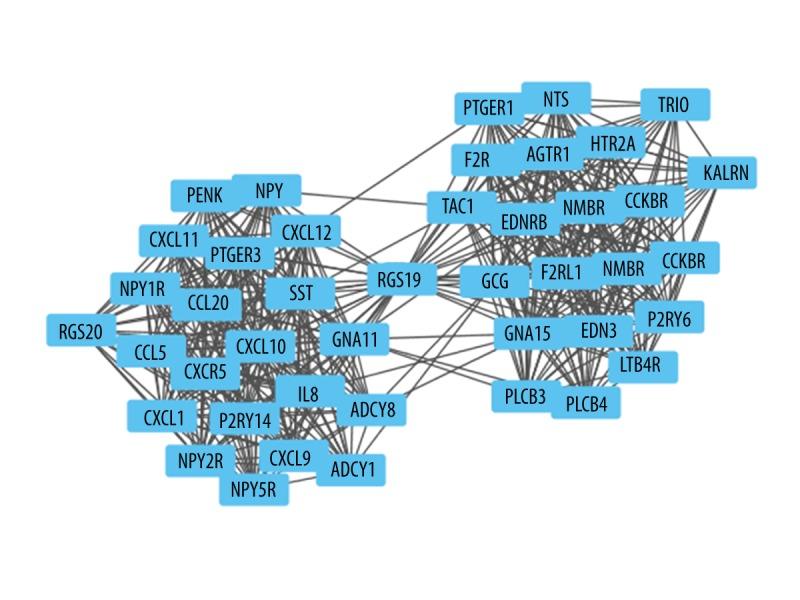
BACKGROUND Tongue squamous cell carcinoma (TSCC) is a major type of oral cancers and has remained an intractable cancer over the past decades. The aim of this study was to identify differentially expressed genes (DEGs) during TSCC and reveal their potential mechanisms. MATERIAL AND METHODS The gene expression profiles of GSE13601 were downloaded from the GEO database. The GSE13601 dataset contains 57 samples, including 31 tongue SCC samples and 26 matched normal mucosa samples. Gene ontology (GO) and Kyoto Encyclopedia of Genes and Genomes pathway (KEGG) enrichment analyses were performed; Cytoscape software was used for the protein-protein interaction (PPI) network and module analysis of the DEGs. RESULTS We identified a total of 1,050 upregulated DEGs (uDEGs) and 702 downregulated DEGs (dDEGs) of TSCC. The GO analysis results showed that uDEGs were significantly enriched in the following biological processes (BP): signal transduction, positive or negative regulation of cell proliferation, and negative regulation of cell proliferation. The dDEGs were significantly enriched in the following biological processes: signal transduction, cell adhesion, and apoptotic process. The KEGG pathway analysis showed that uDEGs were enriched in metabolic pathways, pathways in cancer, and PI3K-Akt signaling pathway, while the dDEGs were enriched in focal adhesion and ECM-receptor interaction. The top centrality hub genes RAC1, APP, EGFR, KNG1, AGT, and HRAS were identified from the PPI network. Module analysis revealed that TSCC was associated with significant pathways, including neuroactive ligand-receptor interaction, calcium signaling pathway, and chemokine signaling pathway. CONCLUSIONS The present study identified key genes and signal pathways, which deepen our understanding of the molecular mechanisms of carcinogenesis and development of the disease, and might be used as diagnostic and therapeutic molecular biomarkers for TSCC.
背景
舌鳞状细胞癌(TSCC)是一种主要的口腔癌,在过去几十年中一直是一种难以治愈的癌症。本研究旨在鉴定 TSCC 过程中的差异表达基因(DEGs),并揭示其潜在机制。
材料与方法
从 GEO 数据库中下载基因表达谱 GSE13601。GSE13601 数据集包含 57 个样本,包括 31 个舌 SCC 样本和 26 个匹配的正常黏膜样本。进行基因本体论(GO)和京都基因与基因组百科全书(KEGG)通路富集分析;使用 Cytoscape 软件进行 DEGs 的蛋白质-蛋白质相互作用(PPI)网络和模块分析。
结果
我们鉴定出了 TSCC 的总共 1050 个上调 DEGs(uDEGs)和 702 个下调 DEGs(dDEGs)。GO 分析结果表明,uDEGs 在以下生物学过程(BP)中显著富集:信号转导、细胞增殖的正或负调节和细胞增殖的负调节。dDEGs 在以下生物学过程中显著富集:信号转导、细胞黏附和凋亡过程。KEGG 通路分析表明,uDEGs 富集在代谢途径、癌症途径和 PI3K-Akt 信号通路中,而 dDEGs 富集在粘着斑和 ECM-受体相互作用中。从 PPI 网络中鉴定出了 RAC1、APP、EGFR、KNG1、AGT 和 HRAS 等重要的中枢基因。模块分析表明,TSCC 与神经活性配体-受体相互作用、钙信号通路和趋化因子信号通路等重要途径相关。
结论
本研究鉴定了关键基因和信号通路,加深了我们对疾病发生和发展的分子机制的理解,可能作为 TSCC 的诊断和治疗分子生物标志物。

 Zotero 插件