
腹内侧下丘脑核(VMH)中葡萄糖感应神经元对全身葡萄糖调节作用
Systemic Glucoregulation by Glucose-Sensing Neurons in the Ventromedial Hypothalamic Nucleus (VMH).
作者信息
Shimazu Takashi, Minokoshi Yasuhiko
机构信息
Department of Medical Biochemistry, Graduate School of Medicine, Ehime University, Tohon-shi, Ehime 791-0295, Japan.
Division of Endocrinology and Metabolism, Department of Homeostatic Regulation, National Institute for Physiological Sciences, 38 Myodaiji, Okazaki, Aichi 444-8585, Japan.
出版信息
J Endocr Soc. 2017 Apr 12;1(5):449-459. doi: 10.1210/js.2016-1104. eCollection 2017 May 1.
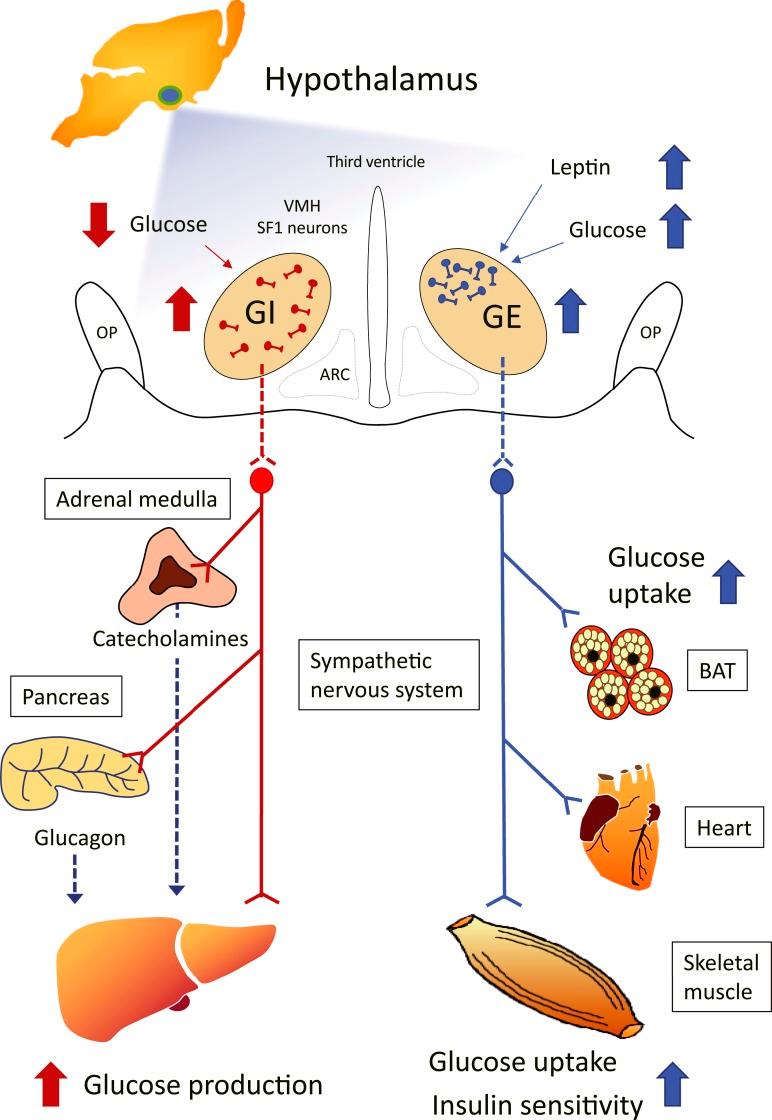
The ventromedial hypothalamic nucleus (VMH) regulates glucose production in the liver as well as glucose uptake and utilization in peripheral tissues, including skeletal muscle and brown adipose tissue, via efferent sympathetic innervation and neuroendocrine mechanisms. The action of leptin on VMH neurons also increases glucose uptake in specific peripheral tissues through the sympathetic nervous system, with improved insulin sensitivity. On the other hand, subsets of VMH neurons, such as those that express steroidogenic factor 1 (SF1), sense changes in the ambient glucose concentration and are characterized as glucose-excited (GE) and glucose-inhibited (GI) neurons whose action potential frequency increases and decreases, respectively, as glucose levels rise. However, how these glucose-sensing (GE and GI) neurons in the VMH contribute to systemic glucoregulation remains poorly understood. In this review, we provide historical background and discuss recent advances related to glucoregulation by VMH neurons. In particular, the article describes the role of GE neurons in the control of peripheral glucose utilization and insulin sensitivity, which depend on mitochondrial uncoupling protein 2 of the neurons, as well as that of GI neurons in the control of hepatic glucose production through hypoglycemia-induced counterregulatory mechanisms.
腹内侧下丘脑核(VMH)通过传出性交感神经支配和神经内分泌机制,调节肝脏中的葡萄糖生成以及外周组织(包括骨骼肌和棕色脂肪组织)中的葡萄糖摄取和利用。瘦素对VMH神经元的作用还通过交感神经系统增加特定外周组织中的葡萄糖摄取,同时提高胰岛素敏感性。另一方面,VMH神经元的亚群,如那些表达类固醇生成因子1(SF1)的神经元,能感知周围葡萄糖浓度的变化,并被分为葡萄糖兴奋(GE)神经元和葡萄糖抑制(GI)神经元,随着葡萄糖水平升高,它们的动作电位频率分别增加和降低。然而,VMH中这些葡萄糖感应(GE和GI)神经元如何参与全身葡萄糖调节仍知之甚少。在这篇综述中,我们提供了历史背景,并讨论了与VMH神经元葡萄糖调节相关的最新进展。特别是,本文描述了GE神经元在控制外周葡萄糖利用和胰岛素敏感性中的作用,这取决于神经元中的线粒体解偶联蛋白2,以及GI神经元在通过低血糖诱导的反调节机制控制肝脏葡萄糖生成中的作用。
 Zotero 插件