
多次注射与单次注射透明质酸的疗效:一项系统评价和荟萃分析。
The efficacy of multiple versus single hyaluronic acid injections: a systematic review and meta-analysis.
作者信息
Concoff Andrew, Sancheti Parag, Niazi Faizan, Shaw Peter, Rosen Jeffrey
机构信息
Departments of Orthopedics and Rheumatology, St. Jude Medical Center, Fullerton, California, USA.
Sancheti Institute for Orthopaedics and Rehabilitation, Maharashtra, India.
出版信息
BMC Musculoskelet Disord. 2017 Dec 21;18(1):542. doi: 10.1186/s12891-017-1897-2.
BACKGROUND
Intra-articular hyaluronic acid (IA-HA) is a common therapy used to treat knee pain and suppress knee inflammation in knee osteoarthritis (OA), typically prescribed in regimens ranging from a single injection to 5 weekly injections given once weekly. We conducted a systematic review to determine the efficacy of IA-HA, with subgroup analyses to explore the differences in knee pain and adverse events (AEs) across different dosing regimens.
METHODS
We conducted a systematic search of the literature to identify studies evaluating IA-HA for the management of knee OA compared to IA-saline. Primary outcome measure was the mean knee pain score at 13 Weeks (3 months) or 26 weeks (6 months). Secondary outcome was the number of treatment-related AEs and treatment-related serious adverse events (SAEs). We evaluated differences in levels of pain and AEs/SAEs between dosing regimens compared to IA-Saline.
RESULTS
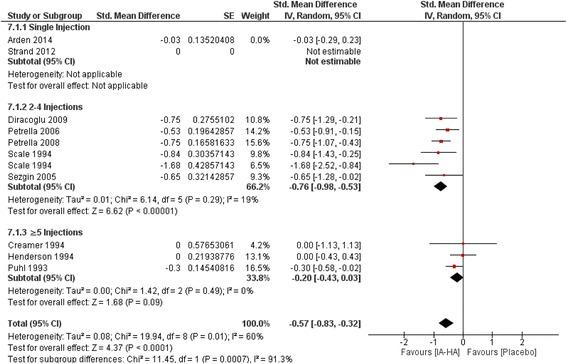
Thirty articles were included. Overall, IA-HA injections were associated with less knee pain compared to IA-Saline injections for all dosing regimens. 2-4 injections of IA-HA vs. IA-Saline produced the largest effect size at both 3-months and 6-months (Standard mean difference [SMD] = -0.76; -0.98 to -0.53, 95% CI, P < 0.00001, and SMD = -0.36; -0.63 to -0.09 95% CI, P = 0.008, respectively). Additionally, single injection studies yielded a non-significant treatment effect at 3 and 6 months, while ≥5 5 injections demonstrated a significant improvement in pain only at 6 months. Five or more injections of IA-HA were associated with a higher risk of treatment-related AEs compared to IA-Saline (Risk ratio [RR] = 1.67; 1.09 to 2.56 95% CI, p = 0.02), which was a result not seen within the 1 and 2-4 injection subgroups.
CONCLUSION
Overall, 2-4 and ≥5 injection regimens provided pain relief over IA-Saline, while single injection did not. Intra-articular injections of HA used in a 2-4 injection treatment regimen provided the greatest benefit when compared to IA-Saline with respect to pain improvement in patients with knee OA, and was generally deemed safe with few to no treatment-related AEs reported across studies. Future research is needed to directly compare these treatment regimens.
背景
关节内注射透明质酸(IA-HA)是治疗膝关节疼痛和抑制膝骨关节炎(OA)炎症的常用疗法,通常的给药方案为单次注射至每周注射一次,共注射5次。我们进行了一项系统评价,以确定IA-HA的疗效,并进行亚组分析,以探讨不同给药方案在膝关节疼痛和不良事件(AE)方面的差异。
方法
我们对文献进行了系统检索,以确定评估IA-HA与关节内注射生理盐水相比治疗膝骨关节炎的研究。主要结局指标是13周(3个月)或26周(6个月)时的平均膝关节疼痛评分。次要结局是治疗相关AE和治疗相关严重不良事件(SAE)的数量。我们评估了与关节内注射生理盐水相比,不同给药方案在疼痛水平和AE/SAE方面的差异。
结果
纳入30篇文章。总体而言,与关节内注射生理盐水相比,所有给药方案的IA-HA注射导致的膝关节疼痛均较少。在3个月和6个月时,2-4次注射IA-HA与关节内注射生理盐水相比产生的效应量最大(标准均差[SMD]=-0.76;95%CI为-0.98至-0.53,P<0.00001;以及SMD=-0.36;95%CI为-0.63至-0.09,P=0.008)。此外,单次注射研究在3个月和6个月时产生的治疗效果不显著,而≥5次注射仅在6个月时显示疼痛有显著改善。与关节内注射生理盐水相比,5次或更多次注射IA-HA与治疗相关AE的风险更高相关(风险比[RR]=1.67;95%CI为1.09至2.56,P=0.02),这一结果在1次和2-4次注射亚组中未出现。
结论
总体而言,2-4次和≥5次注射方案比关节内注射生理盐水能缓解疼痛,而单次注射则不能。与关节内注射生理盐水相比,2-4次注射治疗方案的关节内注射HA在改善膝骨关节炎患者疼痛方面提供了最大益处,并且在各项研究中总体被认为是安全的,报告的治疗相关AE很少或没有。需要进一步的研究来直接比较这些治疗方案。

 Zotero 插件