
雌激素及其他性激素在脑衰老中的作用。神经保护与DNA修复。
Role of Estrogen and Other Sex Hormones in Brain Aging. Neuroprotection and DNA Repair.
作者信息
Zárate Sandra, Stevnsner Tinna, Gredilla Ricardo
机构信息
Instituto de Investigaciones Biomédicas (INBIOMED, UBA-CONICET), Facultad de Medicina, Universidad de Buenos Aires, Buenos Aires, Argentina.
Departamento de Histología, Embriología, Biología Celular y Genética, Facultad de Medicina, Universidad de Buenos Aires, Buenos Aires, Argentina.
出版信息
Front Aging Neurosci. 2017 Dec 22;9:430. doi: 10.3389/fnagi.2017.00430. eCollection 2017.
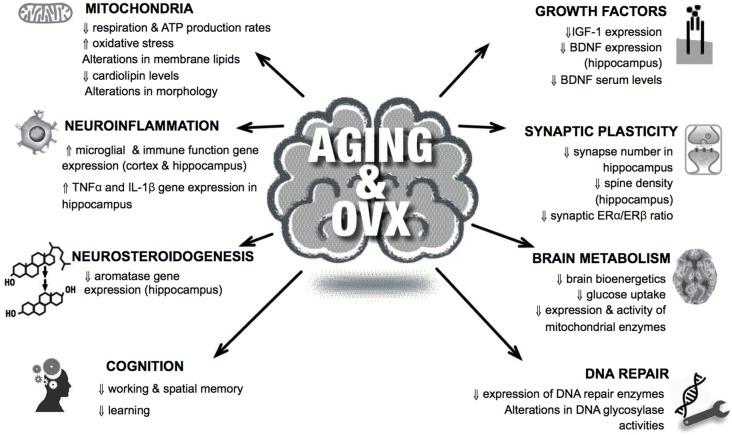
Aging is an inevitable biological process characterized by a progressive decline in physiological function and increased susceptibility to disease. The detrimental effects of aging are observed in all tissues, the brain being the most important one due to its main role in the homeostasis of the organism. As our knowledge about the underlying mechanisms of brain aging increases, potential approaches to preserve brain function rise significantly. Accumulating evidence suggests that loss of genomic maintenance may contribute to aging, especially in the central nervous system (CNS) owing to its low DNA repair capacity. Sex hormones, particularly estrogens, possess potent antioxidant properties and play important roles in maintaining normal reproductive and non-reproductive functions. They exert neuroprotective actions and their loss during aging and natural or surgical menopause is associated with mitochondrial dysfunction, neuroinflammation, synaptic decline, cognitive impairment and increased risk of age-related disorders. Moreover, loss of sex hormones has been suggested to promote an accelerated aging phenotype eventually leading to the development of brain hypometabolism, a feature often observed in menopausal women and prodromal Alzheimer's disease (AD). Although data on the relation between sex hormones and DNA repair mechanisms in the brain is still limited, various investigations have linked sex hormone levels with different DNA repair enzymes. Here, we review estrogen anti-aging and neuroprotective mechanisms, which are currently an area of intense study, together with the effect they may have on the DNA repair capacity in the brain.
衰老 是一个不可避免的生物学过程,其特征是生理功能逐渐衰退,对疾病的易感性增加。衰老的有害影响在所有组织中都有体现,而大脑因其在机体稳态中的主要作用,是最为重要的一个组织。随着我们对大脑衰老潜在机制的了解不断增加,维持大脑功能的潜在方法也显著增多。越来越多的证据表明,基因组维护功能的丧失可能导致衰老,尤其是在中枢神经系统(CNS)中,因为其DNA修复能力较低。性激素,特别是雌激素,具有强大的抗氧化特性,在维持正常生殖和非生殖功能方面发挥着重要作用。它们发挥神经保护作用,而在衰老过程以及自然绝经或手术绝经期间性激素的丧失与线粒体功能障碍、神经炎症、突触衰退、认知障碍以及与年龄相关疾病的风险增加有关。此外,有研究表明性激素的丧失会促进加速衰老的表型,最终导致大脑代谢减退的发生,这是绝经后女性和阿尔茨海默病(AD)前驱期常见的一个特征。尽管关于性激素与大脑DNA修复机制之间关系的数据仍然有限,但各种研究已将性激素水平与不同的DNA修复酶联系起来。在此,我们综述雌激素的抗衰老和神经保护机制,这是目前一个深入研究的领域,以及它们可能对大脑DNA修复能力产生的影响。

 Zotero 插件