
口腔鳞状细胞癌患者肿瘤组织和外周血中程序性死亡受体配体1(PD-L1)的表达情况
PD-L1 expression in tumor tissue and peripheral blood of patients with oral squamous cell carcinoma.
作者信息
Weber Manuel, Wehrhan Falk, Baran Christoph, Agaimy Abbas, Büttner-Herold Maike, Preidl Raimund, Neukam Friedrich W, Ries Jutta
机构信息
Department of Oral and Maxillofacial Surgery, Friedrich-Alexander University Erlangen-Nürnberg, Erlangen, Germany.
Institute of Pathology, Friedrich-Alexander University Erlangen-Nürnberg, Erlangen, Germany.
出版信息
Oncotarget. 2017 Nov 8;8(68):112584-112597. doi: 10.18632/oncotarget.22576. eCollection 2017 Dec 22.
BACKGROUND
Immune checkpoints like programmed cell death-1 (PD-1) and its ligand PD-L1 are involved in immune escape mechanisms of solid tumors including oral squamous cell carcinoma (OSCC). Inhibitors of the pathway are successfully used for treating especially advanced disease. However, the physiological relevance of PD-1/PD-L1-signaling in OSCC is insufficiently understood. The aim of the study was to analyze if PD-L1 expression in tumor tissue and peripheral blood samples of OSCC patients is associated with histomorphological tumor parameters and if PD-L1 expression in patients is different from controls.
RESULTS
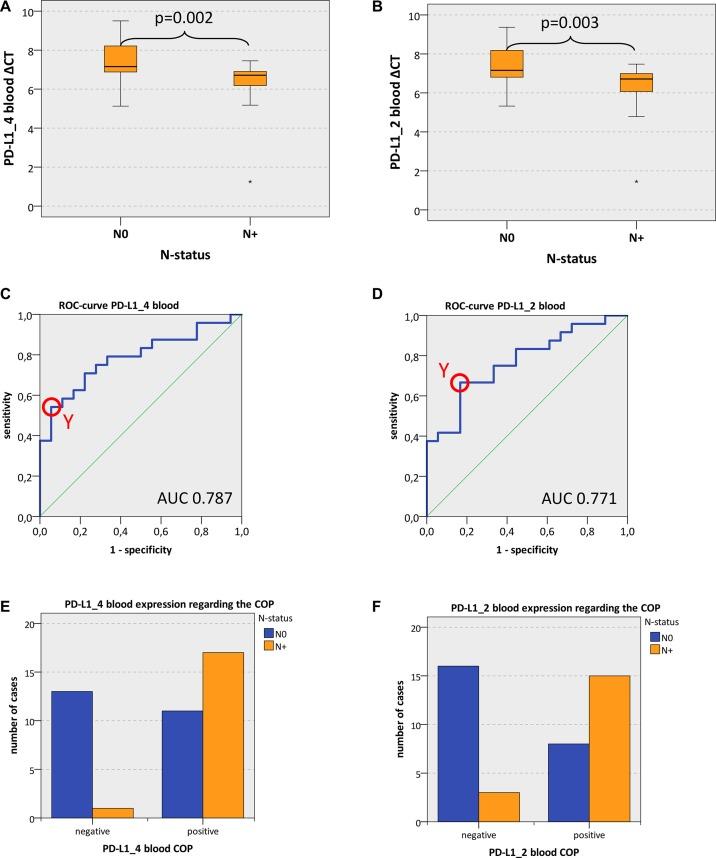
OSCC tumor specimens showed a significantly higher PD-L1 expression than oral mucosa controls ( < 0.001; upregulation more than 3-fold). Cross-tabulation revealed an association of increased expression of PD-L1 mRNA in tissue specimens with malignancy ( < 0.001).OSCC cases with higher tumor grade and cases with lymph node metastases (N+) were significantly ( < 0.05) associated with increased PD-L1 expression in peripheral blood. Cross-tabulation revealed an significant association with lymph node metastases (N+) ( ≤ 0.002).
MATERIALS AND METHODS
PD-L1 mRNA expression was analyzed in tumor specimens and corresponding samples of healthy oral mucosa and peripheral blood of 45 OSCC patients and 36 healthy control persons using RT-qPCR analysis. A Mann-Whitney , a cut-off point analysis and a Chi-square test were carried out.
CONCLUSIONS
PD-L1 expression in OSCC could contribute to the immunosuppressive local tumor microenvironment. Increased malignant behavior (higher tumor grade, positive nodal status) might be associated with PD-L1 mediated systemic immune tolerance. Thus, PD-L1 expression in peripheral blood might be an indicator of the existence of metastatic disease (N+) in OSCC.
背景
程序性细胞死亡蛋白1(PD-1)及其配体PD-L1等免疫检查点参与包括口腔鳞状细胞癌(OSCC)在内的实体瘤的免疫逃逸机制。该通路的抑制剂已成功用于治疗特别是晚期疾病。然而,PD-1/PD-L1信号在OSCC中的生理相关性尚未得到充分了解。本研究的目的是分析OSCC患者肿瘤组织和外周血样本中PD-L1的表达是否与组织形态学肿瘤参数相关,以及患者中PD-L1的表达是否与对照组不同。
结果
OSCC肿瘤标本显示PD-L1表达明显高于口腔黏膜对照组(<0.001;上调超过3倍)。交叉表分析显示组织标本中PD-L1 mRNA表达增加与恶性肿瘤相关(<0.001)。肿瘤分级较高的OSCC病例和有淋巴结转移(N+)的病例与外周血中PD-L1表达增加显著相关(<0.05)。交叉表分析显示与淋巴结转移(N+)有显著关联(≤0.002)。
材料与方法
采用RT-qPCR分析方法,对45例OSCC患者和36例健康对照者的肿瘤标本、相应的健康口腔黏膜样本和外周血样本中的PD-L1 mRNA表达进行分析。进行了曼-惠特尼检验、截断点分析和卡方检验。
结论
OSCC中PD-L1的表达可能有助于形成免疫抑制性局部肿瘤微环境。恶性行为增加(更高的肿瘤分级、阳性淋巴结状态)可能与PD-L1介导的全身免疫耐受有关。因此,外周血中PD-L1的表达可能是OSCC中存在转移性疾病(N+)的一个指标。


 Zotero 插件