
印度昌迪加尔城市成年人中基于信息技术的营养干预整群随机对照试验方案:SMART饮食试验
Protocol for a cluster randomised controlled trial on information technology-enabled nutrition intervention among urban adults in Chandigarh (India): SMART eating trial.
作者信息
Kaur Jasvir, Kaur Manmeet, Webster Jacqui, Kumar Rajesh
机构信息
a Department of Community Medicine, School of Public Health , Post-graduate Institute of Medical Education and Research , Chandigarh.
b Public Health Advocacy and Policy Impact, The George Institute for Global Health , The University of Sydney , Sydney , Australia.
出版信息
Glob Health Action. 2018;11(1):1419738. doi: 10.1080/16549716.2017.1419738.
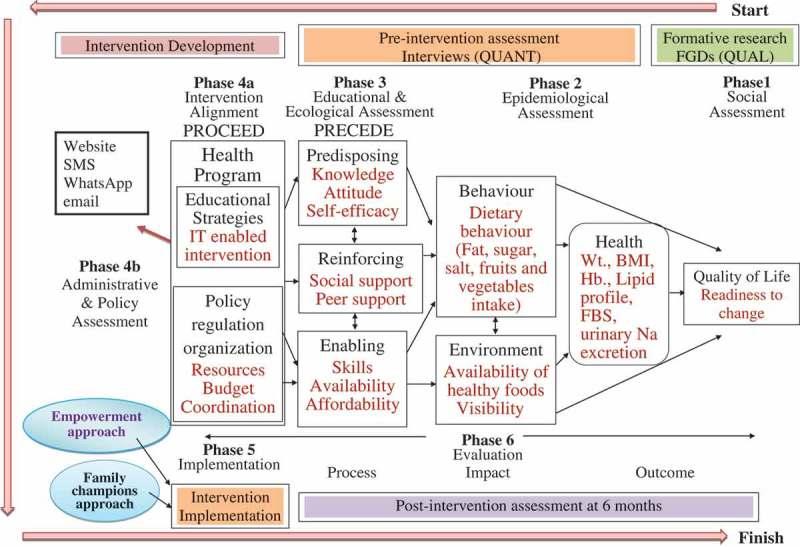
Nutrition is an important determinant of health. At present, nutrition programs in India mainly emphasize improving maternal and child nutrition. Adult nutrition has not received due attention, though diseases like hypertension and diabetes are largely preventable through changes in dietary and physical activity behaviour. Little is known about the best approaches to improve dietary behaviours, especially the role of modern information technology (IT) in health education. We describe the protocol of the SMART Eating (Small, Measurable and Achievable dietary changes by Reducing fat, sugar and salt consumption and Trying different fruits and vegetables) health promotion intervention. A Cluster Randomised Controlled Trial will evaluate the effect of an IT-enabled intervention on nutrition behaviour among urban adults of Chandigarh, India. Formative research using a qualitative exploratory approach was undertaken to inform the intervention. The IT-enabled intervention programme includes website development, Short Message Service (SMS), e-mail reminders and interactive help by mobile and landline phones. The IT-enabled intervention will be compared to the traditional nutrition education program of distributing pamphlets in the control group. The primary outcome will be the percentage of study participants meeting the dietary intake guidelines of the National Institute of Nutrition, Hyderabad, India and the change in intake of fat, sugar, salt, fruit and vegetables after the intervention. The difference in differences method will be used to determine the net change in dietary intakes resulting from the interventions. Measurements will be made at baseline and at 6 months post-intervention, using a food frequency questionnaire. The formative research led to the development of a comprehensive intervention, focusing on five dietary components and using multi-channel communication approach including the use of IT to target urban North Indians from diverse socio-economic backgrounds. The Cluster Randomised Controlled Trial design is suitable for evaluating the effectiveness of this IT-enabled intervention for dietary behaviour change.
营养是健康的重要决定因素。目前,印度的营养项目主要强调改善母婴营养。尽管高血压和糖尿病等疾病很大程度上可通过改变饮食和身体活动行为来预防,但成人营养尚未得到应有的重视。对于改善饮食行为的最佳方法,尤其是现代信息技术(IT)在健康教育中的作用,人们知之甚少。我们描述了SMART饮食(通过减少脂肪、糖和盐的摄入量以及尝试不同的水果和蔬菜来实现小幅度、可衡量且可实现的饮食变化)健康促进干预措施的方案。一项整群随机对照试验将评估一项基于IT的干预措施对印度昌迪加尔城市成年人营养行为的影响。采用定性探索性方法进行了形成性研究,以为干预措施提供依据。基于IT的干预项目包括网站开发、短信服务(SMS)、电子邮件提醒以及通过移动电话和固定电话提供的交互式帮助。将基于IT的干预措施与对照组中发放宣传册的传统营养教育项目进行比较。主要结果将是符合印度海得拉巴国家营养研究所饮食摄入指南的研究参与者的百分比,以及干预后脂肪、糖、盐、水果和蔬菜摄入量的变化。将使用差异中的差异方法来确定干预措施导致的饮食摄入量的净变化。将在基线时以及干预后6个月使用食物频率问卷进行测量。形成性研究促成了一项全面干预措施的制定,该措施聚焦于五种饮食成分,并采用多渠道沟通方法,包括利用IT针对来自不同社会经济背景的城市北印度人。整群随机对照试验设计适用于评估这项基于IT的干预措施对改变饮食行为的有效性。

 Zotero 插件