
基于智能手机应用程序的正常及双任务行走过程中步态评估:有效性和可靠性的验证
Smartphone App-Based Assessment of Gait During Normal and Dual-Task Walking: Demonstration of Validity and Reliability.
作者信息
Manor Brad, Yu Wanting, Zhu Hao, Harrison Rachel, Lo On-Yee, Lipsitz Lewis, Travison Thomas, Pascual-Leone Alvaro, Zhou Junhong
机构信息
Hebrew SeniorLife Institute for Aging Research, Harvard Medical School, Roslindale, MA, United States.
Berenson-Allen Center for Noninvasive Brain Stimulation, Division of Interventional Cognitive Neurology, Beth Israel Deaconess Medical Center, Boston, MA, United States.
出版信息
JMIR Mhealth Uhealth. 2018 Jan 30;6(1):e36. doi: 10.2196/mhealth.8815.
BACKGROUND
Walking is a complex cognitive motor task that is commonly completed while performing another task such as talking or making decisions. Gait assessments performed under normal and "dual-task" walking conditions thus provide important insights into health. Such assessments, however, are limited primarily to laboratory-based settings.
OBJECTIVE
The objective of our study was to create and test a smartphone-based assessment of normal and dual-task walking for use in nonlaboratory settings.
METHODS
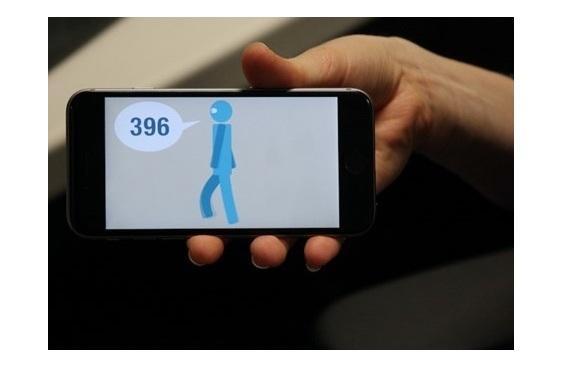
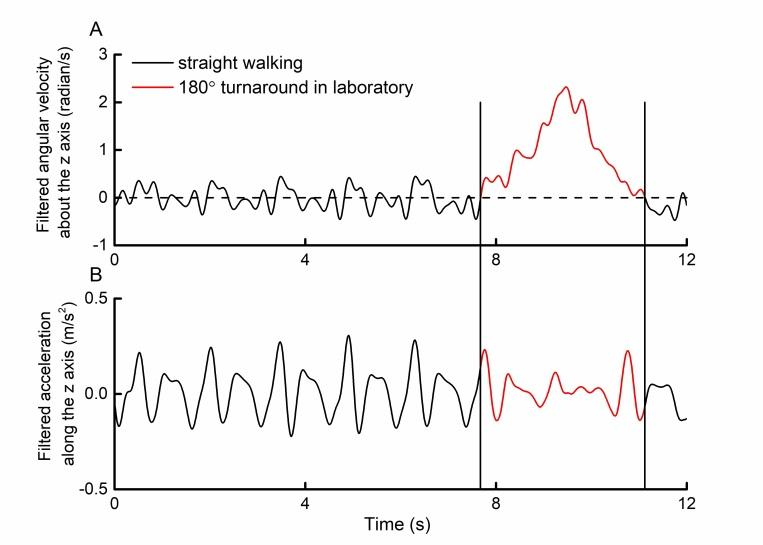
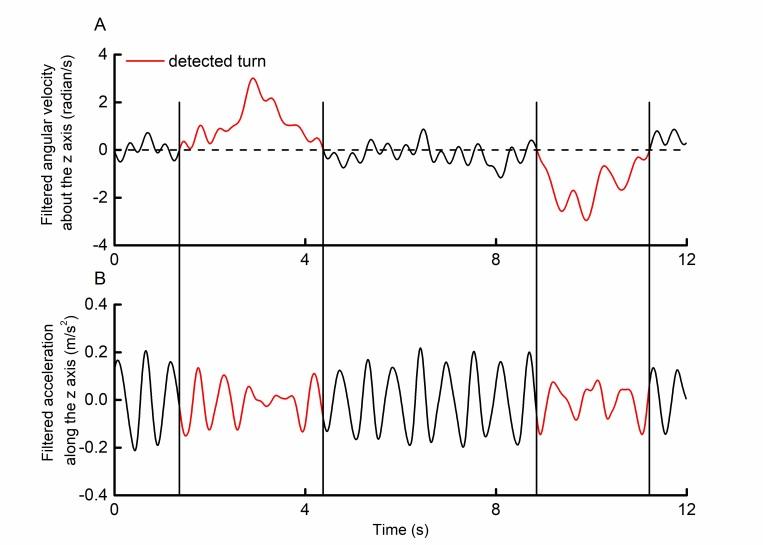
We created an iPhone app that used the phone's motion sensors to record movements during walking under normal conditions and while performing a serial-subtraction dual task, with the phone placed in the user's pants pocket. The app provided the user with multimedia instructions before and during the assessment. Acquired data were automatically uploaded to a cloud-based server for offline analyses. A total of 14 healthy adults completed 2 laboratory visits separated by 1 week. On each visit, they used the app to complete three 45-second trials each of normal and dual-task walking. Kinematic data were collected with the app and a gold-standard-instrumented GAITRite mat. Participants also used the app to complete normal and dual-task walking trials within their homes on 3 separate days. Within laboratory-based trials, GAITRite-derived heel strikes and toe-offs of the phone-side leg aligned with smartphone acceleration extrema, following filtering and rotation to the earth coordinate system. We derived stride times-a clinically meaningful metric of locomotor control-from GAITRite and app data, for all strides occurring over the GAITRite mat. We calculated stride times and the dual-task cost to the average stride time (ie, percentage change from normal to dual-task conditions) from both measurement devices. We calculated similar metrics from home-based app data. For these trials, periods of potential turning were identified via custom-developed algorithms and omitted from stride-time analyses.
RESULTS
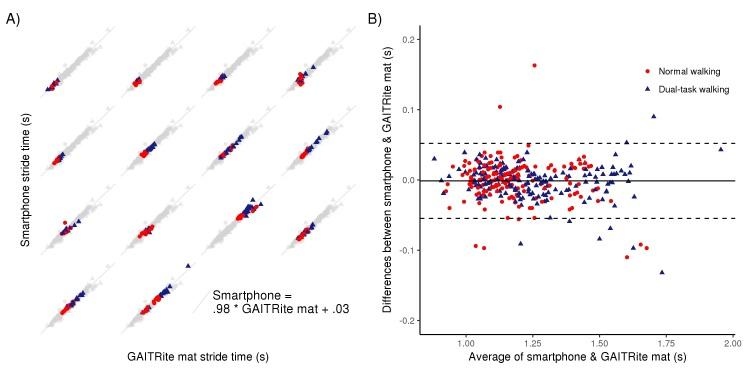
Across all detected strides in the laboratory, stride times derived from the app and GAITRite mat were highly correlated (P<.001, r=.98). These correlations were independent of walking condition and pocket tightness. App- and GAITRite-derived stride-time dual-task costs were also highly correlated (P<.001, r=.95). The error of app-derived stride times (mean 16.9, SD 9.0 ms) was unaffected by the magnitude of stride time, walking condition, or pocket tightness. For both normal and dual-task trials, average stride times derived from app walking trials demonstrated excellent test-retest reliability within and between both laboratory and home-based assessments (intraclass correlation coefficient range .82-.94).
CONCLUSIONS
The iPhone app we created enabled valid and reliable assessment of stride timing-with the smartphone in the pocket-during both normal and dual-task walking and within both laboratory and nonlaboratory environments. Additional work is warranted to expand the functionality of this tool to older adults and other patient populations.
背景
行走是一项复杂的认知运动任务,通常在执行其他任务(如交谈或做决策)时完成。因此,在正常和“双任务”行走条件下进行的步态评估能为健康状况提供重要见解。然而,此类评估主要局限于基于实验室的环境。
目的
我们研究的目的是创建并测试一种基于智能手机的正常和双任务行走评估方法,用于非实验室环境。
方法
我们创建了一款iPhone应用程序,该程序利用手机的运动传感器记录正常行走以及执行连续减法双任务时的运动情况,手机放置在用户的裤兜里。该应用程序在评估前和评估过程中为用户提供多媒体指导。采集到的数据会自动上传到基于云的服务器进行离线分析。共有14名健康成年人完成了两次相隔1周的实验室访问。每次访问时,他们使用该应用程序分别完成三次45秒的正常行走和双任务行走试验。运动学数据通过该应用程序和金标准仪器化的GAITRite垫收集。参与者还在自己家中的3个不同日子里使用该应用程序完成正常和双任务行走试验。在基于实验室的数据中,经过滤波并转换到地球坐标系后,GAITRite得出的手机侧腿的脚跟触地和脚尖离地与智能手机加速度极值对齐。我们从GAITRite和应用程序数据中得出步幅时间(一种对运动控制具有临床意义的指标),用于GAITRite垫上发生的所有步幅。我们从两个测量设备计算步幅时间以及双任务对平均步幅时间的成本(即从正常到双任务条件的百分比变化)。我们从基于家庭的应用程序数据中计算类似指标。对于这些试验,通过定制开发的算法识别潜在转弯时段,并将其从步幅时间分析中排除。
结果
在实验室中所有检测到的步幅中,应用程序得出的步幅时间与GAITRite垫得出的步幅时间高度相关(P<.001,r=.98)。这些相关性与行走条件和口袋松紧度无关。应用程序和GAITRite得出的步幅时间双任务成本也高度相关(P<.001,r=.95)。应用程序得出的步幅时间误差(平均16.9,标准差9.0毫秒)不受步幅时间大小、行走条件或口袋松紧度的影响。对于正常和双任务试验,应用程序行走试验得出的平均步幅时间在实验室和家庭评估内部以及之间均显示出出色的重测信度(组内相关系数范围为.82-.94)。
结论
我们创建的iPhone应用程序能够在正常和双任务行走期间以及实验室和非实验室环境中,将智能手机放在口袋里时对步幅时间进行有效且可靠的评估。有必要开展更多工作,将此工具的功能扩展到老年人和其他患者群体。


 Zotero 插件