
体外冲击波疗法以低能量通量密度抑制动物模型中的增生性瘢痕形成。
Extracorporeal shock wave therapy with low-energy flux density inhibits hypertrophic scar formation in an animal model.
机构信息
Burns and Plastic Reconstruction Unit, The First Hospital of Jilin University, Changchun, Jilin 130021, P.R. China.
出版信息
Int J Mol Med. 2018 Apr;41(4):1931-1938. doi: 10.3892/ijmm.2018.3434. Epub 2018 Jan 29.
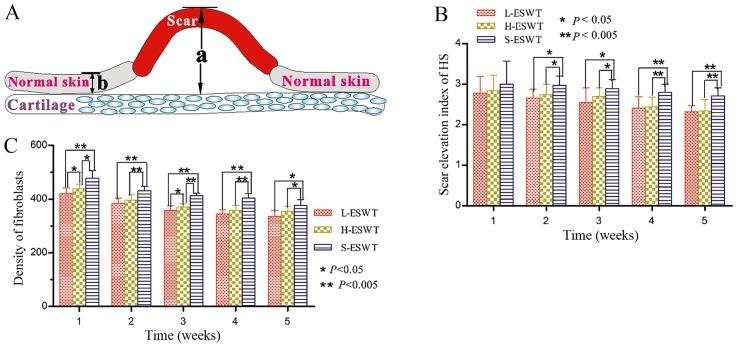
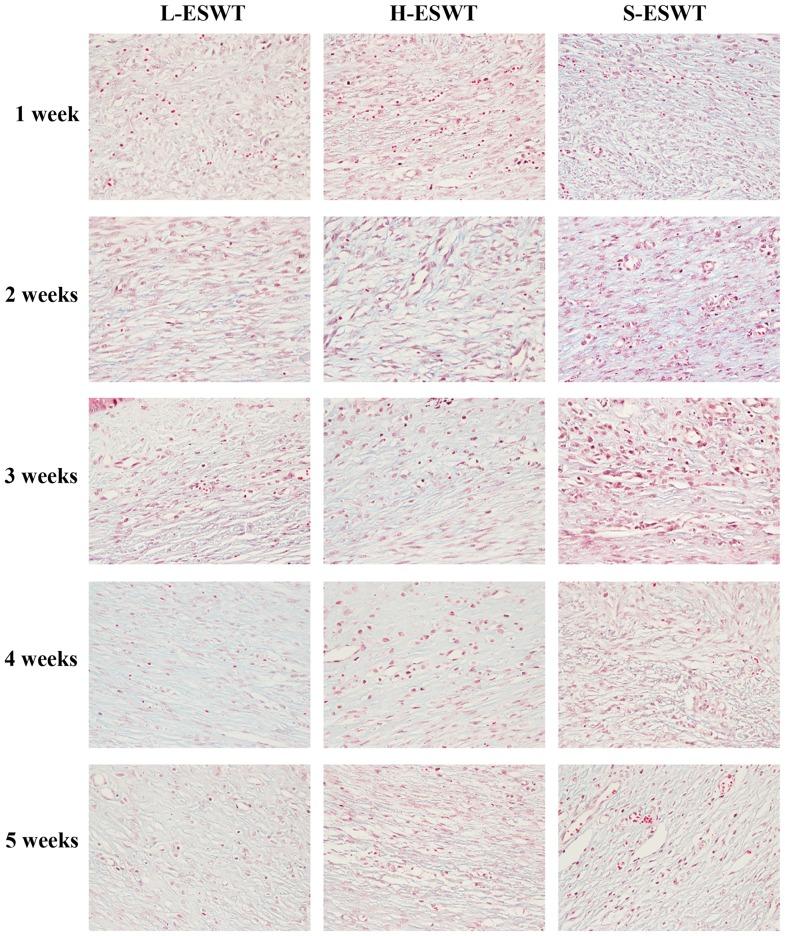
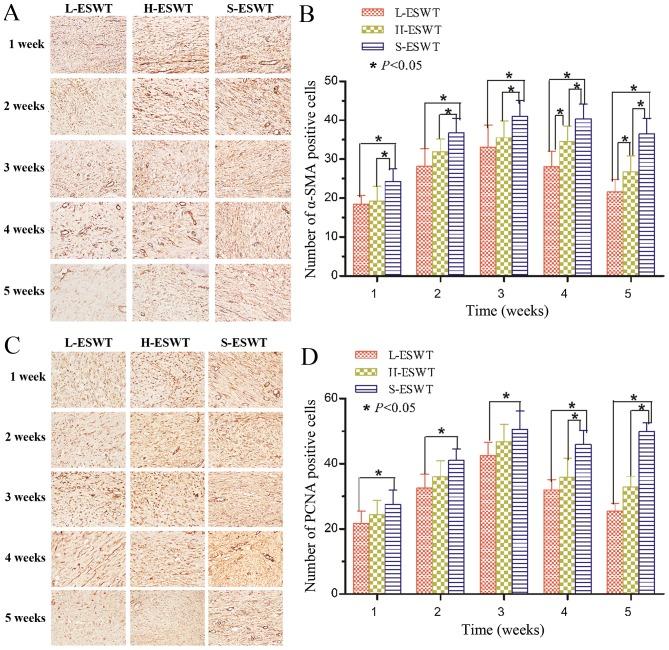
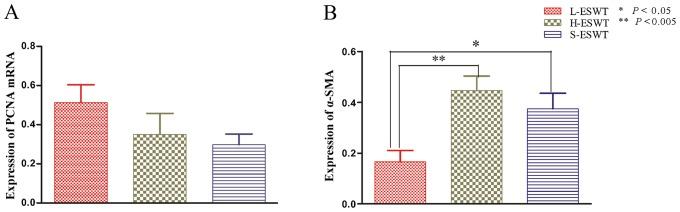
Hypertrophic scar is characterized by excessive deposits of collagen during skin wound healing, which could become a challenge to clinicians. This study assessed the effects of the extracorporeal shock wave therapy (ESWT) on hypertrophic scar formation and the underlying gene regu-lation. A rabbit ear hypertrophic scar model was generated and randomly divided into three groups: L-ESWT group to receive L-ESWT (energy flux density of 0.1 mJ/mm2), H-ESWT (energy flux density of 0.2 mJ/mm2) and sham ESWT group (S-ESWT). Hypertrophic scar tissues were then collected and stained with hematoxylin and eosin (H&E) and Masson's trichrome staining, respectively, to assess scar elevation index (SEI), fibroblast density and collagen fiber arrangement. Expression of cell proliferation marker proliferating cell nuclear antigen (PCNA) and α-smooth muscle actin (α-SMA) were assessed using RT-PCR and immunohistochemistry in hypertrophic scar tissues. H&E staining sections showed significant reduction of SEI and fibroblast density in both ESWT treatment groups compared to S-ESWT, but there was no dramatic difference between L-ESWT and H-ESWT groups. Masson's trichrome staining showed that collagen fibers were more slender and broader and oriented in parallel to skin surface after administration of ESWT compared to control tissues. At the gene level, PCNA‑positive fibroblasts and α-SMA-positive myofibroblasts were significantly decreased after L-ESWT or H-ESWT compared to the controls. Furthermore, there was no significant difference in expression of PCNA mRNA between L-ESWT or H-ESWT and S-ESWT, whereas expression of α-SMA mRNA significantly decreased in L-ESWT compared to that of H-ESWT and S-ESWT (P=0.002 and P=0.030, respectively). In conclusion, L-ESWT could be effective on suppression of hypertrophic scar formation by inhibition of scar elevation index and fibroblast density as well as α-SMA expression in hypertrophic scar tissues of the rabbit model.
增生性瘢痕的特征是皮肤创伤愈合过程中胶原过度沉积,这给临床医生带来了挑战。本研究评估了体外冲击波疗法(ESWT)对增生性瘢痕形成及潜在基因调控的影响。建立兔耳增生性瘢痕模型,并随机分为三组:低能冲击波组(L-ESWT,能量通量密度为 0.1mJ/mm2)、高能冲击波组(H-ESWT,能量通量密度为 0.2mJ/mm2)和假冲击波组(S-ESWT)。然后采集增生性瘢痕组织,分别用苏木精和伊红(H&E)和马松三色染色法染色,评估瘢痕隆起指数(SEI)、成纤维细胞密度和胶原纤维排列。采用 RT-PCR 和免疫组织化学法检测增生性瘢痕组织中细胞增殖标志物增殖细胞核抗原(PCNA)和α-平滑肌肌动蛋白(α-SMA)的表达。H&E 染色切片显示,与 S-ESWT 相比,两种 ESWT 治疗组的 SEI 和成纤维细胞密度均显著降低,但 L-ESWT 组与 H-ESWT 组之间无显著差异。马松三色染色显示,与对照组织相比,ESWT 治疗后胶原纤维更纤细、更宽,并与皮肤表面平行排列。在基因水平上,与对照组相比,L-ESWT 或 H-ESWT 后 PCNA 阳性成纤维细胞和α-SMA 阳性肌成纤维细胞的数量明显减少。此外,L-ESWT 或 H-ESWT 与 S-ESWT 之间 PCNA mRNA 的表达无显著差异,而 L-ESWT 组α-SMA mRNA 的表达明显低于 H-ESWT 组和 S-ESWT 组(P=0.002 和 P=0.030)。结论,L-ESWT 可通过抑制兔模型增生性瘢痕组织中的 SEI 和成纤维细胞密度以及α-SMA 表达来有效抑制增生性瘢痕形成。
 Zotero 插件