
从医院病人护理环境中马桶冲水产生的生物气溶胶浓度。
Bioaerosol concentrations generated from toilet flushing in a hospital-based patient care setting.
机构信息
1Department of Occupational and Environmental Health, College of Public Health, University of Iowa, 100 CPHB, S346 CPHB, Iowa City, IA 52242 USA.
2University of Iowa Health Care, Iowa City, IA 52242 USA.
出版信息
Antimicrob Resist Infect Control. 2018 Jan 26;7:16. doi: 10.1186/s13756-018-0301-9. eCollection 2018.
BACKGROUND
In the United States, 1.7 million immunocompromised patients contract a healthcare-associated infection, annually. These infections increase morbidity, mortality and costs of care. A relatively unexplored route of transmission is the generation of bioaerosols during patient care. Transmission of pathogenic microorganisms may result from inhalation or surface contamination of bioaerosols. The toilet flushing of patient fecal waste may be a source of bioaerosols. To date, no study has investigated bioaerosol concentrations from flushing fecal wastes during patient care.
METHODS
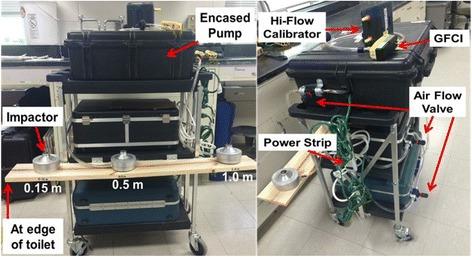
Particle and bioaerosol concentrations were measured in hospital bathrooms across three sampling conditions; no waste no flush, no waste with flush, and fecal waste with flush. Particle and bioaerosol concentrations were measured with a particle counter bioaerosol sampler both before after a toilet flushing event at distances of 0.15, 0.5, and 1 m from the toilet for 5, 10, 15 min.
RESULTS
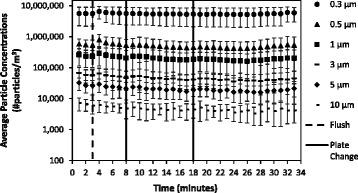
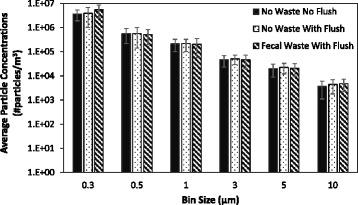
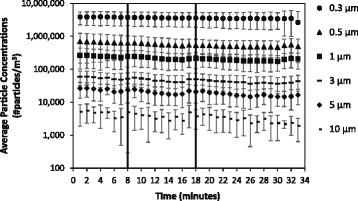
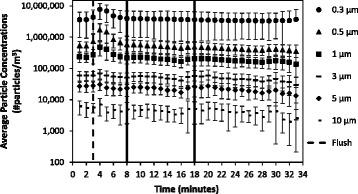
Particle concentrations measured before and after the flush were found to be significantly different (0.3-10 μm). Bioaerosol concentrations when flushing fecal waste were found to be significantly greater than background concentrations (-value = 0.005). However, the bioaerosol concentrations were not different across time (-value = 0.977) or distance (-value = 0.911) from the toilet, suggesting that aerosols generated may remain for longer than 30 min post flush. Toilets produce aerosol particles when flushed, with the majority of the particles being 0.3 μm in diameter. The particles aerosolized include microorganisms remaining from previous use or from fecal wastes. Differences in bioaerosol concentrations across conditions also suggest that toilet flushing is a source of bioaerosols that may result in transmission of pathogenic microorganisms.
CONCLUSIONS
This study is the first to quantify particles and bioaerosols produced from flushing a hospital toilet during routine patient care. Future studies are needed targeting pathogens associated with gastrointestinal illness and evaluating aerosol exposure reduction interventions.
背景
在美国,每年有 170 万免疫功能低下的患者感染与医疗保健相关的感染。这些感染会增加发病率、死亡率和医疗费用。一个相对未被探索的传播途径是在患者护理过程中产生生物气溶胶。致病微生物的传播可能来自吸入或生物气溶胶的表面污染。患者粪便废物的马桶冲洗可能是生物气溶胶的来源。迄今为止,尚无研究调查在患者护理过程中冲洗粪便废物时生物气溶胶的浓度。
方法
在三个采样条件下,即无废物无冲洗、无废物有冲洗和有粪便废物有冲洗,在医院浴室中测量了粒子和生物气溶胶的浓度。在距离马桶 0.15、0.5 和 1 米处,用粒子计数器生物气溶胶采样器测量了粒子和生物气溶胶浓度,在马桶冲洗前后分别在 5、10 和 15 分钟测量了距离马桶 0.15、0.5 和 1 米处的粒子和生物气溶胶浓度。
结果
冲洗前后测量的粒子浓度差异显著(0.3-10μm)。当冲洗粪便废物时,生物气溶胶浓度显著高于背景浓度(-值=0.005)。然而,生物气溶胶浓度在不同时间(-值=0.977)或距离(-值=0.911)上没有差异,这表明冲洗后气溶胶可能会持续 30 分钟以上。马桶冲洗时会产生气溶胶颗粒,其中大部分颗粒的直径为 0.3μm。气溶胶化的颗粒包括来自先前使用或粪便废物的微生物。不同条件下生物气溶胶浓度的差异也表明,马桶冲洗是生物气溶胶的来源,可能导致致病微生物的传播。
结论
本研究首次定量了在常规患者护理过程中冲洗医院马桶产生的颗粒和生物气溶胶。需要进一步的研究针对与胃肠道疾病相关的病原体,并评估减少气溶胶暴露的干预措施。
 Zotero 插件