
测定马桶冲水过程中鼠诺如病毒气溶胶的浓度。
Determination of murine norovirus aerosol concentration during toilet flushing.
机构信息
Cardno ChemRisk, Cincinnati, OH, USA.
College of Public Health, University of Iowa, Iowa City, IA, USA.
出版信息
Sci Rep. 2021 Dec 7;11(1):23558. doi: 10.1038/s41598-021-02938-0.
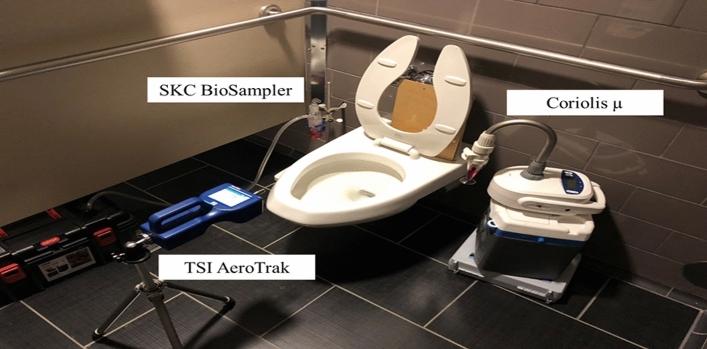
Murine norovirus (MNV) was used as a surrogate for human viral pathogens (e.g., norovirus) to determine if toilet flushing resulted in the aerosolization of virus. A flushometer type toilet was seeded with a viral solution of 10 and 10 PFU mL of MNV and then flushed. Upon flushing, two bioaerosol samplers were activated to collect aerosolized MNV. Prior to the experiment, two optical particle counters monitored particle size and number distribution of aerosol produced from flushing a toilet across height, position, and side. The location with the highest mean particle concentration, was behind the toilet and 0.15 m above the toilet bowl rim, which is where bioaerosol sampling occurred. Bioaerosol and toilet water samples were collected, extracted and then quantified using RT-ddPCR. The concentration of MNV collected after seeding the toilet water ranged from 2.18 × 10 to 9.65 × 10 total copies of MNV. Positive samples of airborne MNV were detected with collected concentrations ranging from 383 to 684 RNA copies/m of air. This study provides evidence that viral pathogens may be aerosolized when a toilet is flushed. Furthermore, the MNV used in this study is a model organism for human norovirus and may be generalizable to other viral pathogens (e.g., coronavirus). This study suggests that virus is aerosolized from toilet flushing and may contribute to human exposure to viral pathogens.
鼠诺如病毒(MNV)被用作人类病毒病原体(如诺如病毒)的替代物,以确定马桶冲水是否会导致病毒气溶胶化。一种冲洗式马桶被接种了含有 10 和 10 PFU/mL MNV 的病毒溶液,然后进行冲洗。冲洗后,两个生物气溶胶采样器被激活,以收集气溶胶化的 MNV。在实验之前,两个光学粒子计数器监测从马桶冲洗过程中产生的气溶胶的粒径和数量分布,跨越高度、位置和侧面。产生最高平均粒子浓度的位置是马桶后面和马桶边缘上方 0.15 米处,这是生物气溶胶采样发生的地方。采集了生物气溶胶和马桶水样本,使用 RT-ddPCR 进行提取和定量。在给马桶水接种后,收集的 MNV 浓度范围为 2.18×10 至 9.65×10 个 MNV 总拷贝。用收集的浓度范围为 383 到 684 RNA 拷贝/立方米空气的方法检测到空气中可检测到的 MNV 阳性样本。本研究提供了证据,表明当马桶冲水时,病毒病原体可能会被气溶胶化。此外,本研究中使用的 MNV 是人类诺如病毒的模式生物,可能适用于其他病毒病原体(如冠状病毒)。本研究表明,病毒从马桶冲水过程中气溶胶化,并可能导致人类接触病毒病原体。

 Zotero 插件