
CD19 抗体 MOR208 治疗复发或难治性 B 细胞非霍奇金淋巴瘤的 IIa 期研究。
Phase IIa study of the CD19 antibody MOR208 in patients with relapsed or refractory B-cell non-Hodgkin's lymphoma.
机构信息
Department of Hematology, Jagiellonian University, Kraków, Poland.
Institute of Hematology "L. e A. Seràgnoli", University of Bologna, Bologna.
出版信息
Ann Oncol. 2018 May 1;29(5):1266-1272. doi: 10.1093/annonc/mdy056.
BACKGROUND
This two-stage, phase IIa study investigated the antitumor activity and safety of MOR208, an Fc-engineered, humanized, CD19 antibody, in patients with relapsed or refractory (R-R) B-cell non-Hodgkin's lymphoma (NHL). CD19 is broadly expressed across the B-lymphocyte lineage, including in B-cell malignancies, but not by hematological stem cells.
PATIENTS AND METHODS
Patients aged ≥18 years, with R-R NHL progressing after ≥1 prior rituximab-containing regimen were enrolled into subtype-specific cohorts: diffuse large B-cell lymphoma (DLBCL), follicular lymphoma (FL), other indolent (i)NHL and mantle cell lymphoma (MCL). Treatment was MOR208, 12 mg/kg intravenously, weekly, for 8 weeks. Patients with at least stable disease could continue treatment for an additional 4 weeks. Those with a partial or complete response after 12 weeks could receive extended MOR208 treatment (12 mg/kg, either monthly or every second week) until progression. The primary end point was overall response rate.
RESULTS
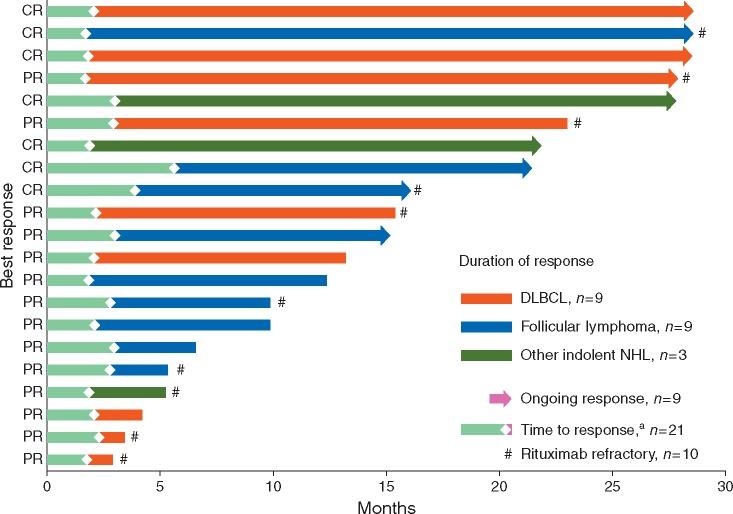
Ninety-two patients were enrolled: DLBCL (n = 35), FL (n = 34), other iNHL (n = 11) and MCL (n = 12). Responses were observed in DLBCL, FL and other iNHL cohorts (26%, 29% and 27%, respectively). They lasted ≥12 months in 5/9 responding patients with DLBCL, 4/9 with FL and 2/3 with other iNHL. Responses in nine patients are ongoing (>26 months in five instances). Patients with rituximab refractory disease showed a similar response rate and progression-free survival time to patients with non-refractory disease. The most common adverse events (any grade) were infusion-related reactions (12%) and neutropenia (12%). One patient experienced a grade 4 infusion-related reaction and eight patients (9%) experienced grade 3/4 neutropenia. No treatment-related deaths were reported.
CONCLUSIONS
MOR208 monotherapy demonstrated promising clinical activity in patients with R-R DLBCL and R-R FL, including in patients with rituximab refractory tumors. These efficacy data and the favorable safety profile support further investigation of MOR208 in phase II/III combination therapy trials in R-R DLBCL.
CLINICALTRIALS.GOV NUMBER: NCT01685008.
背景
这项两阶段、Ⅱa 期研究旨在评估 MOR208(一种 Fc 工程化的、人源化的 CD19 抗体)在复发或难治性(R-R)B 细胞非霍奇金淋巴瘤(NHL)患者中的抗肿瘤活性和安全性。CD19 在 B 淋巴细胞谱系中广泛表达,包括 B 细胞恶性肿瘤,但不包括造血干细胞。
患者和方法
年龄≥18 岁、在接受≥1 种含利妥昔单抗的方案后进展的 R-R NHL 患者被纳入特定亚型队列:弥漫性大 B 细胞淋巴瘤(DLBCL)、滤泡性淋巴瘤(FL)、其他惰性(i)NHL 和套细胞淋巴瘤(MCL)。治疗方案为 MOR208,12mg/kg 静脉注射,每周 1 次,共 8 周。至少疾病稳定的患者可继续接受另外 4 周的治疗。在 12 周时出现部分或完全缓解的患者可接受扩展的 MOR208 治疗(12mg/kg,每月或每两周 1 次),直至疾病进展。主要终点为总缓解率。
结果
共纳入 92 例患者:DLBCL(n=35)、FL(n=34)、其他 iNHL(n=11)和 MCL(n=12)。DLBCL、FL 和其他 iNHL 队列均观察到缓解(分别为 26%、29%和 27%)。5/9 例 DLBCL 缓解患者、4/9 例 FL 缓解患者和 2/3 例其他 iNHL 缓解患者的缓解持续时间≥12 个月。9 例患者的缓解仍在持续(5 例持续时间>26 个月)。利妥昔单抗难治性疾病患者的缓解率和无进展生存期与非难治性疾病患者相似。最常见的不良反应(任何级别)为输注相关反应(12%)和中性粒细胞减少症(12%)。1 例患者发生 4 级输注相关反应,8 例(9%)患者发生 3/4 级中性粒细胞减少症。无治疗相关死亡报告。
结论
MOR208 单药治疗在 R-R DLBCL 和 R-R FL 患者中显示出有前景的临床活性,包括在利妥昔单抗难治性肿瘤患者中。这些疗效数据和良好的安全性特征支持在 R-R DLBCL 的Ⅱ/Ⅲ 期联合治疗试验中进一步研究 MOR208。
临床试验.gov 编号:NCT01685008。
 Zotero 插件