
埃塞俄比亚高血压患病率:一项系统的荟萃分析。
Prevalence of hypertension in Ethiopia: a systematic meta-analysis.
作者信息
Kibret Kelemu Tilahun, Mesfin Yonatan Moges
机构信息
1Department of Public Health, Wollega University, Nekemte, Ethiopia.
2Department of Public Health, Haramaya University, Harar, Ethiopia.
出版信息
Public Health Rev. 2015 Dec 9;36:14. doi: 10.1186/s40985-015-0014-z. eCollection 2015.
BACKGROUND
Hypertension has been increasing in developing countries including Ethiopia. Other than smaller studies, there is no national prevalence study on hypertension in Ethiopia. These smaller studies reported varied prevalence of hypertension. This study is intended to summarize and pool the results of smaller region based studies to provide a national level estimate of the prevalence of hypertension.
METHODS
The studies were identified through internet search using the data base of MEDLINE/PubMed, Google scholar, EMBASE, HINARI, Cochrane library and reference lists of previous prevalence studies. We also made manual searches to identify relevant articles. Descriptive information for the original studies is presented in a table and the quantitative results were presented in forest plots. The Cochrane Q test and I test statistic were used to test heterogeneity across studies. The Pooled estimate of prevalence of hypertension was computed by a random effects model.
RESULTS
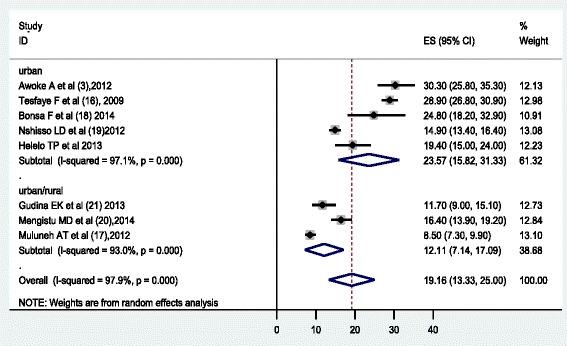
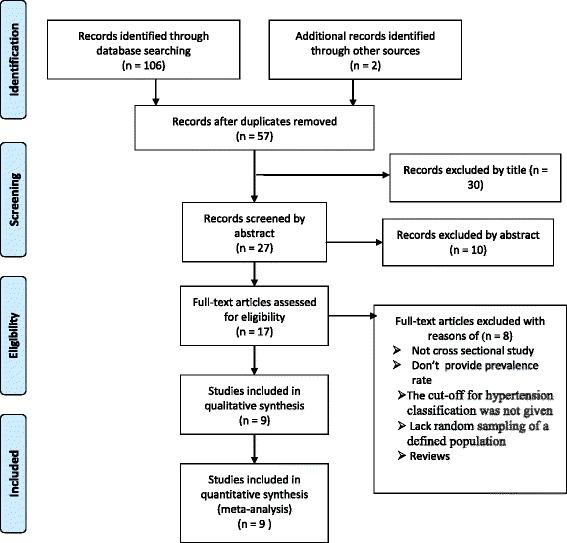
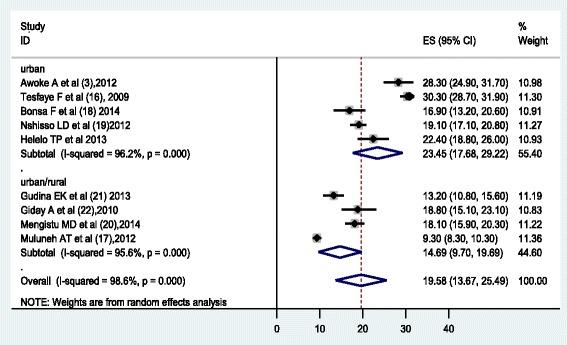
One hundred eight titles were identified through electronic searching using keywords. Of these, nine studies were meet the inclusion criteria. A random effect meta-analysis of the results from these 9 studies was conducted to provide an estimate of the prevalence of hypertension in the Ethiopian population. The analysis showed that the prevalence of hypertension among Ethiopian population was estimated to be 19.6 % (95 % CI: 13.7 %, 25.5 %). Subgroup analyses indicated that the prevalence of hypertension is higher in the urban population (23.7 %) than rural and urban combined (14.7 %). The prevalence of hypertension among males (20.6 %) and females (19.2 %) was similar.
CONCLUSION
This study found that the prevalence of hypertension in Ethiopia is increasing. This evidence suggests that attention has to be given to primary prevention of hypertension in the Ethiopian adult population, especially in the urban population by integrating it with health extension programs.
背景
包括埃塞俄比亚在内的发展中国家高血压发病率一直在上升。除了一些规模较小的研究外,埃塞俄比亚没有关于高血压的全国患病率研究。这些较小规模的研究报告的高血压患病率各不相同。本研究旨在总结和汇总基于较小区域的研究结果,以提供全国范围内高血压患病率的估计。
方法
通过使用MEDLINE/PubMed、谷歌学术、EMBASE、HINARI、Cochrane图书馆数据库以及以往患病率研究的参考文献列表进行互联网搜索来确定研究。我们还进行了人工搜索以确定相关文章。原始研究的描述性信息列于表格中,定量结果以森林图呈现。使用Cochrane Q检验和I检验统计量来检验各研究间的异质性。高血压患病率的合并估计值通过随机效应模型计算。
结果
通过使用关键词进行电子搜索确定了108个标题。其中,9项研究符合纳入标准。对这9项研究的结果进行了随机效应荟萃分析,以估计埃塞俄比亚人群中高血压的患病率。分析表明,埃塞俄比亚人群中高血压的患病率估计为19.6%(95%置信区间:13.7%,25.5%)。亚组分析表明,城市人群中高血压的患病率(23.7%)高于农村和城市合并人群(14.7%)。男性(20.6%)和女性(19.2%)的高血压患病率相似。
结论
本研究发现埃塞俄比亚高血压的患病率在上升。这一证据表明,必须关注埃塞俄比亚成年人群中高血压的一级预防,特别是通过将其与健康推广项目相结合,关注城市人群中的高血压预防。

 Zotero 插件