
耐热和嗜温真菌中肽酶的基因组挖掘及耐热性的可能适应性。
Genome mining for peptidases in heat-tolerant and mesophilic fungi and putative adaptations for thermostability.
机构信息
Department of Biochemistry and Microbiology, São Paulo State University (UNESP), Avenida 24-A, 1515, Bela Vista, Rio Claro, SP, 13560-900, Brazil.
Department of Biology, Biotechnical Faculty, University of Ljubljana, Ljubljana, Slovenia.
出版信息
BMC Genomics. 2018 Feb 20;19(1):152. doi: 10.1186/s12864-018-4549-5.
BACKGROUND
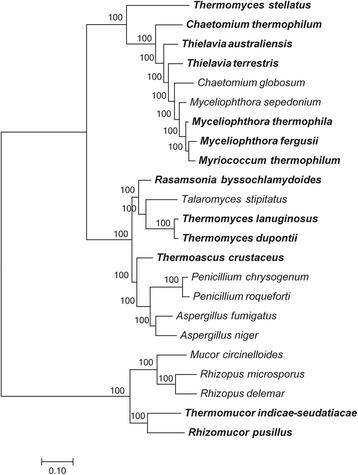
Peptidases (EC 3.4) consist of a large group of hydrolytic enzymes that catalyze the hydrolysis of proteins accounting for approximately 65% of the total worldwide enzyme production. Peptidases from thermophilic fungi have adaptations to high temperature that makes them adequate for biotechnological application. In the present study, we profiled the genomes of heat-tolerant fungi and phylogenetically related mesophilic species for genes encoding for peptidases and their putative adaptations for thermostability.
RESULTS
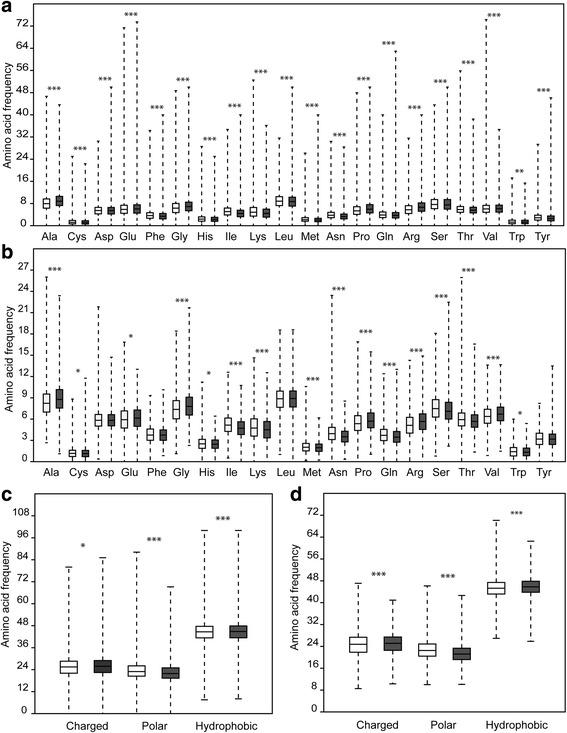
We generated an extensive catalogue of these enzymes ranging from 241 to 820 peptidase genes in the genomes of 23 fungi. Thermophilic species presented the smallest number of peptidases encoding genes in relation to mesophilic species, and the peptidases families with a greater number of genes were the most affected. We observed differences in peptidases in thermophilic species in comparison to mesophilic counterparts, at (i) the genome level: a great reduction in the number of peptidases encoding genes that harbored a higher number of copies; (ii) in the primary protein structure: shifts in proportion of single or groups of amino acids; and (iii) in the three-dimensional structure: reduction in the number of internal cavities. Similar results were reported for extremely thermophilic proteins, but here we show for the first time that several changes also occurred on the moderate thermophilic enzymes of fungi. In regards to the amino acids composition, peptidases from thermophilic species in relation to the mesophilic ones, contained a larger proportion of Ala, Glu, Gly, Pro, Arg and Val residues and a lower number of Cys, His, Ile, Lys, Met, Asn, Gln, Ser, Thr and Trp residues (P < 0.05). Moreover, we observed an increase in the proportion of hydrophobic and charged amino acids and a decrease in polar amino acids.
CONCLUSIONS
Although thermophilic fungi present less genes encoding for peptidases, these have adaptations that could play a role in thermal resistance from genome to protein structure level.
背景
肽酶(EC 3.4)由一大类水解酶组成,它们催化蛋白质的水解,占全球酶总产量的约 65%。耐热真菌的肽酶具有适应高温的特性,使其适合于生物技术应用。在本研究中,我们对耐热真菌和系统发育相关的嗜温种的基因组进行了分析,以确定编码肽酶的基因及其可能的耐热性适应机制。
结果
我们从 23 种真菌的基因组中生成了这些酶的广泛目录,范围从 241 到 820 个肽酶基因。与嗜温种相比,耐热种编码肽酶的基因数量最少,基因数量较多的肽酶家族受影响最大。与嗜温种相比,我们观察到耐热种的肽酶在以下方面存在差异:(i)在基因组水平上:具有更高拷贝数的肽酶编码基因数量大大减少;(ii)在初级蛋白质结构中:单个或氨基酸组的比例发生变化;(iii)在三维结构中:内部空腔数量减少。类似的结果在极耐热蛋白中也有报道,但我们首次表明,真菌中一些中等耐热酶也发生了几种变化。就氨基酸组成而言,与嗜温种相比,耐热种的肽酶含有更多的 Ala、Glu、Gly、Pro、Arg 和 Val 残基,而 Cys、His、Ile、Lys、Met、Asn、Gln、Ser、Thr 和 Trp 残基较少(P<0.05)。此外,我们观察到疏水性和带电荷氨基酸的比例增加,而极性氨基酸的比例减少。
结论
尽管耐热真菌编码的肽酶基因较少,但这些基因具有适应机制,可能在从基因组到蛋白质结构水平的耐热性方面发挥作用。

 Zotero 插件