
蛋白质的热稳定性归因于它们对非极性较小体积氨基酸的偏好、残留理化性质的变化以及更多的盐桥。
Protein Thermostability Is Owing to Their Preferences to Non-Polar Smaller Volume Amino Acids, Variations in Residual Physico-Chemical Properties and More Salt-Bridges.
作者信息
Panja Anindya Sundar, Bandopadhyay Bidyut, Maiti Smarajit
机构信息
Post Graduate Department of Biotechnology, Oriental Institute of Science and Technology, Vidyasagar University, Midnapore, 721102, West Bengal, India.
Post Graduate Department of Biochemistry and Biotechnology, Cell and Molecular Therapeutics Laboratory, Oriental Institute of Science and Technology, Vidyasagar University, Midnapore, 721102, West Bengal, India.
出版信息
PLoS One. 2015 Jul 15;10(7):e0131495. doi: 10.1371/journal.pone.0131495. eCollection 2015.
INTRODUCTION
Protein thermostability is an important field for its evolutionary perspective of mesophilic versus thermophilic relationship and for its industrial/ therapeutic applications.
METHODS
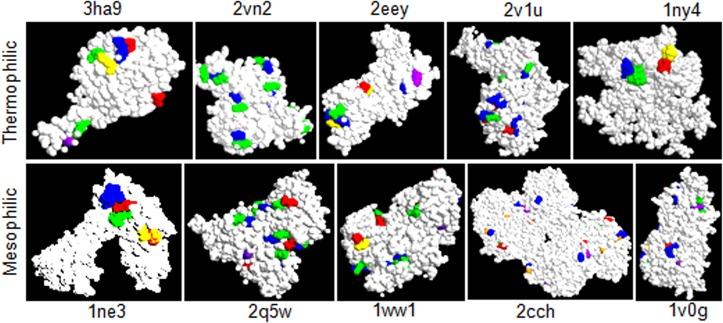
Presently, a total 400 (200 thermophilic and 200 mesophilic homologue) proteins were studied utilizing several software/databases to evaluate their amino acid preferences. Randomly selected 50 homologous proteins with available PDB-structure of each group were explored for the understanding of the protein charges, isoelectric-points, hydrophilicity, hydrophobicity, tyrosine phosphorylation and salt-bridge occurrences. These 100 proteins were further probed to generate Ramachandran plot/data for the gross secondary structure prediction in and comparison between the thermophilic and mesophilic proteins.
RESULTS
Present results strongly suggest that nonpolar smaller volume amino acids Ala (χ2 = 238.54, p<0.001) and Gly (χ2 = 73.35, p<0.001) are highly and Val moderately (χ2 = 144.43, p<0.001) occurring in the 85% of thermophilic proteins. Phospho-regulated Tyr and redox-sensitive Cys are also moderately distributed (χ2~20.0, p<0.01) in a larger number of thermophilic proteins. A consistent lower distribution of thermophilicity and discretely higher distribution of hydrophobicity is noticed in a large number of thermophilic versus their mesophilic protein homolog. The mean differences of isoelectric points and charges are found to be significantly less (7.11 vs. 6.39, p<0.05 and 1 vs. -0.6, p<0.01, respectively) in thermophilic proteins compared to their mesophilic counterpart. The possible sites for Tyr phosphorylation are noticed to be 25% higher (p<0.05) in thermophilic proteins. The 60% thermophiles are found with higher number of salt bridges in this study. The average percentage of salt-bridge of thermophiles is found to be higher by 20% than their mesophilic homologue. The GLU-HIS and GLU-LYS salt-bridge dyads are calculated to be significantly higher (p<0.05 and p<0.001, respectively) in thermophilic and GLU-ARG is higher in the mesophilic proteins. The Ramachandran plot/ data suggest a higher abundance of the helix, left-handed helix, sheet, nonplanar peptide and lower occurrence of cis peptide, loop/ turn and outlier in thermophiles. Pearson's correlation result suggests that the isoelectric points of mesophilic and thermophilic proteins are positively correlated (r = 0.93 and 0.84, respectively; p<0.001) to their corresponding charges. And their hydrophilicity is negatively associated with the corresponding hydrophobicity (r = -0.493, p<0.001 and r = -0.324, p<0.05) suggesting their reciprocal evolvement.
CONCLUSIONS
Present results for the first time with this large amount of datasets and multiple contributing factors suggest the greater occurrence of hydrophobicity, salt-bridges and smaller volume nonpolar residues (Gly, Ala and Val) and lesser occurrence of bulky polar residues in the thermophilic proteins. A more stoichiometric relationship amongst these factors minimized the hindrance due to side chain burial and increased compactness and secondary structural stability in thermophilic proteins.
引言
蛋白质热稳定性是一个重要领域,这是基于中温与嗜热关系的进化视角以及其工业/治疗应用。
方法
目前,利用多种软件/数据库对总共400种(200种嗜热同源物和200种中温同源物)蛋白质进行了研究,以评估它们的氨基酸偏好。每组随机选择50种具有可用PDB结构的同源蛋白质,以了解蛋白质的电荷、等电点、亲水性、疏水性、酪氨酸磷酸化和盐桥出现情况。对这100种蛋白质进一步进行探测,以生成拉氏图/数据,用于嗜热和中温蛋白质的总体二级结构预测及比较。
结果
目前的结果强烈表明,非极性小体积氨基酸丙氨酸(χ2 = 238.54,p<0.001)和甘氨酸(χ2 = 73.35,p<0.001)在85%的嗜热蛋白质中高度出现,缬氨酸中度出现(χ2 = 144.43,p<0.001)。磷酸化调节的酪氨酸和氧化还原敏感的半胱氨酸在大量嗜热蛋白质中也有中度分布(χ2~20.0,p<0.01)。在大量嗜热蛋白质与其对应的中温蛋白质同源物中,发现嗜热蛋白质的嗜热性分布持续较低,而疏水性分布离散较高。与中温蛋白质相比,嗜热蛋白质的等电点和电荷的平均差异显著更小(分别为7.11对6.39,p<0.05和1对 -0.6,p<0.01)。在嗜热蛋白质中,酪氨酸磷酸化的可能位点高出25%(p<0.05)。在本研究中,发现60%的嗜热蛋白质具有更多的盐桥。嗜热蛋白质的盐桥平均百分比比其对应的中温同源物高20%。计算得出,嗜热蛋白质中的谷氨酸 - 组氨酸和谷氨酸 - 赖氨酸盐桥二元组显著更高(分别为p<0.05和p<0.001),而谷氨酸 - 精氨酸盐桥在中温蛋白质中更高。拉氏图/数据表明,嗜热蛋白质中螺旋、左手螺旋、片层、非平面肽的丰度更高,而顺式肽、环/转角和异常值的出现频率更低。皮尔逊相关结果表明,中温蛋白质和嗜热蛋白质与其相应电荷的等电点呈正相关(分别为r = 0.93和0.84;p<0.001)。并且它们的亲水性与相应的疏水性呈负相关(分别为r = -0.493,p<0.001和r = -0.324,p<0.05),表明它们的相互进化。
结论
目前的结果首次基于如此大量的数据集和多个影响因素表明,嗜热蛋白质中疏水性、盐桥和小体积非极性残基(甘氨酸、丙氨酸和缬氨酸)的出现频率更高,而大体积极性残基的出现频率更低。这些因素之间更化学计量的关系将侧链埋藏造成的阻碍最小化,并增加了嗜热蛋白质的紧凑性和二级结构稳定性。




 Zotero 插件