
阿尔茨海默病的遗传风险集中在特定的巨噬细胞和小胶质细胞转录网络中。
Genetic risk for Alzheimer's disease is concentrated in specific macrophage and microglial transcriptional networks.
机构信息
Core Bioinformatics and Statistics Team, College of Biomedical and Life Sciences, Cardiff University, Cardiff, UK.
MRC Centre for Neuropsychiatric Genetics and Genomics, Division of Psychological Medicine and Clinical Neurosciences, School of Medicine, College of Biomedical and Life Sciences, Cardiff University, Hadyn Ellis Building, Maindy Road, Cardiff, CF24 4HQ, UK.
出版信息
Genome Med. 2018 Feb 26;10(1):14. doi: 10.1186/s13073-018-0523-8.
BACKGROUND
Genome-wide association studies of Alzheimer's disease (AD) have identified a number of significant risk loci, the majority of which lie in non-coding regions of the genome. The lack of causal alleles and considerable polygenicity remains a significant barrier to translation into mechanistic understanding. This includes identifying causal variants and the cell/tissue types in which they operate. A fuller understanding of the cell types and transcriptional networks involved in AD genetic risk mechanisms will provide important insights into pathogenesis.
METHODS
We assessed the significance of the overlap between genome-wide significant AD risk variants and sites of open chromatin from data sets representing diverse tissue types. We then focussed on macrophages and microglia to investigate the role of open chromatin sites containing motifs for specific transcription factors. Partitioned heritability using LDscore regression was used to investigate the contribution of specific macrophage and microglia transcription factor motif-containing open chromatin sites to the heritability of AD.
RESULTS
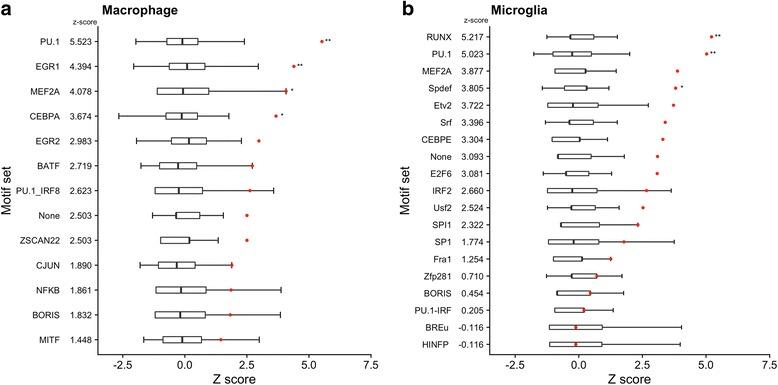
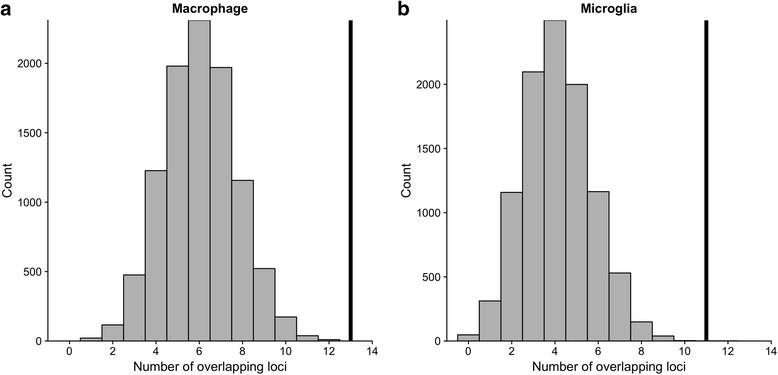
AD risk single nucleotide polymorphisms (SNPs) are preferentially located at sites of open chromatin in immune cells, particularly monocytes (z score = 4.43; corrected P = 5.88 × 10). Similar enrichments are observed for macrophages (z score = 4.10; corrected P < 2.40 × 10) and microglia (z score = 4.34, corrected P = 0.011). In both macrophages and microglia, AD risk variants are enriched at a subset of open chromatin sites that contain DNA binding motifs for specific transcription factors, e.g. SPI1 and MEF2. Genetic variation at many of these motif-containing sites also mediate a substantial proportion of AD heritability, with SPI1-containing sites capturing the majority of the common variant SNP-chip heritability (microglia enrichment = 16.28, corrected enrichment P = 0.0044).
CONCLUSIONS
AD risk alleles plausibly operate in immune cells, including microglia, and are concentrated in specific transcriptional networks. Combined with primary genetic association results, the SPI1 and MEF2 transcriptional networks appear central to AD risk mechanisms. Investigation of transcription factors targeting AD risk SNP associated regulatory elements could provide powerful insights into the molecular processes affected by AD polygenic risk. More broadly, our findings support a model of polygenic disease risk that arises from variants located in specific transcriptional networks.
背景
阿尔茨海默病(AD)的全基因组关联研究已经确定了许多重要的风险位点,其中大多数位于基因组的非编码区域。缺乏因果等位基因和相当大的多基因性仍然是转化为机制理解的一个重大障碍。这包括确定因果变异和它们作用的细胞/组织类型。更全面地了解 AD 遗传风险机制所涉及的细胞类型和转录网络将为发病机制提供重要的见解。
方法
我们评估了全基因组显著 AD 风险变异与代表不同组织类型的数据集中开放染色质位点之间重叠的显著性。然后,我们专注于巨噬细胞和小胶质细胞,以研究包含特定转录因子模体的开放染色质位点在 AD 遗传风险机制中的作用。使用 LDscore 回归进行分区遗传力分析,以研究特定巨噬细胞和小胶质细胞转录因子模体包含的开放染色质位点对 AD 遗传力的贡献。
结果
AD 风险单核苷酸多态性(SNP)优先位于免疫细胞(尤其是单核细胞)中的开放染色质位点(z 分数= 4.43;校正 P = 5.88×10)。在巨噬细胞(z 分数= 4.10;校正 P < 2.40×10)和小胶质细胞(z 分数= 4.34,校正 P = 0.011)中也观察到类似的富集。在巨噬细胞和小胶质细胞中,AD 风险变体在包含特定转录因子 DNA 结合模体的开放染色质位点的子集上富集,例如 SPI1 和 MEF2。这些包含模体的位点的遗传变异也介导了 AD 遗传力的很大一部分,其中包含 SPI1 的位点捕获了大多数常见变体 SNP 芯片遗传力(小胶质细胞富集= 16.28,校正富集 P = 0.0044)。
结论
AD 风险等位基因可能在包括小胶质细胞在内的免疫细胞中起作用,并且集中在特定的转录网络中。结合主要的遗传关联结果,SPI1 和 MEF2 转录网络似乎是 AD 风险机制的核心。针对 AD 风险 SNP 相关调节元件的转录因子的研究可以为受 AD 多基因风险影响的分子过程提供有力的见解。更广泛地说,我们的发现支持了一种多基因疾病风险模型,该模型源于位于特定转录网络中的变体。


 Zotero 插件