
与阿尔茨海默病相关的增强子变异通过染色质环影响基因表达。
Enhancer variants associated with Alzheimer's disease affect gene expression via chromatin looping.
机构信息
Department of Genome Informatics, Graduate School of Medicine, Osaka University, 2-2 Yamadaoka, Suita, Osaka, 565-0871, Japan.
Department of Molecular Genetics, Brain Research Institute, Niigata University, Niigata, Japan.
出版信息
BMC Med Genomics. 2019 Sep 9;12(1):128. doi: 10.1186/s12920-019-0574-8.
BACKGROUND
Genome-wide association studies (GWASs) have identified single-nucleotide polymorphisms (SNPs) that may be genetic factors underlying Alzheimer's disease (AD). However, how these AD-associated SNPs (AD SNPs) contribute to the pathogenesis of this disease is poorly understood because most of them are located in non-coding regions, such as introns and intergenic regions. Previous studies reported that some disease-associated SNPs affect regulatory elements including enhancers. We hypothesized that non-coding AD SNPs are located in enhancers and affect gene expression levels via chromatin loops.
METHODS
To characterize AD SNPs within non-coding regions, we extracted 406 AD SNPs with GWAS p-values of less than 1.00 × 10 from the GWAS catalog database. Of these, we selected 392 SNPs within non-coding regions. Next, we checked whether those non-coding AD SNPs were located in enhancers that typically regulate gene expression levels using publicly available data for enhancers that were predicted in 127 human tissues or cell types. We sought expression quantitative trait locus (eQTL) genes affected by non-coding AD SNPs within enhancers because enhancers are regulatory elements that influence the gene expression levels. To elucidate how the non-coding AD SNPs within enhancers affect the gene expression levels, we identified chromatin-chromatin interactions by Hi-C experiments.
RESULTS
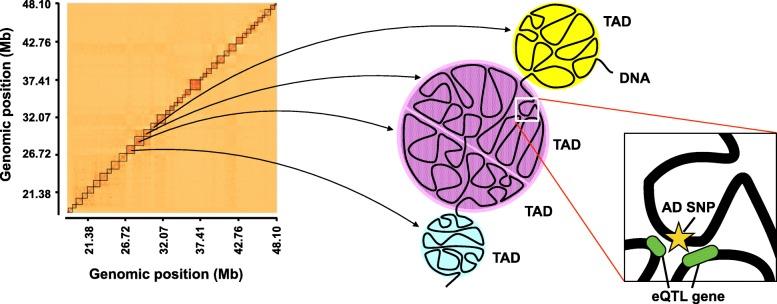
We report the following findings: (1) nearly 30% of non-coding AD SNPs are located in enhancers; (2) eQTL genes affected by non-coding AD SNPs within enhancers are associated with amyloid beta clearance, synaptic transmission, and immune responses; (3) 95% of the AD SNPs located in enhancers co-localize with their eQTL genes in topologically associating domains suggesting that regulation may occur through chromatin higher-order structures; (4) rs1476679 spatially contacts the promoters of eQTL genes via CTCF-CTCF interactions; (5) the effect of other AD SNPs such as rs7364180 is likely to be, at least in part, indirect through regulation of transcription factors that in turn regulate AD associated genes.
CONCLUSION
Our results suggest that non-coding AD SNPs may affect the function of enhancers thereby influencing the expression levels of surrounding or distant genes via chromatin loops. This result may explain how some non-coding AD SNPs contribute to AD pathogenesis.
背景
全基因组关联研究(GWAS)已经确定了可能是阿尔茨海默病(AD)遗传基础的单核苷酸多态性(SNP)。然而,这些与 AD 相关的 SNP(AD SNP)如何导致这种疾病的发病机制尚不清楚,因为它们大多数位于非编码区域,如内含子和基因间区域。先前的研究报告称,一些疾病相关的 SNP 会影响包括增强子在内的调节元件。我们假设非编码 AD SNP 位于增强子中,并通过染色质环影响基因表达水平。
方法
为了描述非编码区域中的 AD SNP,我们从 GWAS 目录数据库中提取了 406 个 GWAS p 值小于 1.00×10 的 AD SNP。其中,我们选择了 392 个非编码区域内的 SNP。接下来,我们使用在 127 个人体组织或细胞类型中预测的增强子的公开可用数据检查这些非编码 AD SNP 是否位于通常调节基因表达水平的增强子中。我们寻找受增强子中非编码 AD SNP 影响的表达数量性状基因座(eQTL)基因,因为增强子是影响基因表达水平的调节元件。为了阐明增强子内非编码 AD SNP 如何影响基因表达水平,我们通过 Hi-C 实验鉴定了染色质-染色质相互作用。
结果
我们报告了以下发现:(1)近 30%的非编码 AD SNP 位于增强子中;(2)增强子内非编码 AD SNP 影响的 eQTL 基因与淀粉样β清除、突触传递和免疫反应有关;(3)95%位于增强子中的 AD SNP 与其在拓扑关联域中的 eQTL 基因共定位,表明调节可能通过染色质高级结构发生;(4)rs1476679 通过 CTCF-CTCF 相互作用与 eQTL 基因的启动子空间接触;(5)其他 AD SNP(如 rs7364180)的作用可能至少部分是间接的,通过调节转录因子来调节 AD 相关基因。
结论
我们的结果表明,非编码 AD SNP 可能通过影响增强子的功能,从而通过染色质环影响周围或远处基因的表达水平。这一结果可能解释了一些非编码 AD SNP 如何导致 AD 的发病机制。



 Zotero 插件