
叶状黏胶蓟马的卵巢激活偏斜取决于住所大小。
Skew in ovarian activation depends on domicile size in phyllode-glueing thrips.
机构信息
University of Hull, Cottingham Road, Hull, HU6 7RX, UK.
Fowlers Gap Arid Zone Research Station, School of Biological, Earth & Environmental Sciences, University of New South Wales, Sydney, NSW 2052, Australia.
出版信息
Sci Rep. 2018 Feb 26;8(1):3597. doi: 10.1038/s41598-018-21635-z.
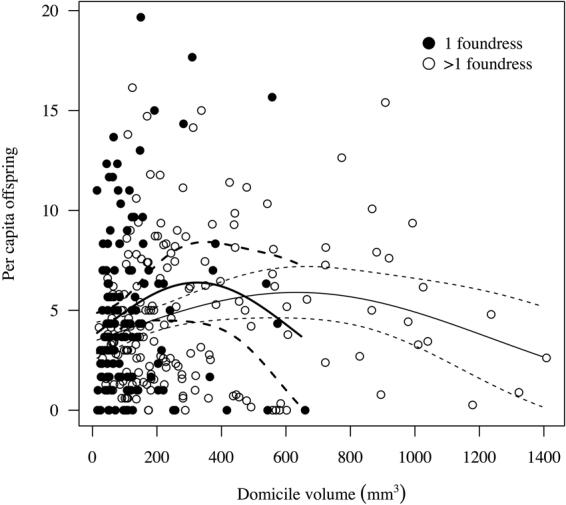
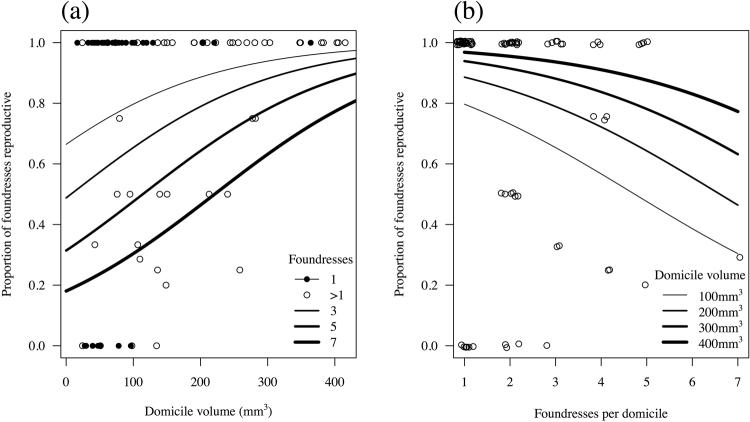
Costs and benefits of group living are a fundamental topic in behavioural ecology. Resource availability affects individuals' breeding prospects alone and in groups, as well as how reproduction is distributed within groups ("reproductive skew"). Here, in facultatively social thrips, we provide correlational evidence that breeding resources are associated with (1) whether solitary or social living is favoured, and (2) the degree of ovarian skew. Dunatothrips aneurae (Thysanoptera, Phlaeothripidae) cooperatively build silk "domiciles" on Australian Acacias, feeding exclusively from internal phyllode surfaces. Per capita productivity scaled differently with group size depending on domicile volume - females in small domiciles did better alone than in groups, whereas in large domiciles single and group-nesting females did equally well. Ovarian dissections revealed that in small domiciles some females were nonreproductive, indicating ovarian (i.e. reproductive) skew. Skew increased as domicile size decreased and group size increased. Breeders had smaller oocyte volume in smaller domiciles, especially those containing nonreproductives. These findings suggest group formation and reproductive skew in D. aneurae may be influenced by reproductive competition for breeding resources. Nonreproductive females in small domiciles may be reproductively suppressed, subfertile, or accumulating resources to reproduce.
群体生活的成本和收益是行为生态学的一个基本课题。资源的可利用性单独和在群体中影响个体的繁殖前景,以及繁殖在群体中的分布情况(“繁殖倾斜”)。在这里,在兼性社会性蓟马中,我们提供了相关证据表明,繁殖资源与(1)是选择独居还是群居生活有关,以及(2)卵巢倾斜的程度有关。Dunatothrips aneurae(缨翅目,Phlaeothripidae)在澳大利亚金合欢上合作建造丝质“住所”,专门从内部叶状表面取食。个体生产力根据住所体积以不同的方式与群体大小成比例缩放-在小住所中的雌性独自生活比在群体中生活更好,而在大住所中,单独和群体筑巢的雌性表现同样出色。卵巢解剖显示,在小住所中,有些雌性是不育的,表明卵巢(即生殖)倾斜。随着住所大小的减小和群体大小的增加,倾斜度增加。在较小的住所中,繁殖者的卵母细胞体积较小,尤其是那些含有非繁殖者的住所。这些发现表明,D. aneurae 中的群体形成和繁殖倾斜可能受到繁殖资源竞争的影响。在小住所中的非繁殖性雌性可能受到生殖抑制、生育力低下或积累资源以繁殖。



 Zotero 插件