
人类接触阻燃剂与精子中印迹基因的异常DNA甲基化有关。
Human exposure to flame-retardants is associated with aberrant DNA methylation at imprinted genes in sperm.
作者信息
Soubry Adelheid, Hoyo Cathrine, Butt Craig M, Fieuws Steffen, Price Thomas M, Murphy Susan K, Stapleton Heather M
机构信息
Epidemiology Research Unit, Faculty of Medicine, Department of Public Health and Primary Care, KU Leuven, Kapucijnenvoer 35, Blok D, Box 7001, University of Leuven, Leuven, Belgium.
Department of Biological Sciences, Center for Human Health and the Environment, North Carolina State University, Campus Box 7633, Raleigh, NC 27633, USA.
出版信息
Environ Epigenet. 2017 Apr 14;3(1):dvx003. doi: 10.1093/eep/dvx003. eCollection 2017 Jan.
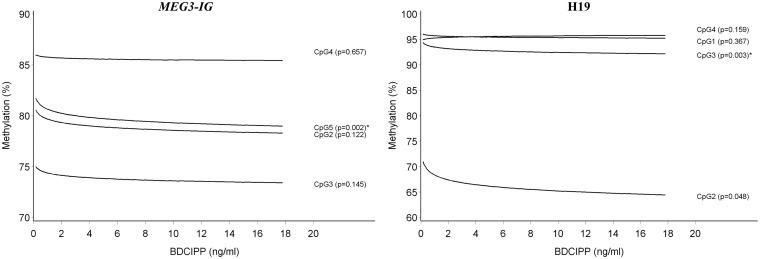
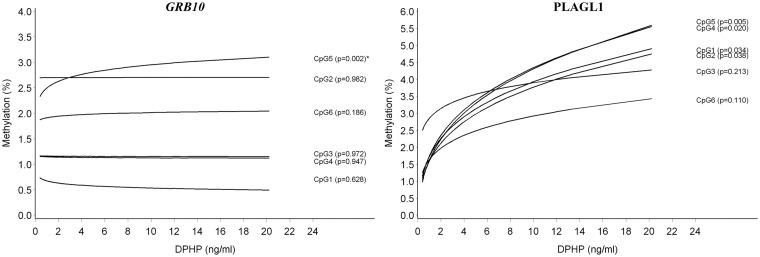
Emerging evidence suggests that early exposure to endocrine disrupting chemicals has long-term consequences that can influence disease risk in offspring. During gametogenesis, imprinted genes are reasonable epigenetic targets with the ability to retain and transfer environmental messages. We hypothesized that exposures to organophosphate (OP) flame-retardants can alter DNA methylation in human sperm cells affecting offspring's health. Sperm and urine samples were collected from 67 men in North Carolina, USA. Urinary metabolites of a chlorinated OP, tris(1,3-dichloro-2-propyl) phosphate, and two non-chlorinated OPs, triphenyl phosphate and mono-isopropylphenyl diphenyl phosphate, were measured using liquid-chromatography tandem mass-spectrometry. Sperm DNA methylation at multiple CpG sites of the regulatory differentially methylated regions (DMRs) of imprinted genes , , , , , , , , , , and was quantified using bisulfite pyrosequencing. Regression models were used to determine potential associations between OP concentrations and DNA methylation. We found that men with higher concentrations of urinary OP metabolites, known to originate from flame-retardants, have a slightly higher fraction of sperm cells that are aberrantly methylated. After adjusting for age, obesity-status and multiple testing, exposure to mono-isopropylphenyl diphenyl phosphate was significantly related to hypermethylation at the DMRs. Exposure to triphenyl phosphate was associated with hypermethylation at the DMR; and tris(1,3-dichloro-2-propyl) phosphate exposure was associated with altered methylation at the and DMRs. Although measured methylation differences were small, implications for public health can be substantial. Interestingly, our data indicated that a multiplicity of OPs in the human body is associated with increased DNA methylation aberrancies in sperm, compared to exposure to few OPs. Further research is required in larger study populations to determine if our findings can be generalized.
新出现的证据表明,早期接触内分泌干扰化学物质会产生长期后果,可能影响后代的疾病风险。在配子发生过程中,印记基因是合理的表观遗传靶点,具有保留和传递环境信息的能力。我们假设,接触有机磷酸酯(OP)阻燃剂会改变人类精子细胞中的DNA甲基化,从而影响后代健康。从美国北卡罗来纳州的67名男性中收集了精子和尿液样本。使用液相色谱串联质谱法测量了一种氯化OP(三(1,3-二氯-2-丙基)磷酸酯)以及两种非氯化OP(磷酸三苯酯和单异丙基苯基二苯基磷酸酯)的尿液代谢物。使用亚硫酸氢盐焦磷酸测序法定量了印记基因、、、、、、、、、和调控性差异甲基化区域(DMR)多个CpG位点的精子DNA甲基化。使用回归模型确定OP浓度与DNA甲基化之间的潜在关联。我们发现,尿液中OP代谢物浓度较高(已知源自阻燃剂)的男性,其精子细胞异常甲基化的比例略高。在调整年龄、肥胖状况和多重检验后,接触单异丙基苯基二苯基磷酸酯与DMR处的高甲基化显著相关。接触磷酸三苯酯与DMR处的高甲基化有关;接触三(1,3-二氯-2-丙基)磷酸酯与和DMR处的甲基化改变有关。尽管测得的甲基化差异很小,但对公共卫生的影响可能很大。有趣的是,我们的数据表明,与接触少量OP相比,人体中多种OP与精子中DNA甲基化异常增加有关。需要在更大的研究人群中进行进一步研究,以确定我们的发现是否具有普遍性。

 Zotero 插件