
NEJ005/TCOG0902的更新生存结果:一项关于吉非替尼与化疗同步或序贯交替用于既往未治疗的具有敏感突变的非小细胞肺癌的随机II期研究。
Updated survival outcomes of NEJ005/TCOG0902: a randomised phase II study of concurrent versus sequential alternating gefitinib and chemotherapy in previously untreated non-small cell lung cancer with sensitive mutations.
作者信息
Oizumi Satoshi, Sugawara Shunichi, Minato Koichi, Harada Toshiyuki, Inoue Akira, Fujita Yuka, Maemondo Makoto, Watanabe Satoshi, Ito Kazuhiko, Gemma Akihiko, Demura Yoshiki, Fukumoto Shinichi, Isobe Hiroshi, Kinoshita Ichiro, Morita Satoshi, Kobayashi Kunihiko, Hagiwara Koichi, Aiba Keisuke, Nukiwa Toshihiro
机构信息
Department of Respiratory Medicine, National Hospital Organization Hokkaido Cancer Center, Sapporo, Japan.
First Department of Medicine, Hokkaido University Hospital, Sapporo, Japan.
出版信息
ESMO Open. 2018 Feb 23;3(2):e000313. doi: 10.1136/esmoopen-2017-000313. eCollection 2018.
BACKGROUND
The North-East Japan Study Group (NEJ) 005/Tokyo Cooperative Oncology Group (TCOG) 0902 study has reported that first-line concurrent and sequential alternating combination therapies of an epidermal growth factor receptor (EGFR) tyrosine kinase inhibitor (gefitinib) plus platinum-based doublet chemotherapy (carboplatin/pemetrexed) offer promising efficacy with predictable toxicities for patients with -mutant non-small cell lung cancer. However, overall survival (OS) data were insufficient in the primary report because of the lack of death events.
PATIENTS AND METHODS
Progression-free survival (PFS) and OS were re-evaluated at the final data cut-off point (March 2017) for the entire population (n=80).
RESULTS
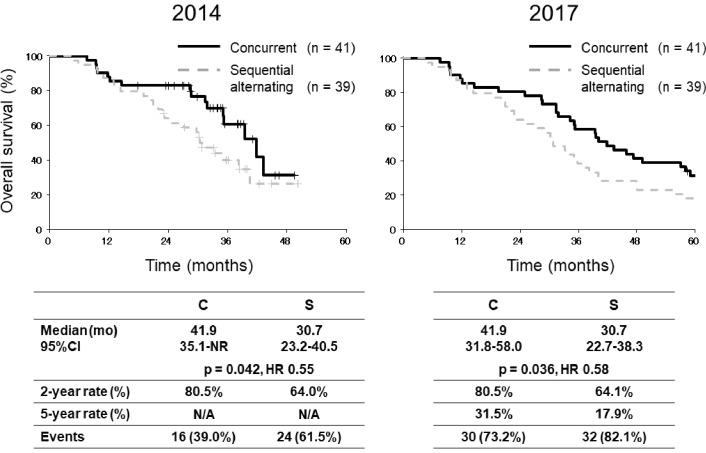
At the median follow-up time of 35.6 months, 88.8% of patients had progressive disease and 77.5% of patients had died. Median PFS was 17.5 months for the concurrent regimen and 15.3 months for the sequential alternating regimen (P=0.13). Median OS was 41.9 and 30.7 months, respectively (P=0.036). Updated response rates were similar in both groups (90.2% and 82.1%, respectively; P=0.34). Patients with Del19 tumours displayed relatively better OS (median: 45.3 vs 33.3 months, respectively) than those with L858R (31.4 vs 28.9 months, respectively). No severe adverse events, including interstitial lung disease, occurred in the period since the primary report.
CONCLUSIONS
This updated analysis confirms that PFS is improved with first-line combination therapy compared with gefitinib monotherapy and that the concurrent regimen, in particular, offers an OS benefit of 42 months in the -mutated setting. Our ongoing NEJ009 study will clarify whether this combination strategy can be incorporated into routine clinical practice.
TRIAL REGISTRATION NUMBER
UMIN C000002789, Post-results.
背景
日本东北研究小组(NEJ)005/东京肿瘤协作组(TCOG)0902研究报告称,对于表皮生长因子受体(EGFR)酪氨酸激酶抑制剂(吉非替尼)联合铂类双联化疗(卡铂/培美曲塞)的一线同步和序贯交替联合疗法,对EGFR突变的非小细胞肺癌患者具有可预测的毒性且疗效可观。然而,由于缺乏死亡事件,主要报告中的总生存期(OS)数据并不充分。
患者与方法
在最终数据截止点(2017年3月)对全部患者(n = 80)重新评估无进展生存期(PFS)和OS。
结果
在35.6个月的中位随访时间时,88.8%的患者出现疾病进展,77.5%的患者死亡。同步治疗方案的中位PFS为17.5个月,序贯交替治疗方案的中位PFS为15.3个月(P = 0.13)。中位OS分别为41.9个月和30.7个月(P = 0.036)。两组的更新缓解率相似(分别为90.2%和82.1%;P = 0.34)。与L858R突变患者(分别为31.4个月和28.9个月)相比,Del19突变肿瘤患者的OS相对更好(分别为45.3个月和33.3个月)。自主要报告以来的这段时间内未发生包括间质性肺病在内的严重不良事件。
结论
这项更新分析证实,与吉非替尼单药治疗相比,一线联合治疗可改善PFS,尤其是同步治疗方案在EGFR突变情况下可提供42个月的OS获益。我们正在进行的NEJ009研究将阐明这种联合策略是否可纳入常规临床实践。
试验注册号
UMIN C000002789,结果后。


 Zotero 插件