
白蛋白结合型紫杉醇联合 S-1 序贯吉西他滨-奥沙利铂方案作为一线交替序贯治疗胰腺导管腺癌。
Nab-paclitaxel plus S-1 followed by gemcitabine-oxaliplatin as first-line alternating sequential treatment of pancreatic ductal adenocarcinoma.
机构信息
Department of Gastrointestinal Medical Oncology, Harbin Medical University Cancer Hospital, Harbin, People's Republic of China.
Shenzhen Engineering Center for Translational Medicine of Precision Cancer Immunodiagnosis and Therapy, YuceBio Technology Co., Ltd, Shenzhen, People's Republic of China.
出版信息
Oncologist. 2024 Nov 4;29(11):997-e1614. doi: 10.1093/oncolo/oyae207.
BACKGROUND
Alternating sequential administration of drugs may be a promising approach to overcome chemotherapy resistance in advanced pancreatic ductal adenocarcinoma (PDAC).
METHODS
This study was an open-label, single-arm, and prospective trial included patients with untreated advanced PDAC. They received 2 cycles of NS regimen (nab-paclitaxel:125 mg/m2, intravenously injected on days 1 and 8, plus S-1:40-60 mg, orally twice per day for 1-14 days) followed by 2 cycles of GemOx regimen (gemcitabine, intravenously injected on days 1 and 8, and oxaliplatin: 130 mg/m2, intravenously injected on day 1). The primary efficacy endpoint was a progression-free survival rate at 6 months (PFSR-6m). The secondary efficacy endpoints included overall survival (OS), progression-free survival (PFS), objective response rate (ORR), disease control rate (DCR), and adverse events (AEs). Specific mRNA transcripts were used to explore survival associated genes.
RESULTS
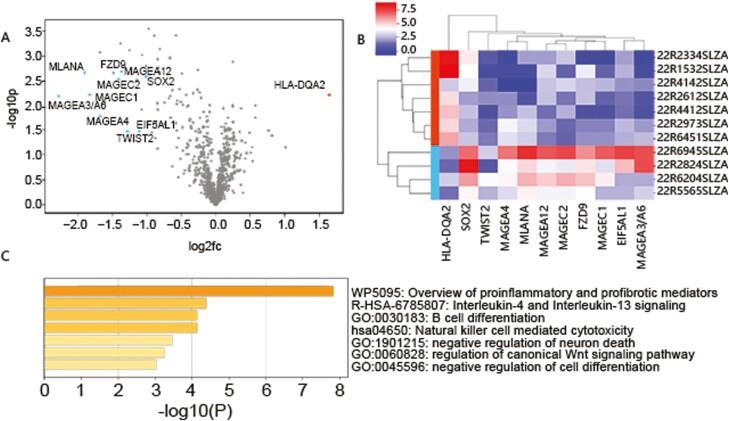
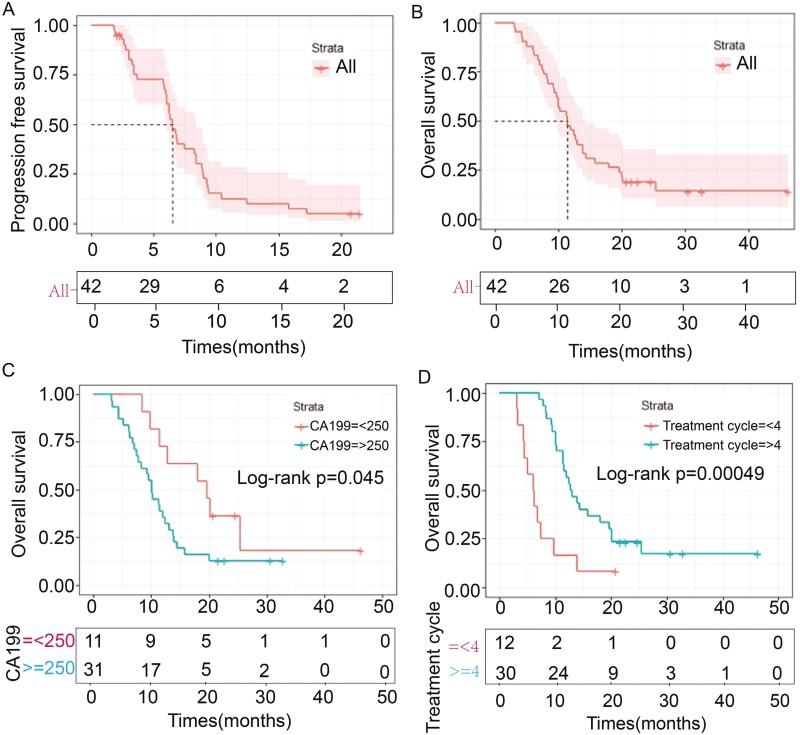
Forty-two patients received a minimum of one treatment cycle, and of these, 30 patients completed one alternating treatment consisting of 4 cycles. The PFSR-6m was 71% (95% CI = 58%-87%). The median PFS and OS were 6.53 months (95% CI = 6.03-8.43) and 11.4 months (95% CI = 9.8-14.4), respectively. Common grades 3-4 hematological AEs included neutropenia 30.9%, leukopenia 26.2%, anemia 2.4%, and thrombocytopenia in 11.9%. Patients with OS > 10 months showed high expression of HLA-DQA2 while melanoma-associated antigen genes (MAGE) were notably upregulated in patients with OS < 10 months.
CONCLUSION
The alternating sequential administration of the NS and GemOx regimens may be a novel approach for first-line chemotherapy in patients with advanced PDAC requiring further study (ClinicalTrials.gov Identifier: ChiCTR1900024867).
背景
交替序贯给药可能是克服晚期胰腺导管腺癌(PDAC)化疗耐药的一种有前途的方法。
方法
这是一项开放标签、单臂、前瞻性试验,纳入未经治疗的晚期 PDAC 患者。他们接受 2 个周期的 NS 方案(白蛋白紫杉醇:125mg/m2,静脉注射,第 1 天和第 8 天;S-1:40-60mg,每日 2 次,口服,第 1-14 天),然后接受 2 个周期的 GemOx 方案(吉西他滨,静脉注射,第 1 天和第 8 天;奥沙利铂:130mg/m2,静脉注射,第 1 天)。主要疗效终点为 6 个月无进展生存率(PFSR-6m)。次要疗效终点包括总生存期(OS)、无进展生存期(PFS)、客观缓解率(ORR)、疾病控制率(DCR)和不良事件(AEs)。使用特定的 mRNA 转录本探索与生存相关的基因。
结果
42 例患者至少接受了一个治疗周期,其中 30 例患者完成了 4 个周期的一个交替治疗。PFSR-6m 为 71%(95%CI=58%-87%)。中位 PFS 和 OS 分别为 6.53 个月(95%CI=6.03-8.43)和 11.4 个月(95%CI=9.8-14.4)。常见的 3-4 级血液学 AE 包括中性粒细胞减少症 30.9%、白细胞减少症 26.2%、贫血 2.4%和血小板减少症 11.9%。OS>10 个月的患者 HLA-DQA2 表达较高,而 OS<10 个月的患者黑色素瘤相关抗原基因(MAGE)明显上调。
结论
交替序贯给予 NS 和 GemOx 方案可能是晚期 PDAC 患者一线化疗的一种新方法,需要进一步研究(临床试验注册号:ChiCTR1900024867)。



 Zotero 插件