
医护人员对同情心的理解和体验是什么?加拿大医护人员的同情心模型:一项扎根理论研究。
What are healthcare providers' understandings and experiences of compassion? The healthcare compassion model: a grounded theory study of healthcare providers in Canada.
机构信息
Faculty of Nursing, University of Calgary, Calgary, Alberta, Canada.
Department of Oncology, Cumming School of Medicine, University of Calgary, Calgary, Alberta, Canada.
出版信息
BMJ Open. 2018 Mar 14;8(3):e019701. doi: 10.1136/bmjopen-2017-019701.
BACKGROUND
Healthcare providers are considered the primary conduit of compassion in healthcare. Although most healthcare providers desire to provide compassion, and patients and families expect to receive it, an evidence-based understanding of the construct and its associated dimensions from the perspective of healthcare providers is needed.
OBJECTIVES
The aim of this study was to investigate healthcare providers' perspectives and experiences of compassion in order to generate an empirically derived, clinically informed model.
DESIGN
Data were collected via focus groups with frontline healthcare providers and interviews with peer-nominated exemplary compassionate healthcare providers. Data were independently and collectively analysed by the research team in accordance with Straussian grounded theory.
SETTING AND PARTICIPANTS
57 healthcare providers were recruited from urban and rural palliative care services spanning hospice, home care, hospital-based consult teams, and a dedicated inpatient unit within Alberta, Canada.
RESULTS
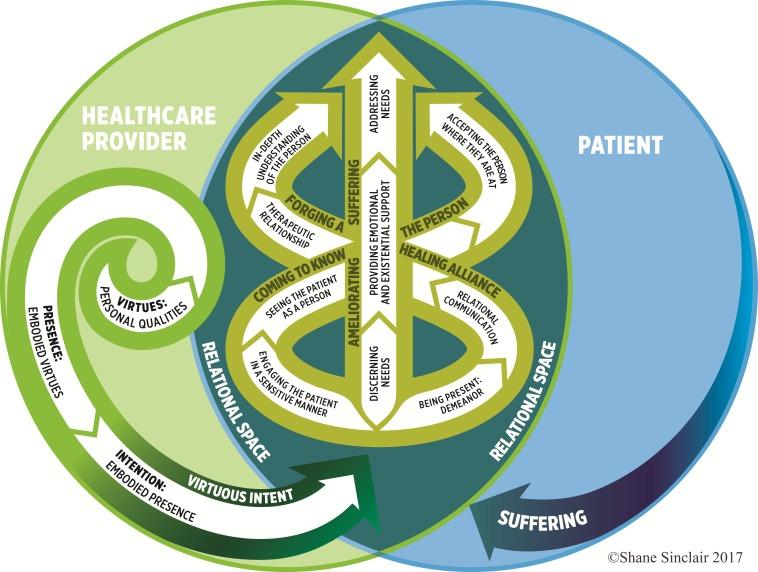
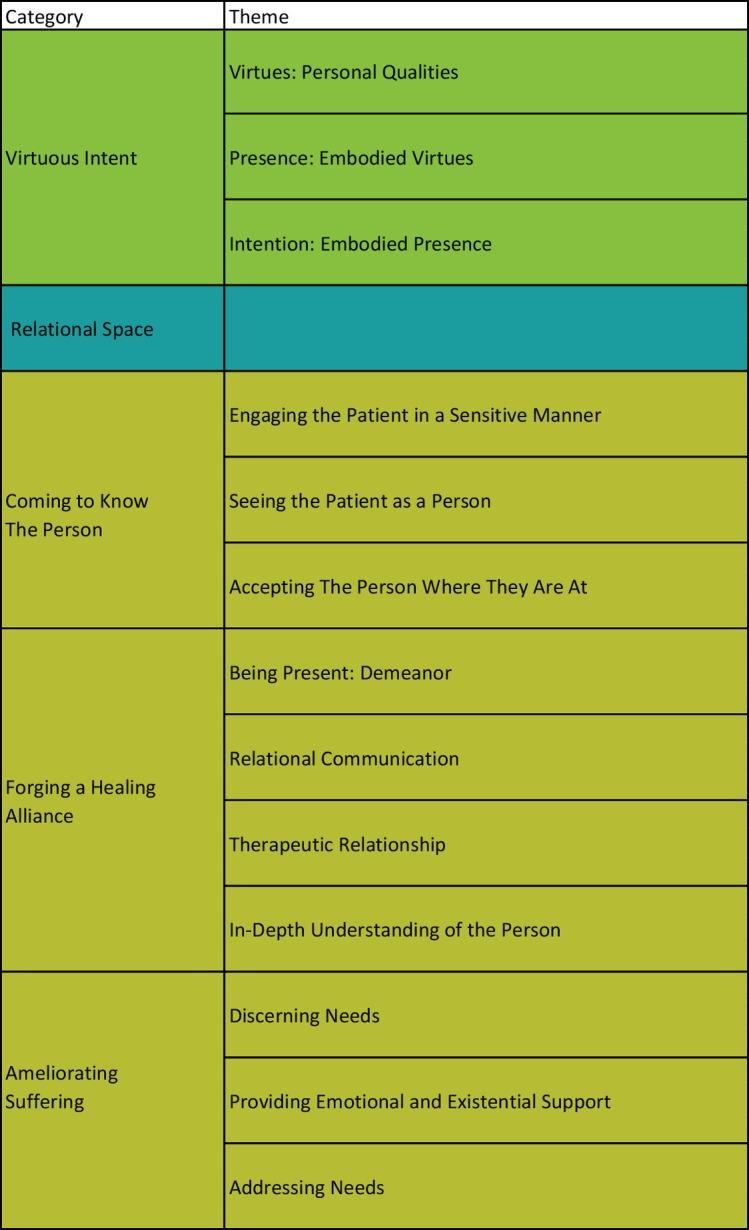
Five categories and 13 associated themes were identified, illustrated in the Healthcare Provider Compassion Model depicting the dimensions of compassion and their relationship to one another. Compassion was conceptualised as-a virtuous and intentional response to know a person, to discern their needs and ameliorate their suffering through relational understanding and action.
CONCLUSIONS
An empirical foundation of healthcare providers' perspectives on providing compassionate care was generated. While the dimensions of the Healthcare Provider Compassion Model were congruent with the previously developed Patient Model, further insight into compassion is now evident. The Healthcare Provider Compassion Model provides a model to guide clinical practice and research focused on developing interventions, measures and resources to improve it.
背景
医疗保健提供者被认为是医疗保健中同情的主要传递者。尽管大多数医疗保健提供者都希望提供同情,并且患者和家属期望得到同情,但需要从医疗保健提供者的角度对该概念及其相关维度有一个基于证据的理解。
目的
本研究旨在调查医疗保健提供者对同情的观点和体验,以便生成一个经验衍生的、具有临床意义的模型。
设计
通过与一线医疗保健提供者进行焦点小组和对被同行提名的富有同情心的医疗保健提供者进行访谈来收集数据。研究团队按照 Straussian 扎根理论的方法独立和集体地对数据进行分析。
地点和参与者
从加拿大艾伯塔省的临终关怀服务机构(包括临终关怀、家庭护理、医院咨询团队以及专门的住院病房)招募了 57 名医疗保健提供者参加研究。
结果
确定了五个类别和 13 个相关主题,并用医疗保健提供者同情模型进行了说明,该模型描绘了同情的维度及其相互关系。同情被概念化为对一个人的一种有道德和有意的反应,通过关系理解和行动来识别他们的需求并减轻他们的痛苦。
结论
生成了医疗保健提供者提供同情护理观点的实证基础。虽然医疗保健提供者同情模型的维度与先前开发的患者模型一致,但现在对同情有了更深入的了解。医疗保健提供者同情模型为指导专注于开发干预措施、措施和资源以改善同情的临床实践和研究提供了一个模型。
 Zotero 插件