
结合社区参与和科学方法进行下一代监测点位选址:以帝国县社区空气网络为例。
Combining Community Engagement and Scientific Approaches in Next-Generation Monitor Siting: The Case of the Imperial County Community Air Network.
机构信息
California Environmental Health Tracking Program, Public Health Institute, 850 Marina Bay Parkway P-3, Richmond, CA 94804, USA.
Comite Civico del Valle, 235 Main St, Brawley, CA 92227, USA.
出版信息
Int J Environ Res Public Health. 2018 Mar 15;15(3):523. doi: 10.3390/ijerph15030523.
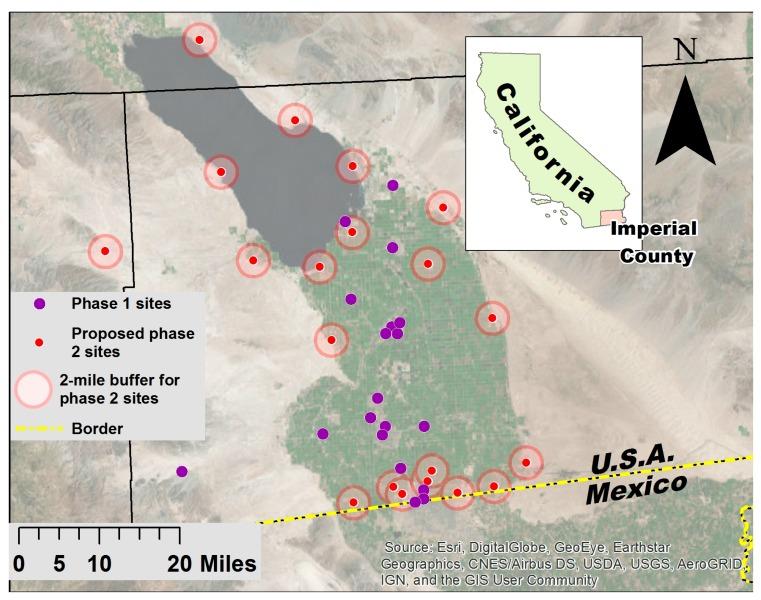
Air pollution continues to be a global public health threat, and the expanding availability of small, low-cost air sensors has led to increased interest in both personal and crowd-sourced air monitoring. However, to date, few low-cost air monitoring networks have been developed with the scientific rigor or continuity needed to conduct public health surveillance and inform policy. In Imperial County, California, near the U.S./Mexico border, we used a collaborative, community-engaged process to develop a community air monitoring network that attains the scientific rigor required for research, while also achieving community priorities. By engaging community residents in the project design, monitor siting processes, data dissemination, and other key activities, the resulting air monitoring network data are relevant, trusted, understandable, and used by community residents. Integration of spatial analysis and air monitoring best practices into the network development process ensures that the data are reliable and appropriate for use in research activities. This combined approach results in a community air monitoring network that is better able to inform community residents, support research activities, guide public policy, and improve public health. Here we detail the monitor siting process and outline the advantages and challenges of this approach.
空气污染仍是一个全球性的公共卫生威胁,而小型、低成本的空气传感器的广泛应用,使得人们对个人和众包式空气监测产生了浓厚的兴趣。然而,迄今为止,很少有低成本的空气监测网络具有开展公共卫生监测和为政策提供信息所需的科学严谨性和连续性。在加利福尼亚州的帝王县,靠近美国/墨西哥边境,我们采用协作、社区参与的方式开发了一个社区空气监测网络,该网络达到了开展研究所需的科学严谨性,同时也实现了社区的优先事项。通过让社区居民参与项目设计、监测选址过程、数据传播和其他关键活动,所产生的空气监测网络数据具有相关性、可信赖性、可理解性,并被社区居民使用。将空间分析和空气监测最佳实践整合到网络开发过程中,可确保数据可靠,适用于研究活动。这种综合方法可以更好地为社区居民提供信息,支持研究活动,指导公共政策,并改善公共卫生。在这里,我们详细介绍了监测选址过程,并概述了这种方法的优势和挑战。
 Zotero 插件