
表达抗肌萎缩蛋白嵌合(DEC)人细胞为杜氏肌营养不良症提供了一种潜在的治疗方法。
Dystrophin Expressing Chimeric (DEC) Human Cells Provide a Potential Therapy for Duchenne Muscular Dystrophy.
机构信息
Department of Surgery, Poznan University of Medical Sciences, Poznan, Poland.
Depatment of Orthopedics, University of Illinois at Chicago, Chicago, IL, USA.
出版信息
Stem Cell Rev Rep. 2018 Jun;14(3):370-384. doi: 10.1007/s12015-018-9807-z.
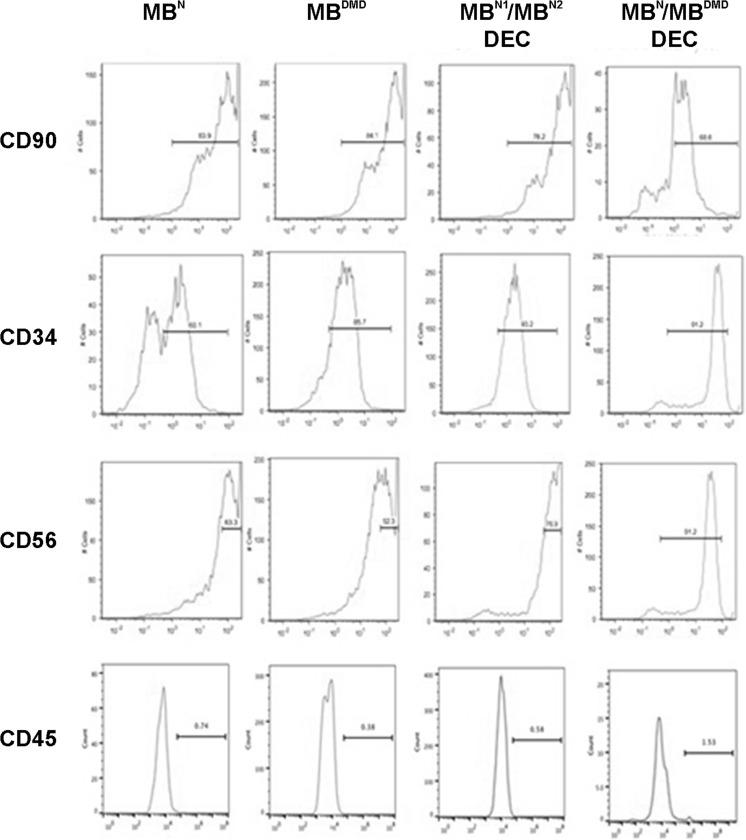
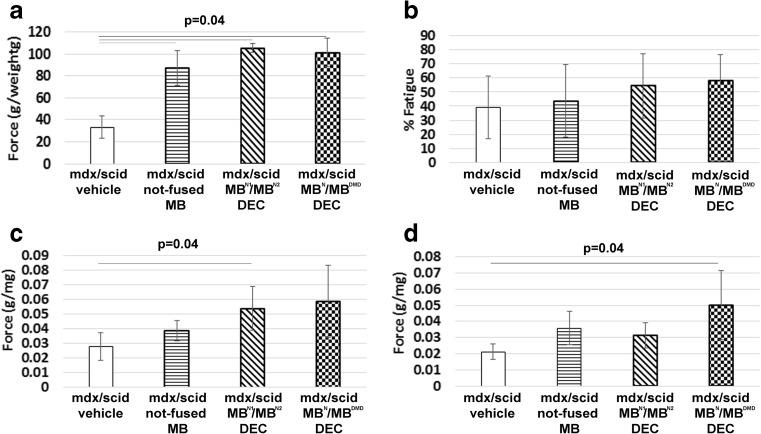
Duchenne Muscular Dystrophy (DMD) is a progressive and lethal disease caused by mutations of the dystrophin gene. Currently no cure exists. Stem cell therapies targeting DMD are challenged by limited engraftment and rejection despite the use of immunosuppression. There is an urgent need to introduce new stem cell-based therapies that exhibit low allogenic profiles and improved cell engraftment. In this proof-of-concept study, we develop and test a new human stem cell-based approach to increase engraftment, limit rejection, and restore dystrophin expression in the mdx/scid mouse model of DMD. We introduce two Dystrophin Expressing Chimeric (DEC) cell lines created by ex vivo fusion of human myoblasts (MB) derived from two normal donors (MB/MB), and normal and DMD donors (MB/MB). The efficacy of fusion was confirmed by flow cytometry and confocal microscopy based on donor cell fluorescent labeling (PKH26/PKH67). In vitro, DEC displayed phenotype and genotype of donor parent cells, expressed dystrophin, and maintained proliferation and myogenic differentiation. In vivo, local delivery of both DEC lines (0.5 × 10) restored dystrophin expression (17.27%±8.05-MB/MB and 23.79%±3.82-MB/MB) which correlated with significant improvement of muscle force, contraction and tolerance to fatigue at 90 days after DEC transplant to the gastrocnemius muscles (GM) of dystrophin-deficient mdx/scid mice. This study establishes DEC as a potential therapy for DMD and other types of muscular dystrophies.
杜氏肌营养不良症(DMD)是一种渐进性和致命性疾病,由肌营养不良蛋白基因的突变引起。目前尚无治愈方法。尽管使用了免疫抑制,针对 DMD 的干细胞疗法仍然受到有限的移植物植入和排斥的挑战。迫切需要引入新的基于干细胞的治疗方法,这些方法具有低同种异体特征和改善的细胞植入。在这项概念验证研究中,我们开发并测试了一种新的基于人类干细胞的方法,以增加植入物、限制排斥并在 DMD 的 mdx/scid 小鼠模型中恢复肌营养不良蛋白的表达。我们引入了两种通过体外融合来自两个正常供体的人类成肌细胞(MB)而创建的肌营养不良蛋白表达嵌合(DEC)细胞系(MB/MB),以及正常和 DMD 供体(MB/MB)。融合的功效通过基于供体细胞荧光标记(PKH26/PKH67)的流式细胞术和共聚焦显微镜得到确认。在体外,DEC 显示供体亲本细胞的表型和基因型,表达肌营养不良蛋白,并保持增殖和肌源性分化。在体内,两种 DEC 系(0.5×10)的局部递送恢复了肌营养不良蛋白的表达(17.27%±8.05-MB/MB 和 23.79%±3.82-MB/MB),这与肌营养不良蛋白缺陷的 mdx/scid 小鼠腓肠肌(GM)中 DEC 移植后 90 天肌肉力量、收缩和抗疲劳能力的显著改善相关。这项研究确立了 DEC 作为 DMD 和其他类型肌肉营养不良症的潜在治疗方法。




 Zotero 插件