
越南出现引发手足口病的新型柯萨奇病毒 A6。
Emerging Coxsackievirus A6 Causing Hand, Foot and Mouth Disease, Vietnam.
出版信息
Emerg Infect Dis. 2018 Apr;24(4):654-662. doi: 10.3201/eid2404.171298.
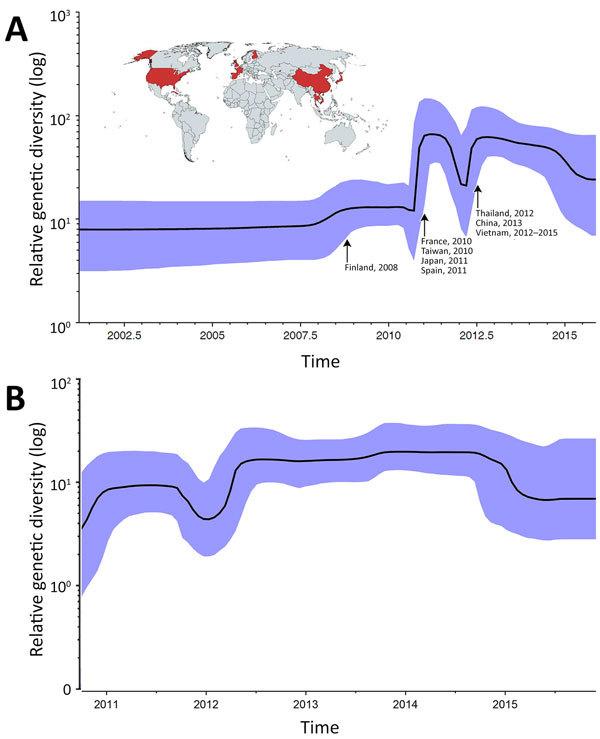
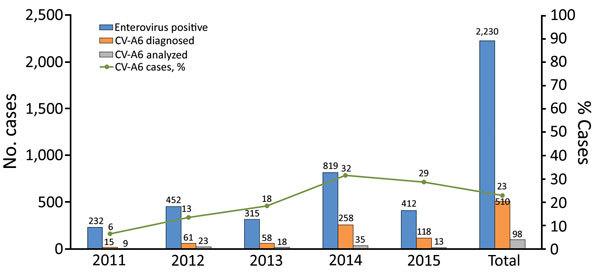
Hand, foot and mouth disease (HFMD) is a major public health issue in Asia and has global pandemic potential. Coxsackievirus A6 (CV-A6) was detected in 514/2,230 (23%) of HFMD patients admitted to 3 major hospitals in southern Vietnam during 2011-2015. Of these patients, 93 (18%) had severe HFMD. Phylogenetic analysis of 98 genome sequences revealed they belonged to cluster A and had been circulating in Vietnam for 2 years before emergence. CV-A6 movement among localities within Vietnam occurred frequently, whereas viral movement across international borders appeared rare. Skyline plots identified fluctuations in the relative genetic diversity of CV-A6 corresponding to large CV-A6-associated HFMD outbreaks worldwide. These data show that CV-A6 is an emerging pathogen and emphasize the necessity of active surveillance and understanding the mechanisms that shape the pathogen evolution and emergence, which is essential for development and implementation of intervention strategies.
手足口病(HFMD)是亚洲地区的一个主要公共卫生问题,具有全球大流行的潜力。2011 年至 2015 年,在越南南部的 3 家大医院中,共检测到 2230 例手足口病患者中有 514 例(23%)为柯萨奇病毒 A6(CV-A6)感染。这些患者中,93 例(18%)为重症手足口病。对 98 个基因组序列的系统进化分析显示,它们属于 A 群,在越南流行了 2 年才出现。CV-A6 在越南国内各地之间的传播非常频繁,而病毒在国际边界的传播则很少见。轨迹图显示,CV-A6 的相对遗传多样性与全球范围内大规模 CV-A6 相关的手足口病暴发相对应,存在波动。这些数据表明 CV-A6 是一种新出现的病原体,并强调了积极监测和了解病原体进化和出现机制的必要性,这对于制定和实施干预策略至关重要。


 Zotero 插件